


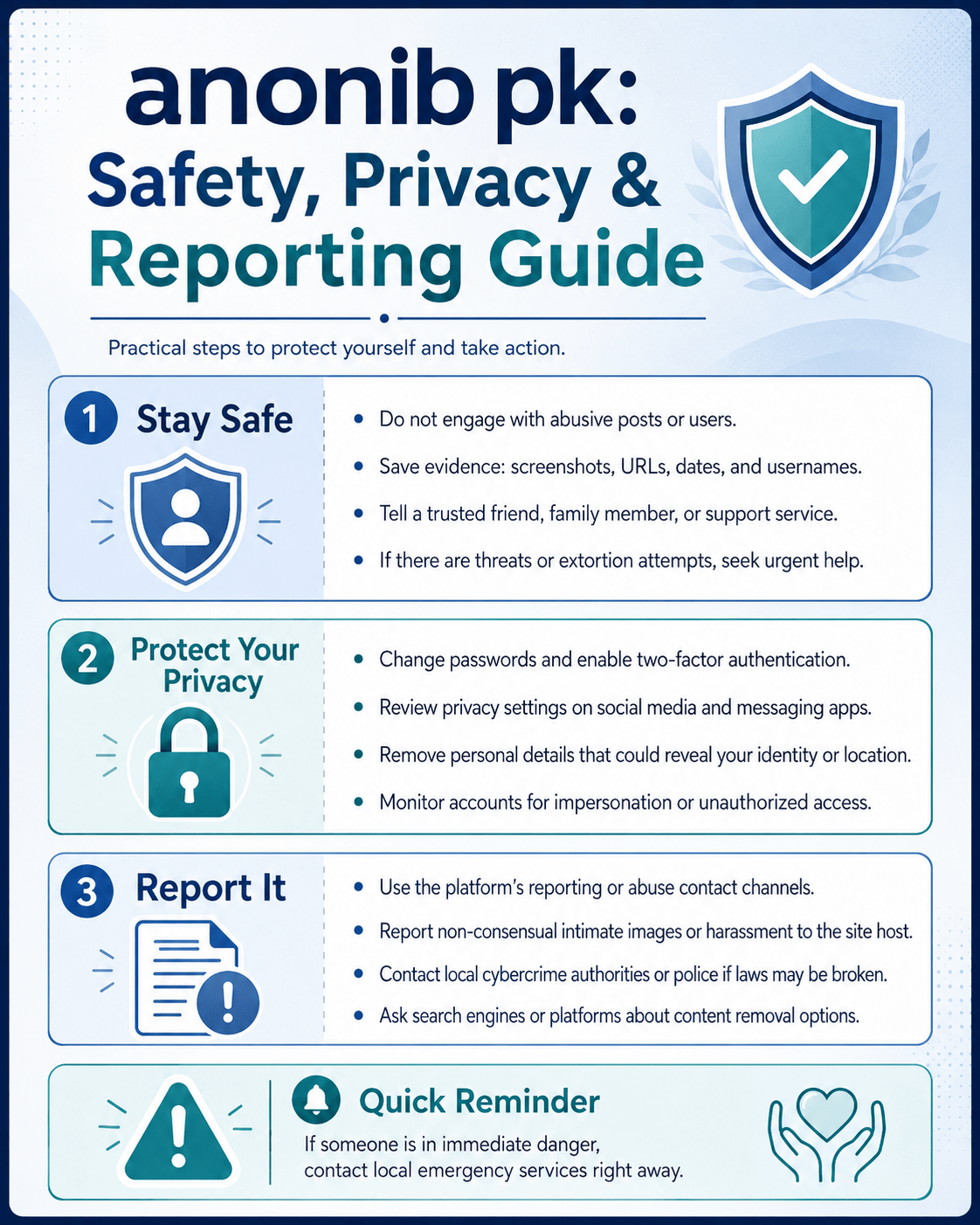
If you searched for anonib pk, you are probably trying to understand what the name refers to, whether the site is safe, or what to do about content connected with anonymous image boards.
Those are important questions because the Anon-IB name has a complicated history. The original Anon-IB became widely known for anonymous image sharing and was investigated over non-consensual intimate material before Dutch authorities took the forum offline in 2018.
A modern domain using a similar name should not automatically be assumed to be identical to the historical service. However, anyone researching anonib pk should understand the privacy, consent, cybersecurity, and reporting issues associated with anonymous user-generated platforms before interacting with them.
anonib pk Quick Facts
| Topic | What You Should Know |
|---|---|
| Search term | Usually refers to the anonib.pk domain or information connected with it |
| Type of interest | Often navigational, site-related, or safety-focused |
| Main concern | Anonymous user-generated content can create privacy and moderation risks |
| Personal images | Never upload or redistribute private material without clear consent |
| If you are affected | Preserve evidence, request removal, and report abusive content |
| Pakistan reporting | Cybercrime complaints can be submitted through Pakistan’s NCCIA |
| Intimate-image support | StopNCII and Take It Down provide specialized tools in qualifying cases |
What Is anonib pk?
The phrase anonib pk is commonly used by people searching for information about the anonib.pk domain. Third-party web analytics and technology-monitoring services currently recognize the domain, indicating that it remains an identifiable web property rather than merely a historical search phrase.
The name resembles Anon-IB, an anonymous image-board brand with a controversial history. The historical platform attracted scrutiny because intimate photographs were sometimes distributed without the permission of the people depicted.
That distinction matters.
A domain operating today may change owners, infrastructure, policies, moderators, or content over time. Historical information about Anon-IB therefore provides useful context, but it should not be treated as proof of what every similarly named website currently hosts.
Why Do People Search for anonib pk?
Searchers may have several different goals, including:
- Finding out what the domain is.
- Checking whether the website is operating.
- Understanding its relationship to the older Anon-IB name.
- Researching privacy or cybersecurity concerns.
- Looking for information about content posted about themselves.
- Finding ways to report or remove unwanted images.
For most users, the most useful answer is therefore not simply a link to a website. It is an explanation of the risks and the steps that protect your privacy.
Is anonib pk Safe?
There is no meaningful way to declare an anonymous-content website universally “safe” simply because the domain loads or a malware scanner does not flag it.
Online safety has several separate dimensions.
1. Technical Security
Websites relying heavily on user-generated content, advertising networks, redirects, or third-party scripts can expose visitors to risks that have little to do with the site’s main content.
Be cautious of:
- Unexpected downloads.
- Browser notification requests.
- Pop-ups that imitate system warnings.
- Requests to install extensions or applications.
- Cryptocurrency or payment requests from unknown parties.
- Login pages asking for credentials used on another service.
A domain-security scan is useful evidence, but it is never a guarantee that every page, advertisement, download, or external destination is trustworthy.
2. Privacy
Anonymous browsing does not mean visitors are automatically anonymous.
A website can potentially receive technical information such as an IP address, browser characteristics, device information, referral data, and cookies. Third-party advertising or analytics services may collect additional information depending on how a site is configured.
For that reason, avoid giving an unfamiliar image board unnecessary personal information.
Do not use your primary email address, reuse important passwords, disclose your home address, upload identification documents, or post information that could identify another person.
3. Content Safety
User-generated platforms introduce another risk: you cannot necessarily predict what another user will upload.
That becomes particularly serious when private or intimate material is involved.
Non-consensual intimate imagery—sometimes called image-based sexual abuse—means intimate material is distributed without the depicted person’s permission. Research has documented significant harms associated with this form of abuse and continuing difficulties victims face when trying to get material removed from smaller or high-risk websites.
The Most Important Rule: Consent Comes First
Whether you are researching anonib pk, another image board, a social network, or a private messaging group, one principle should govern what you share:
If an identifiable person has not agreed to the distribution of an intimate image, do not upload, repost, request, trade, or forward it.
Receiving an image privately does not automatically grant permission to publish it publicly.
Likewise, finding an image elsewhere online does not prove that the person depicted consented to its publication or redistribution.
Screenshots and Reuploads Can Cause Additional Harm
A common mistake is assuming that reposting questionable material is harmless because “it is already online.”
Every new upload can make removal more difficult.
Copies can be indexed, downloaded, archived, forwarded to private groups, or reposted on other platforms. If you encounter material that appears to have been shared without consent, reporting it is far more responsible than redistributing it.
anonib pk and the History of Anon-IB
Understanding the historical context helps explain why searches involving this name often raise privacy concerns.
The earlier Anon-IB forum was reported as a major anonymous image-sharing community where non-consensual intimate images appeared. In 2018, Dutch cybercrime investigators seized the forum while investigating criminal activity associated with it.
That history does not by itself establish that every website subsequently using an AnonIB-related name has the same operators, policies, infrastructure, or content.
This is an important distinction that many articles miss.
When evaluating a current domain, separate documented historical facts from assumptions based purely on branding.
Privacy Mistakes to Avoid on Anonymous Image Boards
Anonymous communities can encourage users to behave as though normal privacy rules no longer apply. They do.
Reusing Your Main Username
A username used across Instagram, TikTok, gaming platforms, forums, and email accounts can make otherwise anonymous activity surprisingly easy to connect.
Avoid creating an unnecessary trail between anonymous browsing and your real identity.
Revealing Small Pieces of Personal Information
People often protect obvious details such as their full name but reveal enough smaller clues to identify themselves.
Examples include:
- University or workplace.
- Neighborhood.
- Age and birthday.
- Vehicle details.
- Regular locations.
- Social usernames.
- Distinctive tattoos.
- Background details visible in photographs.
Individually, these details may appear harmless. Together, they can become identifying information.
Downloading Unknown Files
An image should normally behave like an image.
If a page claims you must download a special viewer, executable file, browser extension, archive, or mobile application to see something, treat that request cautiously.
Paying Strangers for “Private Collections”
Payment does not establish that material was obtained legally or consensually.
It can also expose your payment identity while creating opportunities for fraud, blackmail, or repeated payment demands.
What to Do If Your Images Appear on anonib pk or Another Site
Discovering that a private image has been posted publicly can make people act quickly and accidentally destroy useful evidence.
A more effective approach is systematic.
Step 1: Record the Evidence
Save the relevant page address, username, post title, date, and time.
Take screenshots showing enough surrounding context to demonstrate where the content appeared. Avoid creating unnecessary additional copies of intimate material.
Step 2: Do Not Argue Publicly With Uploaders
Public confrontation can sometimes attract additional attention to the post.
Instead, document what exists and use official reporting or removal procedures where available.
Step 3: Request Removal
Look for the website’s reporting, abuse, privacy, copyright, contact, or takedown process.
Keep copies of your requests and any responses. A written timeline can become useful if you later need assistance from a platform, hosting provider, search engine, lawyer, or law-enforcement agency.
Step 4: Report Copies on Other Platforms
If the same content appears on social networks, file-hosting services, search results, or other websites, report each location through the relevant abuse mechanism.
Removing one page does not necessarily remove copies elsewhere.
Step 5: Consider Hash-Based Protection
Adults dealing with non-consensual intimate images may be eligible to use StopNCII, which creates a digital fingerprint—or hash—of qualifying images on the user’s device. Participating platforms can compare uploaded content against these hashes without StopNCII receiving the original image itself.
This does not erase an image from the entire internet, because protection depends on participating services. It can nevertheless provide another layer of defense against repeated uploads.
Step 6: If the Image Was Taken When You Were Under 18
Do not download or redistribute an explicit image simply to collect evidence.
The National Center for Missing & Exploited Children’s Take It Down service is specifically designed for nude, partially nude, or sexually explicit images or videos taken when the depicted person was under 18. Its hashing system works locally on the user’s device, so the original file does not need to be uploaded to the service.
Reporting Cyber Harassment in Pakistan
People in Pakistan who believe they are experiencing cyber harassment, unlawful distribution of private material, impersonation, threats, or related online abuse can also consider making an official cybercrime complaint.
Pakistan’s National Cyber Crime Investigation Agency (NCCIA) provides an official cybercrime complaint system and lists cyber harassment among the issues it handles. The agency currently provides an online complaint portal and helpline 1799.
Pakistan’s principal federal cybercrime legislation is the Prevention of Electronic Crimes Act, 2016 (PECA), available through the Ministry of Law and Justice’s Pakistan Code. Which legal provisions apply depends on the circumstances of a particular case, so complex situations may require advice from a qualified lawyer.
What Evidence Should You Keep?
Good documentation can make reporting significantly easier.
Keep records of:
- The exact page or post address.
- Screenshots showing the surrounding page.
- Usernames associated with uploads or threats.
- Dates and approximate times.
- Messages showing threats, requests for money, or admissions.
- Copies of takedown requests you submitted.
- Responses received from the website or platform.
- Search results showing additional copies.
Store this information somewhere private and secure.
Avoid forwarding intimate images to friends merely to prove what happened. Share sensitive evidence only when necessary with legitimate reporting services, legal professionals, or relevant authorities.
Can Search Engines Remove the Content?
Search engines and websites perform different functions.
Removing a search result may make a page substantially harder to discover, but it does not necessarily delete the original material from the website hosting it.
That is why effective removal efforts often involve multiple layers:
Original website → hosting/platform reports → search-result removal → duplicate-content reports → prevention tools
Treat de-indexing and deletion as separate tasks.
Can Someone Completely Erase an Image From the Internet?
Nobody can honestly guarantee complete removal once a file has been widely distributed.
Copies may exist on devices, private groups, archives, mirrors, or services you do not know about.
That does not make reporting pointless.
Reducing public availability, removing indexed copies, preventing reuploads on participating platforms, and documenting repeat abuse can materially reduce further exposure.
anonib pk Alternatives: What Should You Use Instead?
If your goal is simply to participate in online communities or share legitimate photography, established platforms with clear moderation rules, reporting systems, privacy controls, and documented terms of service are generally easier to evaluate.
When choosing any user-generated platform, look for:
- Clear moderation guidelines.
- A working abuse-reporting process.
- Privacy and data-retention information.
- Rules against doxxing and harassment.
- Explicit policies on non-consensual imagery.
- A contact method for urgent safety issues.
- Controls for deleting your own account and uploads.
A platform’s moderation system matters more than whether it describes itself as “anonymous.”
Frequently Asked Questions
What does anonib pk mean?
anonib pk generally refers to searches connected with the anonib.pk domain. The wording is also associated by name with the older Anon-IB image-board ecosystem.
Is anonib pk the original Anon-IB?
A similarly named domain should not automatically be treated as the same operation as the historical Anon-IB forum.
Ownership, hosting, administration, policies, and content can change. Claims about a current website should therefore be based on current evidence rather than its name alone.
Is it illegal to look at anonib pk?
The legal implications of visiting a website depend on your jurisdiction and the material or activities involved.
The more important boundary is what you access, save, request, upload, redistribute, or participate in. Never seek, save, or share illegal material, and never redistribute intimate content without consent.
What should I do if someone threatens to post my private images?
Save evidence of the threat without escalating the conversation.
Report the account or service involved, secure your online accounts, and consider appropriate cybercrime or legal reporting channels. If you are in Pakistan, NCCIA provides an official cybercrime reporting route.
Can StopNCII remove an image from every website?
No.
StopNCII shares image hashes with participating companies that can detect matching files on their services. The organization explicitly notes that it cannot remove content from the entire internet.
What if the image shows someone under 18?
Do not download, save, or redistribute explicit material involving a minor.
For an image of yourself taken when you were under 18, Take It Down provides a specialized hashing service designed to help prevent qualifying material from being shared on participating platforms.
Final Thoughts on anonib pk
The most useful way to approach anonib pk is with caution rather than curiosity alone.
The Anon-IB name has a documented history involving serious privacy and consent concerns, but historical associations should not be used to make unsupported claims about every similarly named domain operating today. What remains universally relevant is protecting personal information, refusing to distribute intimate material without consent, avoiding suspicious downloads, and knowing how to document and report abuse.
If you discovered private content involving yourself, focus first on evidence preservation and removal rather than confrontation or redistribution. Tools such as StopNCII, Take It Down, platform reporting systems, and Pakistan’s NCCIA can provide practical next steps depending on the situation.
Ultimately, whether researching anonib pk or any anonymous image-sharing community, privacy, consent, and digital safety should always come before access.