
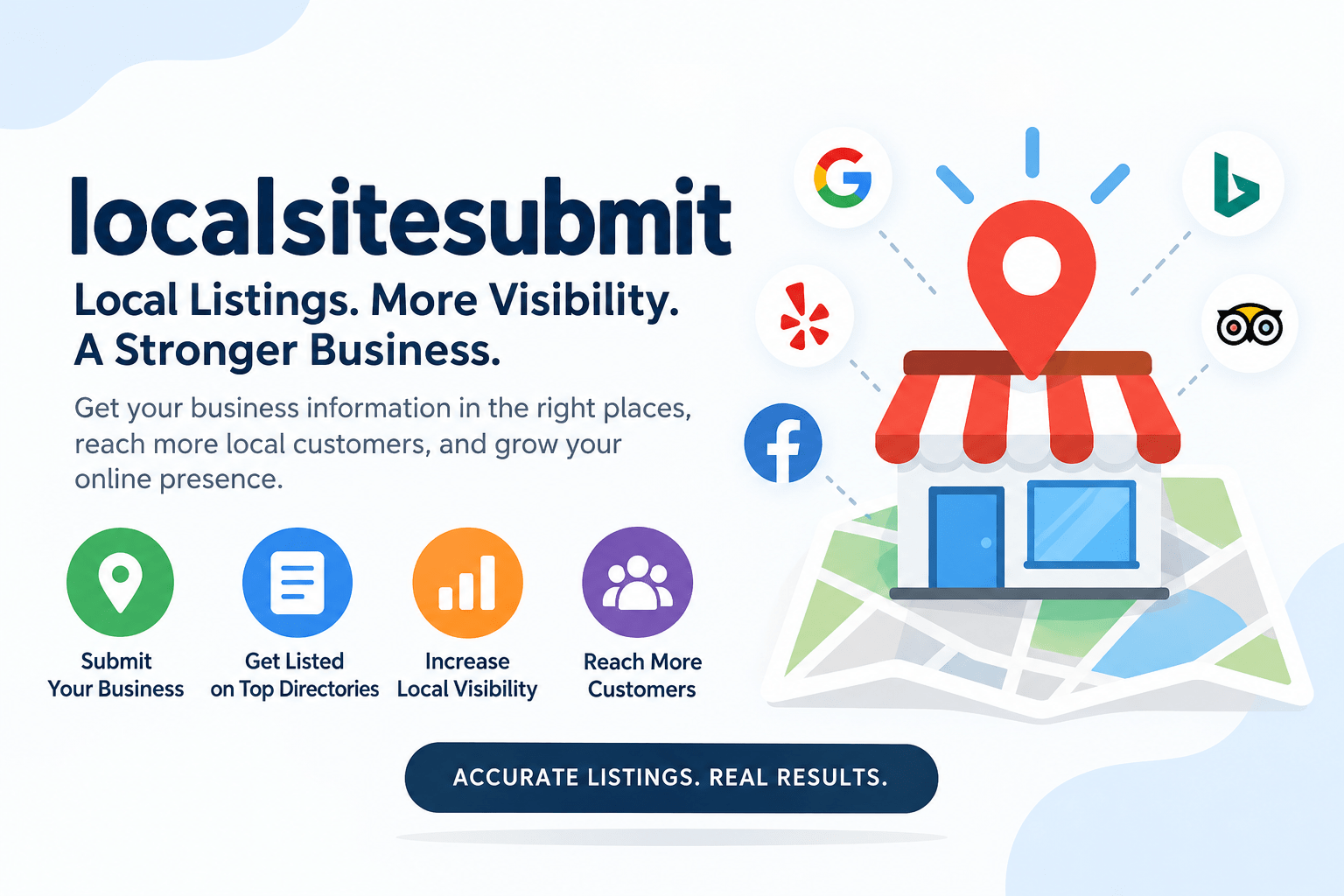
If you searched for localsitesubmit, you are probably trying to understand the Local Site Submit platform, find its current service, or learn whether local directory submission can still improve a business’s visibility.
The most important fact is that Local Site Submit is not simply another modern directory-submission website. Local Site Submit was created by Advice Interactive Group and was officially rebranded as Advice Local in March 2016. The company said the change reflected its expansion beyond basic directory submissions into broader local digital presence management.
Today, the useful question is therefore not simply, “Where can I submit my business?” It is how to keep your business information accurate across Google, mapping platforms, directories, data providers, and other places potential customers use to find local companies.
What Is localsitesubmit?
localsitesubmit, commonly written as Local Site Submit, originally referred to a local listing and citation management platform created to help businesses and marketing agencies distribute company information across online directories.
The platform was launched by Advice Interactive Group in 2011. According to the company’s historical announcement, Local Site Submit had processed millions of directory submissions and citations before being renamed Advice Local in 2016.
Its core purpose was straightforward: make accurate business information available across more places where consumers might search.
That information typically includes:
- Business name
- Street address
- Phone number
- Website URL
- Opening hours
- Business categories
- Services
- Photos
- Location information
- Other business attributes
Modern listing management builds on the same concept but increasingly focuses on maintaining and updating data rather than performing one-time directory submissions.
Is localsitesubmit Still Available?
The original Local Site Submit brand was rebranded as Advice Local beginning March 7, 2016. It should therefore be viewed as the predecessor to Advice Local rather than as a completely separate modern platform.
Advice Local currently describes its offering as a listings-management and digital-presence platform. Its services can include distributing business information, synchronizing listings, handling duplicate listings, reporting, APIs, white-label tools, and managed services.
Quick Facts
| Topic | Details |
|---|---|
| Original name | Local Site Submit |
| Common search term | localsitesubmit |
| Original purpose | Local directory and citation management |
| Rebrand | Advice Local |
| Rebrand announced | 2016 |
| Current focus | Listings and digital presence management |
| Typical users | Local businesses, agencies and multi-location brands |
| Core objective | Accurate, discoverable local business information |
What Does Local Listing Management Actually Mean?
Local listing management is the process of controlling business information across websites, apps, search platforms, directories, and navigation services.
A listing can contain much more than a business name and phone number. It may include hours, categories, website links, products, services, payment options, accessibility features, photos, and other attributes.
The objective is consistency.
A customer should not discover one phone number on Google, another on a directory, an old address on a mapping platform, and different opening hours somewhere else.
Why Business Listing Accuracy Matters
Google explicitly recommends keeping Business Profile information complete, accurate, and up to date. Complete information can help Google understand what a business does, where it operates, and when customers can visit.
For users, the benefit is even more immediate.
Imagine someone searches for a plumber, dentist, restaurant, lawyer, repair company, or retail store nearby. An incorrect telephone number or outdated address can turn a highly motivated potential customer into a lost lead.
Consistency Builds a Clear Business Identity
Search engines encounter information about businesses from many different sources.
A company might appear on:
- Its official website
- Google Business Profile
- Bing
- Apple Maps
- Yelp
- Industry directories
- Local directories
- Social platforms
- Mapping applications
- Review websites
- Business associations
When important details consistently describe the same real-world business, the company’s digital identity becomes easier for users and search systems to interpret.
NAP Consistency Explained
You will frequently encounter the term NAP when researching localsitesubmit and local SEO.
NAP means:
- N: Name
- A: Address
- P: Phone number
These three elements have traditionally been central to citation management.
However, modern listing optimization should go beyond NAP.
Maintain a master record containing:
- Official business name
- Full address
- Primary phone number
- Website
- Primary category
- Secondary categories
- Regular opening hours
- Holiday hours
- Service area
- Business description
- Logo
- Photos
- Social profiles
- Appointment or booking URL
- Services and products
Use this master record whenever important listings are created or updated.
How localsitesubmit Fits Into Modern Local SEO
Local listing management can support local visibility, but it should never be mistaken for a complete SEO strategy.
Google says local results are primarily influenced by relevance, distance, and prominence. Accurate and detailed business information can help with relevance, while prominence may also be influenced by factors such as links and reviews.
This means creating hundreds of directory profiles does not automatically produce high Google Maps rankings.
A stronger local SEO strategy combines listings with several other signals.
1. Google Business Profile Optimization
Your Google Business Profile should be one of your highest priorities.
Google recommends verifying the business and maintaining complete information, including accurate address details, opening hours, categories, attributes, photos, and other useful information.
Review it regularly rather than treating setup as a one-time task.
2. A Strong Local Website
Your website should clearly establish:
- Who you are
- What you offer
- Where you operate
- How customers can contact you
- Why customers should trust you
For a multi-location company, dedicated location pages can make individual branches easier for users and search engines to understand.
3. Relevant Citations
Focus on directories that customers, search engines, and industry audiences actually use.
A roofing company may gain more value from a respected construction directory than from dozens of unrelated generic directories.
4. Customer Reviews
Reviews contribute to trust and can affect how prominently a business appears in local search.
Google specifically notes that more reviews and positive ratings can help local ranking, while useful responses demonstrate that a business values customer feedback.
5. Local Links and Mentions
Useful local links can come from:
- Chambers of commerce
- Trade associations
- Local newspapers
- Community organizations
- Suppliers
- Sponsorships
- Business partners
- Professional organizations
These opportunities are usually harder to automate, which is exactly why they can be valuable.
A Better localsitesubmit Strategy: Step by Step
Instead of sending business information to every directory you can find, use a controlled process.
Step 1: Create a Master Business Record
Document the authoritative version of all business information.
Do not begin submitting listings until you know exactly which name, address, phone number, URL, category, and opening hours should be used.
Step 2: Audit Existing Listings
Your business may already have profiles created by:
- Former employees
- Previous SEO agencies
- Directory databases
- Customers
- Automated data providers
- Previous owners
Search for:
Business Name + City
Business Name + Phone
Old Business Name + City
Phone Number + Address
Record every important profile you discover.
Step 3: Find Incorrect Information
Look for problems such as:
- Old phone numbers
- Former addresses
- Misspelled names
- Incorrect website URLs
- Duplicate profiles
- Wrong opening hours
- Closed locations
- Incorrect categories
Correcting established errors can be more important than creating another 50 listings.
Step 4: Prioritize Important Platforms
Create a priority list rather than chasing raw submission volume.
A sensible hierarchy is:
- Major search and mapping platforms
- Major business/review directories
- Relevant industry directories
- Strong regional or city directories
- Professional associations
- Trusted community resources
- Additional legitimate niche opportunities
Quality should guide your decisions.
Step 5: Complete Every Important Profile
Do not submit only the bare minimum.
Where appropriate, add:
- Categories
- Description
- Services
- Photos
- Logo
- Opening hours
- Website
- Appointment links
- Accessibility information
- Business attributes
A complete listing is more useful to customers than a nearly empty citation.
Step 6: Verify Ownership
Claim and verify important profiles whenever possible.
Ownership makes future edits easier and reduces reliance on third parties.
For Google Business Profile, Google says verification confirms that you are authorized to represent the business.
Step 7: Record Login and Ownership Details
Keep a listing-management spreadsheet or database containing:
| Field | Example |
|---|---|
| Platform | Business Directory A |
| Listing URL | Profile URL |
| Status | Live |
| Verification | Verified |
| Username | Company-controlled account |
| Last checked | Date |
| Notes | Address corrected |
This seemingly simple step prevents major problems when employees, agencies, or vendors change.
Step 8: Monitor Listings
Business information changes.
You may:
- Move offices
- Change telephone numbers
- Add locations
- Close branches
- Change hours
- Rebrand
- Launch new services
Listings need maintenance whenever significant business information changes.
Manual Submission vs Automated Listing Management
Both approaches have legitimate uses.
| Factor | Manual Submission | Automated/Managed Service |
|---|---|---|
| Control | High | Depends on provider |
| Speed | Slower | Faster at scale |
| Cost | Mostly staff time | Usually paid |
| Best for | Small businesses | Agencies and multi-location brands |
| Customization | High | Varies |
| Ongoing updates | Labor intensive | Often centralized |
| Scalability | Limited | Strong |
When Manual Submission Makes Sense
Manual management may work well when you have:
- One business location
- A limited number of important directories
- Stable business information
- Enough time to maintain profiles
- Existing ownership of key accounts
When a Listing Management Service Makes Sense
Managed software becomes more attractive when you have:
- Numerous locations
- Frequent data changes
- Hundreds of profiles
- Multiple clients
- Duplicate-listing problems
- A need for centralized reporting
- Limited internal resources
Advice Local describes its current approach as combining APIs with manual processes for creating, claiming, optimizing, and managing listings.
How to Evaluate a localsitesubmit-Type Service
Do not choose a platform because it promises the biggest directory number.
Ask more important questions.
Which Platforms Are Actually Included?
Request the full network.
Then separate:
- Major platforms
- Relevant niche sites
- Regional directories
- Low-value generic websites
“500 submissions” sounds impressive until you discover that customers never use most of them.
Who Owns the Listings?
This is one of the most overlooked questions.
Ask whether the business retains access to profiles and whether important listings remain manageable if the service is cancelled.
For Google Business Profile, Google’s policies for authorized representatives emphasize that business owners should understand management arrangements and be able to retain or receive ownership.
Does the Service Correct Existing Listings?
Creating new listings without fixing old information can increase inconsistency.
A useful service should explain how it handles:
- Existing profiles
- Duplicate profiles
- Incorrect information
- Suppression
- Updates
- Verification
Are Listings Continuously Maintained?
A one-time submission and an ongoing listings-management service are different products.
Clarify what happens when your:
- Phone number changes
- Address changes
- Hours change
- Website changes
- Location closes
What Reporting Is Provided?
Good reporting should help you understand what actually happened.
Look for:
- Listing status
- Profile URLs
- Submission dates
- Verification status
- Errors
- Duplicate issues
- Data updates
Avoid judging success solely by a large “number submitted” figure.
The Biggest Local Citation Mistakes to Avoid
Submitting Before Auditing
A common mistake is immediately creating new profiles.
You may already have existing listings that simply need to be claimed or corrected.
Audit first.
Keyword Stuffing the Business Name
Do not transform:
Smith Plumbing
into:
Smith Plumbing Best Emergency Plumber Dallas 24/7
unless those words genuinely form part of the business’s real-world name.
Google specifically requires Business Profile names to reflect the name used consistently in the real world and warns against adding unnecessary information.
Choosing Too Many Categories
More categories do not automatically mean greater visibility.
Google recommends using the fewest categories necessary to accurately describe the business and choosing categories that represent its core activity.
Creating Duplicate Google Profiles
More profiles do not mean more rankings.
Google generally states that there should be only one Business Profile per business, subject to its specific rules for departments, practitioners, and other eligible entities.
Using Fake Locations
Virtual locations created only to rank in additional cities can cause serious problems.
Google says businesses should use a real-world location and states that virtual offices generally are not eligible unless they satisfy specific operational requirements.
Believing Citations Guarantee Rankings
No legitimate provider can guarantee a particular Google Maps position simply by submitting citations.
Google explicitly says there is no way to request or pay Google for a better local ranking.
Treating Every Directory as Equally Valuable
A trusted platform relevant to your industry or geography can be substantially more useful than an obscure directory created only to host thousands of business pages.
Think relevance before volume.
Build a Local Entity, Not Just a Citation List
One of the strongest ways to improve a modern localsitesubmit strategy is to stop thinking only about listings.
Think about the entire identity of the business.
Search engines and customers can encounter connections between your:
- Business name
- Website
- Physical locations
- Services
- Team members
- Reviews
- Social profiles
- Industry memberships
- News mentions
- Community activities
- Awards
- Partnerships
All of these contribute to a clearer real-world business presence.
A listing campaign becomes much stronger when it supports that larger identity rather than existing as an isolated link-building exercise.
Use LocalBusiness Structured Data on Your Website
Listings tell external platforms about your business, while structured data can help describe business information directly on your own website.
Google supports LocalBusiness structured data and recommends using the most specific applicable business subtype. Supported information can include an address, telephone number, opening hours, geographical coordinates, business URL, and other properties.
Structured data is not a replacement for Google Business Profile or citations.
It is another way to make important business information machine-readable and clearly associated with the correct location.
Measure Results Beyond Rankings
Do not measure a local listing campaign using rankings alone.
Track business outcomes such as:
- Organic website visitors
- Google Business Profile interactions
- Phone calls
- Direction requests
- Appointment bookings
- Form submissions
- Store visits where measurable
- Referral traffic from directory profiles
- Review growth
- Corrected duplicate listings
Ranking positions can fluctuate because local results depend partly on the searcher’s location.
Lead and revenue metrics provide a more useful long-term view.
A Practical 90-Day Local Listing Plan
Days 1–30: Audit and Correct
Focus on foundational accuracy.
- Finalize master business data
- Audit Google Business Profile
- Find major existing citations
- Identify duplicate listings
- Correct inaccurate information
- Claim important profiles
Days 31–60: Expand Relevant Coverage
Once the foundation is accurate:
- Add missing major directories
- Build industry-specific listings
- Join relevant associations
- Improve profile descriptions
- Upload high-quality imagery
- Review category selections
Days 61–90: Strengthen Local Authority
Move beyond submissions.
- Build useful location pages
- Earn local links
- Request genuine customer reviews
- Respond to existing reviews
- Publish locally relevant content
- Add appropriate LocalBusiness structured data
- Measure calls, leads and organic visibility
At that point, listing management becomes part of an integrated local marketing strategy rather than an isolated SEO task.
Is localsitesubmit Worth Using for Local SEO?
The underlying idea behind localsitesubmit remains relevant: businesses benefit when accurate information is distributed and maintained across important local discovery platforms.
What has changed is the strategy.
Modern local SEO is not about submitting the same company details to hundreds of random directories. It is about maintaining trustworthy business information across authoritative platforms while strengthening your Google Business Profile, website, reviews, local links, content, and overall digital identity.
Because Local Site Submit was rebranded as Advice Local, users searching for the original service should evaluate the present-day Advice Local platform and its current features rather than relying on descriptions of the older product.
Conclusion
localsitesubmit began as a local directory and citation-management platform and later evolved into Advice Local. Its history reflects a broader change in local SEO: businesses have moved from simple bulk directory submission toward continuous listings and digital-presence management.
The most effective approach today is straightforward. Keep your business information accurate, control important profiles, remove duplicates, prioritize authoritative and relevant citation sources, optimize Google Business Profile, strengthen your website, earn legitimate reviews and local mentions, and track real customer actions.
Use localsitesubmit as the starting point for understanding local listing management—not as a shortcut for rankings—and you will build a far more durable local search presence.