

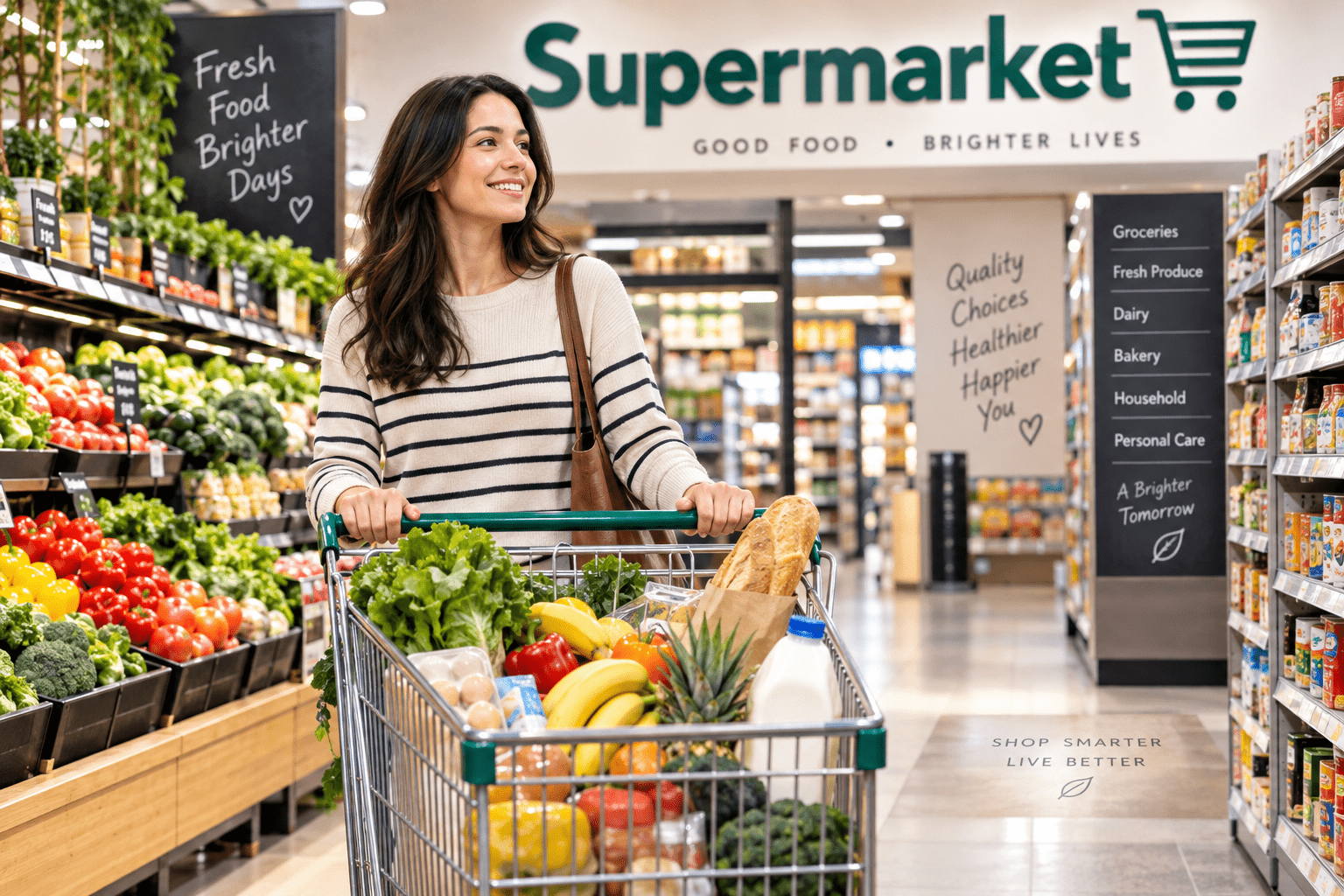
A supermarket is more than a place to buy groceries. Modern supermarkets bring fresh food, packaged goods, household essentials, personal-care products, and everyday necessities together under one roof, making routine shopping faster and more convenient.
However, choosing the right store and shopping efficiently can make a significant difference to your weekly budget. Understanding supermarket pricing, product placement, food labels, promotions, and shopping options can help you spend less while buying products that better match your needs.
What Is a Supermarket?
A supermarket is a self-service retail store that primarily sells food, beverages, household products, and everyday consumer goods.
Unlike small neighborhood grocery stores, supermarkets normally offer a much wider product selection organized into dedicated departments. Many also provide bakeries, pharmacies, deli counters, online ordering, home delivery, and click-and-collect services.
Quick Facts About Supermarkets
| Feature | Typical Supermarket Offering |
|---|---|
| Main products | Food, drinks and groceries |
| Fresh departments | Produce, meat, dairy and bakery |
| Household items | Cleaning and everyday essentials |
| Shopping method | Primarily self-service |
| Pricing | Standard prices plus promotions |
| Checkout | Staffed and self-checkout options |
| Online shopping | Common at larger chains |
| Loyalty programs | Frequently available |
What Can You Buy at a Supermarket?
The exact selection varies according to store size, location, and target customers.
Most supermarkets divide products into several major categories.
Fresh Fruit and Vegetables
The produce department normally contains fresh fruit, vegetables, herbs, salads, and occasionally locally sourced or organic produce.
Check freshness rather than automatically choosing the most visually perfect item. Seasonal produce can also provide better value because availability is usually higher.
Meat, Poultry, and Seafood
Larger supermarkets may have refrigerated meat departments containing beef, chicken, lamb, seafood, and prepared products.
When buying fresh meat, check:
- Use-by dates
- Package condition
- Storage temperature
- Price per unit of weight
- Preparation requirements
Buying a larger package is not automatically cheaper. Compare the unit price before deciding.
Dairy and Refrigerated Foods
Milk, cheese, yogurt, butter, eggs, desserts, and refrigerated prepared meals are supermarket staples.
Products with the longest remaining shelf life are sometimes positioned behind products that expire sooner. Always check dates when shelf life matters to you.
Bakery Products
Many supermarkets sell packaged bread alongside fresh bakery items such as:
- Bread loaves
- Rolls
- Cakes
- Pastries
- Cookies
- Pies
Freshly baked products can be appealing, but compare their price and portion size with packaged alternatives if budget is your priority.
Frozen Food
Frozen sections typically include vegetables, fruit, meat, pizza, desserts, ready meals, and snacks.
Frozen fruit and vegetables can be useful when you struggle to use fresh produce before it spoils. Longer storage can also reduce unnecessary food waste.
Pantry Essentials
The central aisles generally contain shelf-stable foods including pasta, rice, cereal, flour, canned foods, sauces, cooking oils, spices, snacks, and beverages.
Because these products keep longer, comparing prices carefully and buying during genuine promotions can sometimes produce meaningful savings.
Household and Personal-Care Products
A modern supermarket may also stock:
- Laundry detergent
- Cleaning products
- Paper goods
- Shampoo
- Soap
- Toothpaste
- Baby products
- Pet supplies
- Basic kitchen accessories
Convenience is the main advantage, although specialist retailers may sometimes offer a broader selection.
Supermarket vs Grocery Store vs Hypermarket
These terms are frequently used interchangeably, but they can describe different retail formats.
| Store Type | Typical Size | Product Range | Best For |
|---|---|---|---|
| Grocery store | Small to medium | Mainly food and essentials | Fast everyday shopping |
| Supermarket | Medium to large | Food plus household products | Regular weekly shopping |
| Hypermarket | Very large | Food, clothing, electronics and more | Large combined shopping trips |
| Convenience store | Small | Limited essentials | Quick purchases |
| Discount supermarket | Medium | Streamlined product range | Budget-focused shopping |
The boundaries are not always strict. Retailers can combine characteristics from several formats.
How to Choose the Right Supermarket
The closest supermarket is not necessarily the best option.
Price matters, but convenience, product quality, availability, customer service, and shopping frequency should also influence your decision.
Compare Your Regular Purchases
Instead of comparing one heavily promoted item, create a small basket of products you buy frequently.
For example, compare the cost of:
- Milk
- Bread
- Eggs
- Rice
- Chicken
- Fresh vegetables
- Fruit
- Cooking oil
- Cleaning products
This produces a more realistic comparison of what your normal shopping trip might cost.
Check Product Variety
A supermarket with hundreds of additional products provides little benefit if it regularly lacks the items you actually buy.
Consider whether the store reliably stocks your preferred sizes, brands, dietary products, and fresh foods.
Consider Store Location
Transportation costs are easy to overlook.
Driving significantly farther to save a small amount on groceries may provide little overall benefit once fuel, transportation costs, and additional time are considered.
Review Online Shopping Options
For online supermarket shopping, compare more than product prices.
Look at:
- Delivery fees
- Minimum order values
- Collection options
- Product substitution policies
- Delivery windows
- Loyalty benefits
A slightly higher-priced retailer may still offer better total value if delivery is cheaper or more reliable.
How to Save Money at a Supermarket
Saving money does not require purchasing the cheapest version of everything.
The better strategy is controlling what enters your basket while reducing waste.
1. Plan Meals Before Shopping
Decide what meals you expect to prepare over the next several days.
Then check your refrigerator, freezer, and cupboards before writing your shopping list.
This prevents duplicate purchases and helps you use food you already own.
2. Use a Shopping List
A list gives your shopping trip structure.
Organizing it by department—produce, meat, dairy, pantry, frozen goods—can also reduce unnecessary wandering through aisles where impulse purchases occur.
3. Compare Unit Prices
Package price can be misleading.
Suppose one product costs $4 for 500 grams while another costs $6 for 1 kilogram. The larger package costs more at checkout but offers a lower price per gram.
Unit pricing helps reveal the better-value option.
Use This Simple Formula
Unit Price = Product Price ÷ Quantity
Always compare identical units before making a decision.
4. Do Not Assume Larger Packs Are Cheaper
Bulk products often offer good value, but not always.
Promotions, pricing strategies, and different package sizes can occasionally make smaller packs cheaper per unit.
Check instead of assuming.
5. Consider Store Brands
Store-brand products can cost less because retailers may spend less on branding, advertising, and elaborate packaging.
That does not automatically mean lower quality. Compare ingredients, nutrition information, quantity, and your own experience rather than relying entirely on the brand name.
6. Understand Promotions
Signs such as “special,” “deal,” or “multi-buy” are designed to attract attention.
Before purchasing, ask:
- Did I already intend to buy this?
- Is the unit price actually lower?
- Will I use everything before it expires?
- Am I buying additional products only to qualify for the promotion?
A discount saves money only when it reduces spending on something you genuinely need.
7. Use Loyalty Programs Carefully
Supermarket loyalty programs may offer member prices, points, personalized discounts, or coupons.
They can be useful when you already shop at that retailer. Avoid purchasing unnecessary items simply because they earn extra points.
8. Reduce Food Waste
Food thrown away is money thrown away.
Buy realistic quantities, understand product dates, freeze suitable foods, and plan meals around ingredients that need to be used first.
Understanding Supermarket Product Placement
Supermarket layouts are rarely random.
Retailers generally design stores to make products easy to discover while also encouraging customers to browse.
Eye-Level Shelves
High-visibility positions are valuable because customers notice them quickly.
Do not limit your comparison to products directly in front of you. Look at higher and lower shelves where different brands, pack sizes, or prices may appear.
End-of-Aisle Displays
Endcaps are highly visible promotional areas.
An item displayed prominently is not necessarily the cheapest available option. Compare it with similar products in its normal aisle.
Checkout Areas
Small snacks, drinks, and convenience products around checkout areas encourage last-minute purchases.
Ask yourself whether you intended to buy the item before adding it to your basket.
How to Read Food Labels
Food labels help you compare products beyond packaging and marketing.
Pay particular attention to serving size because nutritional figures may represent only part of the package.
Check the Ingredient List
Ingredients are generally presented according to quantity, with major ingredients appearing first.
This can help you compare products that make similar claims.
Review Nutrition Information
Depending on your dietary priorities, useful figures may include:
- Calories
- Protein
- Fat
- Saturated fat
- Carbohydrates
- Sugars
- Fiber
- Sodium or salt
Compare equivalent serving sizes when evaluating different products.
Understand Date Labels
Date terminology can differ by country and product.
Some dates relate primarily to food safety, while others indicate expected quality. Follow local food-safety guidance and the instructions printed on the package, particularly for highly perishable foods.
Fresh Food Shopping Tips
Fresh products require more judgment than shelf-stable foods.
Buying carefully can improve quality while reducing waste.
Fruit and Vegetables
Select produce based on when you intend to eat it.
If you are shopping for several days, combining ready-to-eat produce with items that will ripen later can help extend usability.
Meat
Check package seals and storage conditions carefully.
Keep raw meat separated from ready-to-eat foods in your basket and shopping bags to reduce contamination risks.
Chilled and Frozen Foods
Pick up frozen and refrigerated products toward the end of your shopping trip.
Transport them home promptly, particularly during warm weather.
Is Online Supermarket Shopping Worth It?
Online grocery shopping can be valuable for busy households, people with limited transportation, or customers who prefer structured purchasing.
It also changes the way impulse buying happens.
Advantages
- Shop from home
- Easier price comparison
- Faster repeat orders
- Convenient delivery
- Easier access to previous purchases
- Better visibility of running basket totals
Possible Drawbacks
- Delivery charges
- Minimum spending requirements
- Product substitutions
- Limited ability to inspect fresh food personally
- Unavailable delivery windows
One useful online-shopping habit is reviewing your cart before checkout and removing products added impulsively.
Supermarket Delivery vs Click and Collect
Both services can save time, but they solve slightly different problems.
Home delivery works well when convenience is the priority and you want to avoid traveling to the store.
Click and collect can be more practical when you are already traveling nearby and want to avoid spending time inside the supermarket.
Always include service fees when comparing overall costs.
Common Supermarket Shopping Mistakes
Even experienced shoppers regularly make decisions that increase their grocery bills.
Shopping Without Checking Home Supplies
Buying another bottle of sauce when three already sit in your cupboard creates unnecessary spending and clutter.
Check your kitchen before leaving.
Shopping Hungry
Shopping while hungry can make snacks and convenience foods more tempting.
Eating beforehand may make it easier to stick to your planned purchases.
Looking Only at the Final Price
A cheaper package may simply contain less product.
Compare quantity and unit price instead of relying entirely on the shelf price.
Buying Too Much Fresh Food
Buying healthy food is useful only if it gets eaten.
Purchase quantities that match your realistic meal plan rather than your ideal one.
Treating Every Promotion as a Bargain
Promotional signs draw attention but do not replace comparison.
Always evaluate the normal price, package size, and whether you actually need the product.
Ignoring Your Receipt
Reviewing supermarket receipts can identify incorrect prices, duplicate scans, unexpected substitutions, and spending categories that are becoming expensive.
How to Make Supermarket Shopping Faster
Efficiency can be just as valuable as saving money.
Use a predictable shopping system instead of beginning every visit without a plan.
A practical routine is:
- Plan meals.
- Check existing supplies.
- Create a shopping list.
- Set an approximate budget.
- Organize the list by department.
- Compare unit prices on important purchases.
- Add refrigerated and frozen foods last.
- Review your basket before checkout.
- Check your receipt.
- Store food promptly when you get home.
Repeating the same process makes supermarket shopping easier to manage.
Choosing Between Premium and Budget Products
Paying more does not automatically guarantee better value.
For basic ingredients such as flour, sugar, rice, canned vegetables, and cleaning staples, differences between premium and budget alternatives may be less important to some shoppers.
For other products, taste, ingredients, durability, sourcing, or personal preference may justify a higher price.
The useful question is not simply, “Which product is cheapest?”
Ask, “Which option gives me the best combination of quality, quantity, usefulness, and price?”
How Supermarkets Encourage Impulse Buying
Impulse purchases are not necessarily bad, but repeated unplanned purchases can significantly affect a household grocery budget.
Common triggers include:
- Attractive displays
- Limited-time messaging
- Checkout products
- Seasonal displays
- Free samples
- Multi-buy promotions
- Convenient ready-to-eat products
Creating a small allowance for optional purchases can be more realistic than expecting yourself never to buy anything unplanned.
Supermarket Shopping for Families
Family shopping introduces additional challenges because preferences, school meals, snacks, dietary requirements, and household supplies all compete for the same budget.
Create a core weekly list of regularly consumed products first.
Then separate “essentials” from “optional” purchases. This makes it easier to adjust spending when the total basket exceeds your budget.
Shopping for One Person
Single-person households face a different problem: package sizes can be too large.
Useful strategies include:
- Choosing smaller packages when waste would offset bulk savings
- Freezing individual portions
- Buying loose produce
- Planning multiple meals around shared ingredients
- Avoiding multi-buy deals you cannot realistically consume
The cheapest unit price is not the best deal if half the product gets discarded.
Supermarket Shopping for Special Diets
People following vegetarian, vegan, gluten-free, allergy-aware, religious, or medically recommended diets may need more careful label checking.
Never rely solely on shelf placement or front-of-package marketing.
Read the complete label and follow professional medical advice where allergies or health conditions are involved.
Local Supermarket or Large Chain?
Both can offer advantages.
A large supermarket chain may provide:
- Wider selection
- Loyalty programs
- Extensive online services
- Consistent product availability
A smaller local supermarket may offer:
- Convenient location
- Regional products
- Familiar customer service
- Products tailored to local communities
The better choice depends on your priorities rather than store size alone.
Are Discount Supermarkets Always Cheaper?
Discount supermarkets often control costs by offering fewer brands, streamlined stores, limited services, or a strong focus on private-label products.
That can result in competitive pricing, but no retailer is cheapest for every product.
Compare the cost of your normal basket instead of relying on a supermarket’s overall reputation.
Grocery Budgeting Made Simple
Setting a grocery budget becomes easier when you know where your money goes.
Divide spending into broad groups such as:
- Fresh food
- Protein
- Dairy
- Pantry staples
- Snacks and drinks
- Household products
- Personal care
After several shopping trips, patterns usually become visible.
If spending is higher than expected, reducing waste and unnecessary extras often produces better results than cutting essential food first.
What Makes a Good Supermarket?
A high-quality supermarket combines more than low prices.
Important factors include:
- Clean and organized premises
- Proper food storage
- Reliable stock levels
- Clear pricing
- Fresh produce
- Useful product variety
- Accessible store layout
- Convenient payment options
- Helpful customer service
- Straightforward returns and refunds
- Convenient online services where available
Individual priorities will determine which factors matter most.
The Changing Supermarket Experience
Supermarkets continue to evolve as customer expectations and retail technology change.
Many stores now combine physical shopping with digital services such as online ordering, mobile loyalty programs, electronic receipts, self-checkout, and automated collection systems.
At the same time, shoppers increasingly expect clearer pricing, convenient fulfillment options, less unnecessary packaging, and more information about the products they purchase.
Despite these changes, the central purpose of the supermarket remains straightforward: making everyday products conveniently available to a broad range of customers.
Practical Supermarket Checklist
Before your next shopping trip, use this checklist:
- Check your refrigerator, freezer, and cupboards.
- Plan several meals.
- Write a realistic shopping list.
- Set a spending target.
- Compare unit prices.
- Check package sizes.
- Review expiry or use-by dates.
- Question unnecessary multi-buy offers.
- Buy realistic quantities of fresh food.
- Review your basket before paying.
- Check your receipt.
- Store chilled and frozen food promptly.
Conclusion
A supermarket can make everyday shopping convenient, but smart shopping depends on more than choosing products from a shelf. Planning meals, comparing unit prices, reading labels, understanding promotions, reducing food waste, and choosing the right store can all improve the value of every shopping trip.
Instead of chasing every supermarket discount, focus on buying the products your household genuinely needs at a sensible combination of price, quantity, and quality. Over time, those small decisions can make grocery shopping faster, more organized, and significantly more cost-effective.