
Searching for kogniz.com can produce confusing results. Some pages describe an artificial intelligence company that developed workplace-safety technology, while the current website presents itself as a broader technology publication covering mobile applications, virtual reality, cloud platforms, AI, and digital trends.
This guide explains what kogniz.com appears to be today, how it differs from the original Kogniz business, what trust signals the website provides, and what users should verify before relying on its content or sharing personal information.
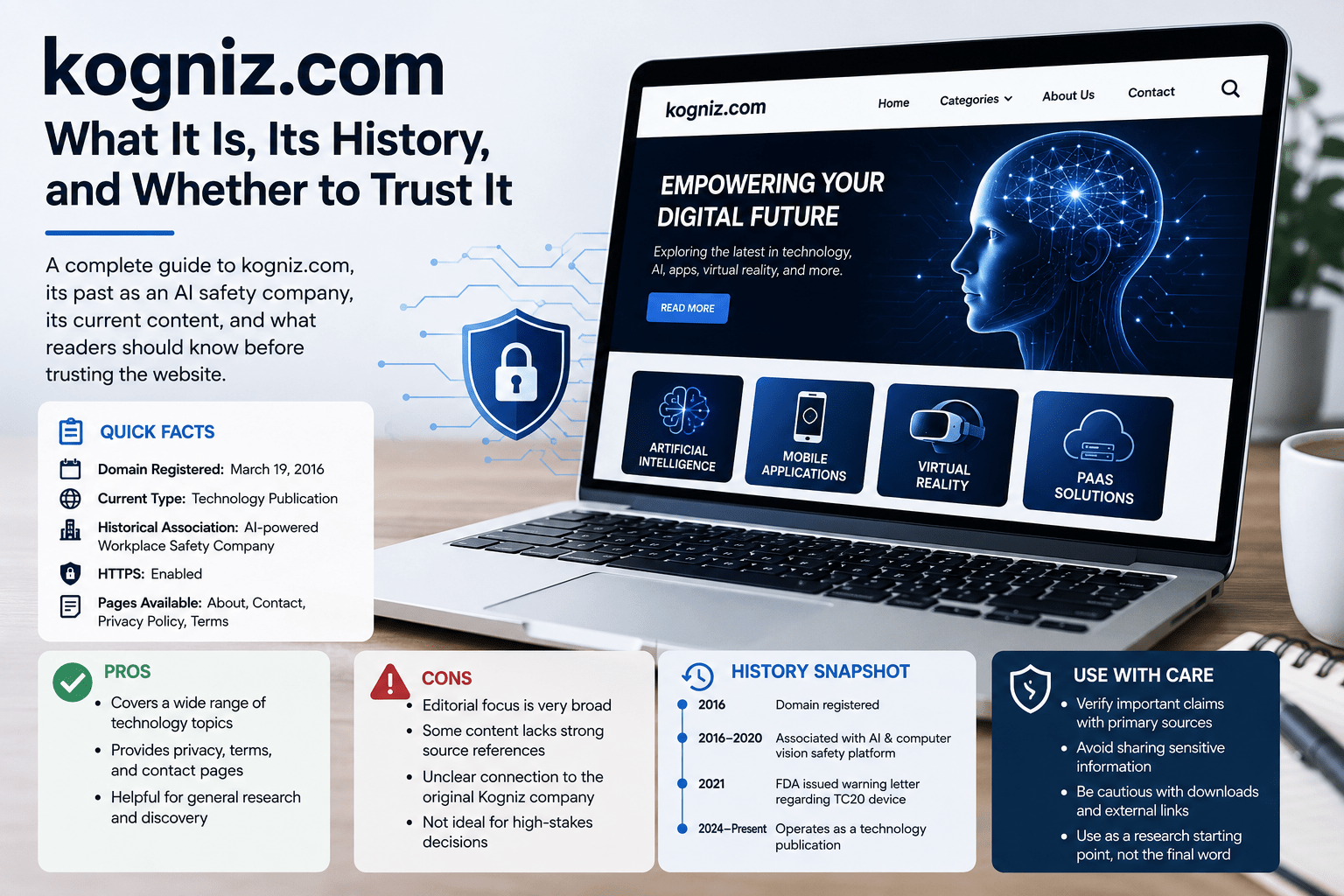
kogniz.com Quick Facts
| Detail | Current finding |
|---|---|
| Domain | kogniz.com |
| Registration date | March 19, 2016 |
| Current website type | Technology and digital-trends publication |
| Historical association | AI-powered workplace safety and computer-vision company |
| Main topics today | AI, mobile apps, virtual reality, PaaS, digital platforms and online trends |
| HTTPS availability | Detected |
| Public privacy policy | Available |
| Public terms page | Available |
| Contact page | Available |
| Primary caution | Current editorial content differs significantly from the domain’s original business identity |
Public WHOIS information indicates that the domain was registered in March 2016 and updated in March 2026. Its infrastructure currently uses Cloudflare nameservers.
What Is kogniz.com Today?
The current version of kogniz.com describes itself as a technology-focused information hub. Its About page says the website explores subjects such as mobile applications, virtual reality, platform-as-a-service solutions, emerging technologies, and the relationship between technology and business.
Its audience appears to include:
- Technology enthusiasts
- Developers
- Startup founders
- Business leaders
- Readers researching unfamiliar digital terms
- People interested in AI, automation and virtual experiences
However, the homepage covers a much wider range of topics than the About page suggests. Alongside conventional technology articles, it contains guides about unexplained phone numbers, unfamiliar usernames, unusual search terms and miscellaneous internet topics.
This broad editorial scope makes kogniz.com more similar to a general informational blog than a focused software-product website.
The Original Kogniz Company
Historically, Kogniz was associated with a California-based technology company developing artificial intelligence and computer-vision systems for physical workplaces.
Third-party software profiles describe the original Kogniz platform as a cloud-based workplace-safety solution that analyzed video, sensor and text data. Reported use cases included:
- Occupational-safety monitoring
- PPE and mask detection
- Social-distancing analysis
- Contact tracing
- Forklift and machinery-risk detection
- Slip, trip and fall alerts
- Perimeter monitoring
- Unattended-baggage detection
- Workplace-violence alerts
- Evacuation and personnel accountability
The platform was reportedly designed to work with cameras and other workplace data sources to identify potential incidents and notify safety teams.
Several current business directories still describe Kogniz as an AI and computer-vision company founded in 2016. Some even continue to list the organization as active and associate it with workplace safety, security and anomaly detection.
Is the Current Website the Same Business?
The publicly visible evidence is unclear.
The original company was promoted as a workplace-safety software provider. The current website describes itself primarily as a technology publication and contains articles across many unrelated subjects.
That contrast suggests the domain’s purpose or editorial direction has changed. Publicly available pages do not clearly explain when the transition occurred, whether the original company still controls the domain, or how the present publication relates to the former software operation.
Users should therefore avoid assuming that every current article, contact address or product description represents the original Kogniz company.
What Did the Kogniz Platform Do?
The historical Kogniz system used AI-powered video analytics to help organizations identify safety and security events in physical environments.
A typical implementation could involve the following process:
- Existing cameras or compatible sensors collect workplace data.
- Computer-vision software analyzes people, objects or activities.
- The system identifies an event matching a configured detection rule.
- An alert or video clip is sent to an authorized team.
- A human reviewer confirms or dismisses the incident.
- The organization records the response for reporting or compliance purposes.
Possible applications included detecting missing protective equipment, monitoring restricted areas, identifying unsafe proximity between workers and machinery, and improving response times after an incident.
These systems were intended to supplement—not replace—trained safety personnel, documented procedures and human judgment.
The 2021 FDA Warning Letter
One important historical fact is that the U.S. Food and Drug Administration issued a warning letter to Kogniz, Inc. on March 4, 2021.
The letter concerned the “KOGNIZ TC20,” a telethermographic system marketed for measuring human body temperature. According to the FDA, the product was offered for sale in the United States without the required approval, clearance or authorization for its stated medical use.
The agency also raised concerns about claims involving the simultaneous temperature screening of groups. It warned that inaccurate temperature assessments could create public-health risks.
This historical action should be understood accurately:
- It related to a particular temperature-screening product and its regulatory status.
- It does not automatically prove that every Kogniz service or current website page is unsafe.
- It remains relevant when evaluating historical medical or health-related claims associated with the brand.
- Current product availability or regulatory status should be checked directly through official regulatory databases.
Readers should never rely solely on an old marketing page when evaluating equipment used for medical screening, diagnosis or health-related decisions.
Is kogniz.com Legit?
There is no single technical test that can conclusively label an entire website “legitimate.” A more reliable approach is to examine different types of trust separately.
Technical Legitimacy
The domain is registered and currently resolves through Cloudflare infrastructure. Third-party technical records also detect HTTPS support.
HTTPS means information exchanged with the website may be encrypted in transit. It does not prove that every article is accurate, that every offer is genuine, or that the current operator is the original Kogniz company.
Organizational Transparency
The website provides:
- An About page
- A contact page
- Terms and conditions
- A privacy policy
Its contact page states that visitors can reach the team by email, while its privacy policy describes the collection of account, communication and contact information.
These pages are positive baseline signals, but visitors should look beyond their existence. A trustworthy website should also provide clear ownership, accountable authorship, reliable sourcing and a consistent editorial purpose.
Content Trustworthiness
This is where users should exercise greater caution.
The homepage includes a large mix of conventional technology topics, obscure identifiers, unexplained phone numbers, usernames and loosely connected subjects. Some articles make detailed claims about unfamiliar products or terms without clearly identifying primary sources.
That does not mean every article is incorrect. It means readers should independently verify important claims before acting on them.
kogniz.com Pros and Cons
| Potential strengths | Potential limitations |
| Covers a broad range of technology topics | Editorial focus is unusually broad |
| Uses short, accessible explanations | Some topics have limited verifiable sourcing |
| Provides privacy, terms and contact pages | Current ownership is not prominently explained |
| May introduce readers to unfamiliar terms | Historical company information can be mixed with current content |
| Includes articles about AI and digital platforms | Readers may mistake blog content for official product documentation |
| Domain has a long registration history | Domain age alone does not guarantee content quality |
How to Evaluate an Article on kogniz.com
Do not judge an article solely by its length, confident tone or polished formatting. Use the following checks before relying on it.
1. Identify the Original Source
Look for links to:
- Official company documentation
- Government databases
- Academic research
- Regulatory notices
- Recognized industry publications
- Verified product manuals
Be careful when an article repeats detailed statistics, prices, product specifications or company claims without identifying where the information came from.
2. Check the Publication Date
Technology information becomes outdated quickly.
Confirm whether the article reflects the current version of a product, law, platform or service. A page updated in 2026 may still repeat older information if its sources were not reviewed.
3. Verify the Author
Check whether the author has:
- A complete biography
- Relevant professional experience
- Links to verifiable work
- Subject-specific expertise
- A transparent editorial role
A short generic biography is not the same as demonstrated expertise.
4. Separate Facts From Speculation
Some articles about unknown terms or phone numbers may suggest several possible meanings. Possibilities should not be presented as confirmed facts.
Watch for phrases such as:
- “Could be”
- “May represent”
- “Possibly connected”
- “Some users believe”
- “Might indicate”
These phrases can be useful when uncertainty is clearly acknowledged. They become misleading when followed by unsupported conclusions.
5. Cross-Check High-Stakes Claims
Always verify information independently when it concerns:
- Health or medical devices
- Cybersecurity
- Financial transactions
- Legal requirements
- Personal-data collection
- Investment opportunities
- Employment offers
- Account credentials
- Software downloads
No general-interest blog should be the only source used for a high-risk decision.
How to Use kogniz.com More Safely
Visitors can reduce risk by treating the website as a starting point for research rather than a final authority.
For General Reading
Use an article to learn relevant terminology, discover possible use cases or identify questions that require further investigation.
Then confirm the important details through primary sources.
Before Creating an Account
Determine whether the page genuinely requires registration. Review what information is collected, how it is stored and whether account deletion instructions are available.
Use a unique password that is not shared with banking, email or business accounts.
Before Contacting the Website
Avoid including sensitive personal or company information in an initial message.
Do not send:
- Passwords
- Identification documents
- Payment-card details
- Private medical records
- Confidential workplace files
- API keys or access tokens
A general inquiry should require only basic contact information.
Before Downloading Anything
Verify the publisher, file type and digital signature where applicable. Scan downloaded files with updated security software.
A professionally written download page does not guarantee that a file is authentic.
Before Buying a Product
Confirm the seller’s legal business name, physical address, refund policy, customer-support channel and payment protections.
For medical, safety or surveillance equipment, also verify certifications and regulatory status.
Common Mistakes When Researching kogniz.com
Confusing It With Similar Companies
Kogniz can easily be confused with similarly named organizations such as:
- Kognic
- Kognitiv
- Kognition AI
- Kognit
- Kognity
These are separate brands associated with different industries, including autonomous-vehicle data annotation, customer-loyalty software, physical security, customer support and education.
Check the spelling and domain before attributing a product, review, legal notice or job listing to a particular company.
Assuming Old Product Pages Remain Current
A search engine may surface archived descriptions, old directories or historical product profiles. These may not reflect the current website or current commercial availability.
Always confirm information on a recently updated official product page.
Treating HTTPS as Proof of Trust
HTTPS protects the connection between a browser and a website. It does not verify editorial accuracy, ownership or business practices.
A trustworthy assessment should combine technical, organizational and content-level evidence.
Believing Every Confidently Written Claim
An article can sound authoritative while relying on weak evidence. Specificity is not proof.
Look for traceable facts, named sources and transparent uncertainty.
Who May Find kogniz.com Useful?
The website may be useful for readers who want:
- Accessible introductions to technology topics
- Explanations of unfamiliar digital terms
- General coverage of AI, virtual reality and mobile apps
- Background information about the historical Kogniz platform
- Ideas for further research
It is less suitable as the sole authority for:
- Medical-device decisions
- Workplace-safety compliance
- Cybersecurity configuration
- Legal interpretation
- Financial decisions
- Identity verification
- Regulatory approval
Frequently Asked Questions
What is kogniz.com?
Today, kogniz.com appears to operate primarily as a technology and digital-trends publication. Historically, the domain was associated with an AI and computer-vision company providing workplace-safety and security tools.
Is kogniz.com still a workplace-safety platform?
The current public website does not present a clear, conventional software-product homepage. It mainly publishes informational articles.
Third-party company directories continue to describe Kogniz as a workplace-safety technology business, but those profiles may reflect historical information.
Is kogniz.com safe to visit?
The domain currently supports HTTPS, which protects the browser connection. That alone cannot confirm the reliability of every article, form, service or external link.
Visitors should use normal security precautions and avoid submitting sensitive information without verifying the current operator and purpose of the page.
Was Kogniz an AI company?
Yes. The historical Kogniz business was described as an AI and computer-vision company focused on safety, security and operational monitoring.
Did Kogniz receive an FDA warning?
Yes. In March 2021, the FDA issued a warning letter concerning the regulatory status and marketing of the KOGNIZ TC20 temperature-screening system.
Can kogniz.com articles be trusted?
Some articles may provide useful introductory information, but trust should be evaluated page by page. Check the author, sources, date, evidence and consistency with primary references.
Is kogniz.com the same as Kognic or Kognitiv?
No. The names are similar, but they refer to different domains and organizations. Verify the exact spelling before researching products, employment opportunities or company history.
Final Verdict on kogniz.com
kogniz.com has a genuine domain history connected to an AI-powered workplace-safety business, but its current public identity is considerably broader. Today, it functions mainly as a technology and internet-content publication covering both established digital subjects and highly obscure search terms.
The website provides basic transparency pages and uses HTTPS, but those signals should not replace careful verification. Its mixed editorial focus, unclear relationship with the original Kogniz company and limited sourcing on some pages mean readers should treat it as a secondary research resource.
Use kogniz.com for general discovery and background reading, but confirm important technical, medical, financial, legal or security-related claims through authoritative primary sources before making a decision.