


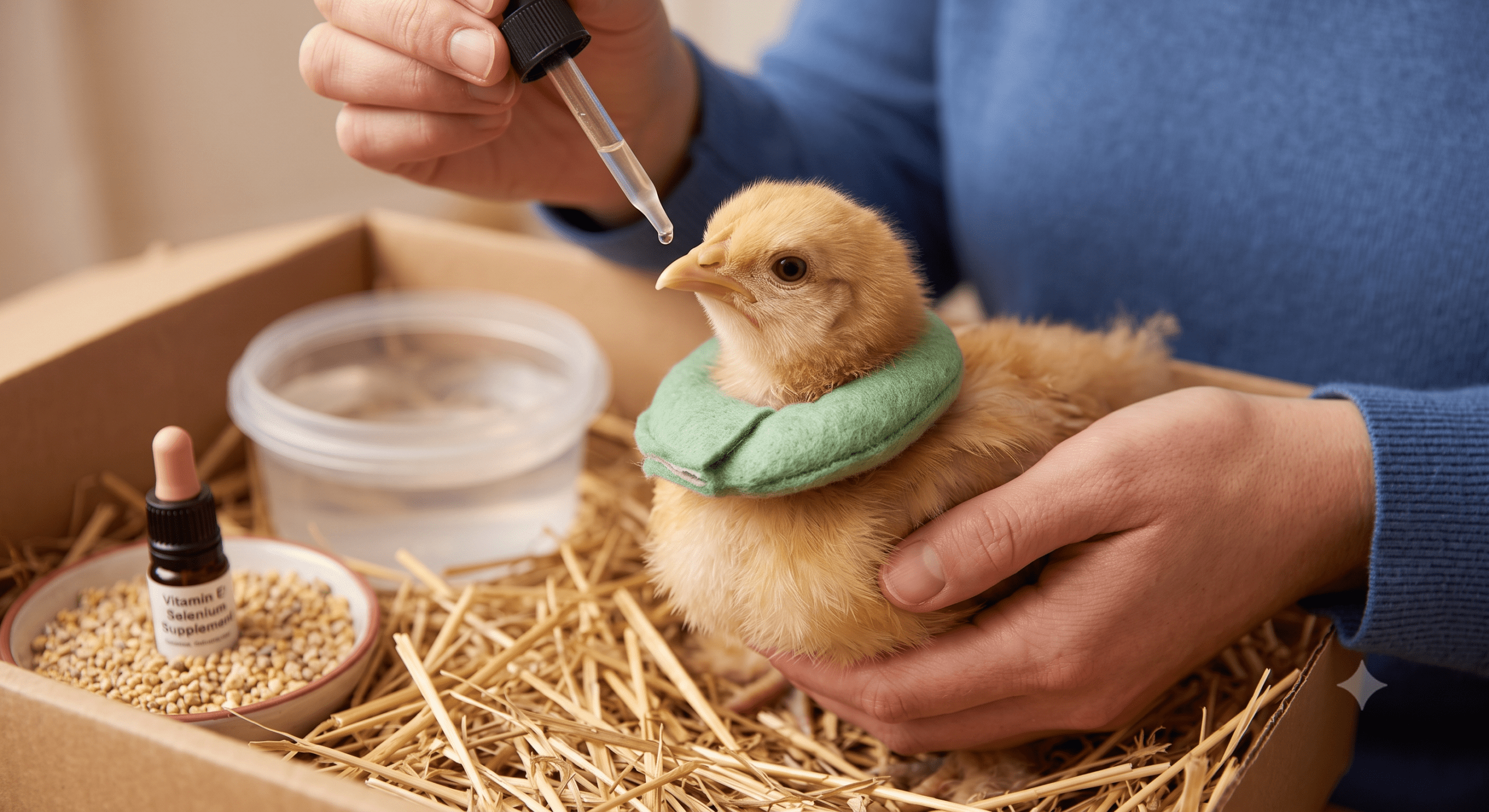
Finding a wry neck chick can be alarming. A chick that suddenly twists its head sideways, looks upward, bends its neck backward, loses balance, or struggles to eat may appear severely ill—but the neck position itself is not a diagnosis.
Wry neck, also called torticollis, is a neurological or muscular sign that can have several underlying causes. Nutritional deficiencies are one possibility, especially vitamin E deficiency, but infections, toxins, injuries, developmental problems, and other neurological diseases must also be considered.
The most useful approach is therefore not simply asking, “How do I straighten the chick’s neck?” Instead, determine why the chick cannot control its head normally, provide immediate supportive care, and watch carefully for signs that require veterinary investigation.
Important: A twisted neck accompanied by breathing problems, green diarrhea, paralysis, sudden deaths, or illness in several birds should be treated as potentially serious rather than assumed to be a simple vitamin deficiency.
What Is Wry Neck in a Chick?
Wry neck describes abnormal positioning or movement of the head and neck. Veterinarians may refer to the condition as torticollis.
A chick with wry neck may:
- Hold its head permanently to one side
- Twist its head underneath its body
- Stretch its neck backward
- Look upward repeatedly
- Walk backward or in circles
- Fall over while trying to stand
- Shake or tremble
- Struggle to coordinate its legs
- Have difficulty reaching food or water
- Appear normal for short periods before twisting again
The severity can range from a mild head tilt to a neurological problem that prevents the bird from standing, eating, or drinking.
Most importantly, wry neck is a symptom rather than a disease. Treating every case with the same home remedy can delay diagnosis of the actual problem.
Wry Neck Chick Quick Facts
| Question | Practical Answer |
|---|---|
| Is wry neck a disease? | No. It is a neurological or muscular sign. |
| Can vitamin E deficiency cause it? | Vitamin E deficiency can cause neurological disease and ataxia in chicks. |
| Is wry neck contagious? | The neck problem itself is not contagious, but some underlying diseases can be. |
| Should the chick be separated? | Usually yes, especially if it cannot compete safely for food or water. |
| Can a chick recover? | Some chicks recover, particularly when a reversible cause is identified early. |
| Is selenium always required? | No. Selenium should not be added casually because excessive selenium can be harmful. |
| When is it an emergency? | Multiple sick birds, respiratory disease, severe paralysis, sudden deaths, or rapid deterioration warrant urgent veterinary attention. |
What Causes Wry Neck in Chicks?
There is no single cause of wry neck. The chick’s age, diet, flock history, accompanying symptoms, and speed of onset provide valuable clues.
1. Vitamin E Deficiency and Encephalomalacia
Vitamin E deficiency is one of the best-known nutritional conditions associated with neurological problems in young chickens.
Severe deficiency can produce encephalomalacia, a condition involving damage to the brain, particularly the cerebellum. The classic clinical sign is ataxia—loss of coordinated movement.
Affected chicks may consequently:
- Stagger
- Fall over
- Have poor balance
- Develop abnormal head movements
- Lose normal coordination
- Struggle to stand or walk
Vitamin E acts as an antioxidant, helping protect tissues from oxidative damage. Dietary factors also matter: the bird’s vitamin E requirement is influenced by the amount and type of fat in the diet and its relationship with other nutrients, including selenium.
A nutritional cause becomes more suspicious when chicks have been receiving an incomplete ration, improperly stored feed, nutritionally unbalanced homemade food, or feed in which nutrient quality may have deteriorated.
However, seeing a twisted neck does not prove vitamin E deficiency.
2. Vitamin E and Selenium Problems Are Not Identical
Vitamin E and selenium are frequently discussed together because both participate in antioxidant defense, but their deficiencies do not produce exactly the same syndromes.
In chicks, vitamin E deficiency is associated with encephalomalacia, exudative diathesis, and certain forms of muscular dystrophy. Exudative diathesis specifically involves interactions between vitamin E and selenium deficiency.
This distinction matters because backyard poultry advice sometimes recommends combining high doses of vitamin E and selenium for virtually every bird with neurological symptoms.
That is not a risk-free strategy.
Selenium is an essential trace element, but excessive dietary selenium can cause toxicity. Veterinary references specifically describe harmful effects when poultry receive excessive selenium concentrations.
For that reason, avoid improvising with concentrated human selenium tablets unless an avian veterinarian has calculated an appropriate dose.
3. Newcastle Disease
A twisted neck can also occur with Newcastle disease, including virulent forms of the disease.
Neurological signs may include:
- Tremors
- Seizures
- Wing or leg paralysis
- Torticollis
- Circling
- Complete paralysis
Respiratory distress, nasal discharge, coughing, lethargy, reduced appetite, watery greenish diarrhea, and sudden death may also occur depending on the strain and form of disease.
This creates an important diagnostic difference.
A single otherwise bright chick with a nutritional problem is very different from several birds developing twisted necks alongside coughing, diarrhea, severe depression, or deaths.
In the United States, virulent Newcastle disease is a serious reportable animal disease concern. USDA APHIS advises owners who suspect it to contact a veterinarian rather than attempting to manage the outbreak themselves.
4. Marek’s Disease
Marek’s disease should also be considered when neurological symptoms develop, particularly in older chicks and growing chickens.
Marek’s disease affects peripheral nerves and can produce:
- Ataxia
- Weakness
- Paralysis
- Abnormal leg positioning
- Persistent neurological disease
A classic presentation involves one leg extended forward and the other backward, although not every affected bird displays this posture. Marek’s disease can develop in chickens from approximately three weeks of age, and there is no treatment that eliminates established Marek’s disease.
Vaccination and biosecurity are the principal control measures.
This is another reason not to automatically label neurological symptoms as a vitamin deficiency.
5. Botulism or “Limberneck”
Botulism produces a different type of neck problem sometimes called limberneck.
Rather than strongly twisting the neck, affected birds typically develop progressive weakness followed by flaccid paralysis. The paralysis can spread through the legs, wings, neck, and eyelids. Severely affected birds may become unable to hold their heads up.
Potential environmental clues include access to:
- Decaying animal material
- Carcasses
- Maggots associated with decomposing animals
- Contaminated organic matter
The carcass-maggot cycle can help perpetuate botulism outbreaks in poultry environments, making prompt carcass removal particularly important.
6. Head or Neck Injury
Trauma is easy to overlook, especially when only one chick is affected.
Potential causes include:
- Being stepped on
- Falling from equipment
- Getting trapped
- Pecking injuries
- Being crushed during piling
- Rough handling
- Collision with brooder equipment
A traumatic case may appear suddenly while all other chicks remain normal.
Avoid repeatedly forcing the neck into a straight position. If there is an injury, aggressive manipulation could worsen pain or tissue damage.
7. Developmental or Congenital Problems
A chick that has held its head abnormally since hatching may have a developmental problem rather than an acquired nutritional deficiency.
Possible factors include abnormal embryonic development, neurological defects, musculoskeletal abnormalities, or incubation-related problems.
These cases can be difficult to distinguish without veterinary examination.
8. Other Nutritional Disorders
Vitamin E receives much of the attention, but neurological signs are not exclusive to vitamin E deficiency.
For example, severe vitamin A deficiency in young chicks can cause weakness, incoordination, and ataxia. Veterinary references therefore emphasize that nutritional diseases can overlap clinically.
A balanced chick starter ration is usually more useful for prevention than attempting to correct individual nutrients one at a time after problems appear.
How to Tell What May Be Causing Wry Neck
The pattern of illness often provides better clues than the neck position itself.
| Pattern | Possible Concern | Other Clues |
| One young chick, poor diet history | Nutritional deficiency | Ataxia, weakness, poor growth |
| Several chicks affected | Feed problem or infectious disease | Check diet and flock-wide symptoms |
| Twisted neck plus coughing or gasping | Newcastle or another infectious disease | Respiratory illness, diarrhea, deaths |
| Progressive leg paralysis | Marek’s or another neurological disease | Abnormal leg position, older chick |
| Neck becomes limp rather than twisted | Botulism | Progressive flaccid paralysis |
| Sudden onset after accident | Trauma | Only one bird affected |
| Abnormal since hatch | Developmental problem | Persistent early signs |
These patterns are clues, not diagnoses. Different diseases can produce overlapping symptoms, and laboratory testing may be necessary when infectious disease is suspected.
What to Do Immediately for a Wry Neck Chick
Step 1: Separate the Chick Safely
Place the affected chick in a clean hospital brooder or protected enclosure.
Separation prevents stronger chicks from:
- Trampling it
- Pecking it
- Blocking access to feed
- Spilling water on it
- Increasing its stress
Keep the enclosure close enough to other chicks for visual or auditory contact when practical, unless you suspect contagious disease.
If several birds are sick, treat the situation as a flock-health problem rather than repeatedly isolating individual chicks without investigating the cause.
Step 2: Make the Environment Easy to Navigate
A neurological chick may be unable to use a normal brooder effectively.
Use:
- Secure, nonslip flooring
- Low-sided feed dishes
- Easily accessible water
- Soft barriers around hard edges
- Adequate brooder warmth appropriate for the chick’s age
Avoid deep water containers because an uncoordinated chick may fall into them.
Do not overheat a sick chick in an attempt to “warm it back to health.” It still needs an appropriate temperature gradient where possible.
Step 3: Confirm That It Can Eat and Drink
The immediate danger is often not the neck angle itself but the chick becoming unable to reach food and water.
Watch it closely.
Can it:
- Locate the water?
- Swallow normally?
- Reach feed?
- Remain upright long enough to eat?
- Keep food inside its mouth?
If the bird cannot swallow normally, force-feeding or squirting liquids into its mouth can create additional problems. Veterinary help is preferable for a severely neurologically impaired chick.
Step 4: Inspect the Feed
This step is frequently missed.
Check:
- Feed type
- Expiration or manufacturing date
- Storage conditions
- Moisture exposure
- Mold or unusual odor
- Whether the feed is intended for chicks
- Whether treats are replacing nutritionally complete feed
Chick starter should form the nutritional foundation for young chicks.
A handful of grains, vegetables, seeds, mealworms, kitchen scraps, or homemade mixes may look wholesome while still failing to provide the nutrient balance required for rapid early growth.
Step 5: Consider Vitamin Support Carefully
If dietary deficiency is plausible, replacing questionable feed with fresh, nutritionally complete chick starter is an important first step.
A poultry-labeled vitamin supplement can also be considered according to its label directions or veterinary guidance. Vitamin E supplementation can help certain deficiency-related conditions, although recovery from encephalomalacia depends partly on how much neurological damage has already occurred.
Do not assume that “more is better.”
Vitamin E is fat soluble, and poultry nutrient requirements depend on the bird’s total diet. Excessive supplementation over prolonged periods is not an ideal substitute for correcting the underlying ration.
Be especially cautious with concentrated selenium.
Step 6: Examine the Rest of the Flock
A wry neck chick should never be evaluated in isolation from its flock.
Check every bird for:
- Sneezing
- Coughing
- Gasping
- Nasal discharge
- Trembling
- Circling
- Paralysis
- Green or watery diarrhea
- Reduced appetite
- Sudden weakness
- Unexpected death
Several birds developing neurological or respiratory signs changes the situation dramatically.
When a Wry Neck Chick Needs a Veterinarian
Contact an avian or poultry veterinarian promptly if:
- More than one bird develops neurological symptoms.
- The chick cannot eat or drink independently.
- Paralysis is progressing.
- The chick develops seizures or severe tremors.
- Respiratory symptoms occur.
- Watery green diarrhea appears alongside neurological disease.
- Birds begin dying suddenly.
- You suspect botulism or toxin exposure.
- The chick continues deteriorating despite appropriate supportive care.
- You cannot identify a nutritional or traumatic explanation.
Respiratory disease combined with neurological abnormalities deserves particular attention because virulent Newcastle disease can produce both patterns.wry neck chick
Can Vitamin E Cure Wry Neck?
Sometimes—but the wording matters.
Vitamin E does not cure “wry neck” as a universal condition because wry neck has multiple causes.
Vitamin E supplementation may help when the underlying disease is genuinely related to vitamin E deficiency. Veterinary literature indicates that some vitamin E deficiency syndromes can improve when supplementation begins early, while neurological damage from encephalomalacia may or may not completely reverse depending on its severity.
Vitamin E will not cure:
- Marek’s disease
- Newcastle disease
- A serious neck injury
- Botulism
- Every congenital neurological disorder
A bird briefly improving after supplementation also does not necessarily establish the diagnosis.
Should You Give Selenium With Vitamin E?
Not automatically.
Selenium and vitamin E interact within antioxidant systems, which explains why they are frequently discussed together. Selenium deficiency itself can produce disease in growing poultry, and commercial feeds generally provide carefully controlled amounts.
The problem is that selenium is required in extremely small quantities and excessive supplementation can become toxic.
Therefore, a safer backyard-flock principle is:
Correct the complete diet first and use poultry-formulated supplements according to their directions rather than improvising concentrated selenium doses.
How Long Does Wry Neck Take to Improve?
There is no universal recovery timeline because recovery depends on the cause.
A bird with an early nutritional problem may gradually become more coordinated after its nutritional status is corrected. A traumatic injury may require a different recovery period, while progressive infectious or neurological disease may not respond to nutritional therapy at all.
Instead of watching the calendar, track functional improvement.
Useful signs include:
- Better head control
- Less frequent twisting
- Improved standing
- More accurate walking
- Independent drinking
- Independent eating
- Normal droppings
- Increased alertness
- Steady weight gain
A chick that continues losing the ability to stand or swallow needs escalation rather than simply “another few days” of home treatment.
Can a Chick With Wry Neck Survive?
Yes, some chicks recover well.
The prognosis is generally more favorable when:
- The underlying problem is reversible
- Treatment begins early
- The chick continues eating and drinking
- Severe neurological damage has not occurred
- No serious infectious disease is present
The prognosis becomes more guarded when neurological abnormalities are progressive, the chick cannot swallow, severe paralysis develops, or the underlying disease has no effective treatment.
Marek’s disease, for example, has no curative treatment once clinical disease develops.
Should You Massage or Straighten the Chick’s Neck?
Avoid forcefully straightening or repeatedly manipulating the neck.
A twisted position caused by a neurological problem is not necessarily the result of a physically “stuck” neck. Forcing the head into position does nothing to correct abnormal nerve or brain function.
If trauma is involved, aggressive manipulation may be particularly inappropriate.
Support the bird in a comfortable position instead and focus on determining the underlying cause.
Common Wry Neck Treatment Mistakes
Assuming Every Case Is Vitamin E Deficiency
This is probably the biggest mistake.
Vitamin E deficiency is an important differential diagnosis, but infectious disease, toxin exposure, neurological disease, and trauma can produce similar-looking signs.
Giving Large Amounts of Selenium
More selenium does not equal faster recovery.
Veterinary sources document selenium toxicity in poultry, and selenium concentrations in poultry diets are normally controlled carefully.
Continuing the Same Questionable Feed
Supplementing a bird while continuing to feed an old, incomplete, or poorly stored ration misses the underlying nutritional problem.
Correct the dietary foundation.
Ignoring the Other Chickens
One neurological chick may represent an individual problem.
Five neurological chicks represent a very different investigation.
Always examine the flock.
Waiting Too Long When Respiratory Signs Appear
Twisted neck plus respiratory disease, diarrhea, or sudden mortality should never be dismissed as a routine nutritional problem.
Newcastle disease is one important reason.
Force-Feeding an Uncoordinated Bird
A bird that cannot control its head may also have difficulty swallowing normally.
The priority is safe access to nutrition and hydration—not forcing large volumes of liquid or food into an unstable bird.
Preventing Wry Neck in Chicks
Not every case is preventable, but good flock management reduces several important risks.
Feed a Complete Chick Starter
Young birds grow extremely quickly and require a carefully balanced ration.
Use a commercial feed designed for the chick’s age rather than making treats or individual grains the main diet.wry neck chick
Store Feed Properly
Protect poultry feed from:
- Moisture
- Excessive heat
- Direct sunlight
- Mold
- Rodents
- Long storage periods
Nutritional quality can deteriorate when feed and fats are poorly stored.
Avoid Excessive Treats
Treats dilute the nutrient concentration of an otherwise balanced diet.
For rapidly growing chicks, nutritionally complete feed should remain the dominant food source.
Maintain Brooder Safety
Reduce trauma by:
- Eliminating sharp edges
- Preventing piling
- Using nonslip flooring
- Providing enough space
- Securing equipment
- Preventing larger birds from trampling chicks
Practice Biosecurity
Biosecurity matters because infectious poultry diseases can spread through birds, contaminated equipment, litter, clothing, footwear, and other materials.
New birds should be managed carefully rather than immediately introduced into an established flock. USDA APHIS emphasizes separation of newly introduced birds and strong sanitation practices as important defenses against serious poultry disease.
Remove Carcasses Promptly
Dead birds should not remain accessible to the flock.
This is particularly important when preventing botulism because decomposition and the carcass-maggot cycle can contribute to toxin exposure.
Wry Neck Chick vs. Limberneck
These terms are sometimes used interchangeably online, but they can describe different presentations.
Wry neck or torticollis usually describes an abnormally twisted, tilted, or extended head position.
Limberneck traditionally refers to the neck paralysis associated with botulism, where the bird becomes unable to hold its head upright. Botulism produces progressive flaccid paralysis rather than simply a fixed twist.
Recognizing the difference can provide an important diagnostic clue.
Frequently Asked Questions
Is wry neck painful for a chick?
The abnormal neck position does not tell you whether the bird is experiencing pain. Some neurological causes primarily affect coordination, while injuries or other diseases may cause discomfort.
Watch the chick’s behavior, activity, appetite, breathing, and response to handling rather than assuming pain is absent.
Is wry neck contagious between chickens?
Wry neck itself is not contagious because it is a symptom.
However, an underlying infection can be contagious. Newcastle disease, for example, spreads between birds and can produce torticollis alongside respiratory, digestive, and neurological signs.
What deficiency causes wry neck in chicks?
Vitamin E deficiency is strongly associated with neurological disease in chicks, particularly encephalomalacia and ataxia.
However, a twisted neck alone cannot confirm vitamin E deficiency.
Can a chick recover from vitamin E deficiency?
Recovery is possible, especially when deficiency is identified and corrected early.
With encephalomalacia, response depends partly on how much damage has already occurred within the cerebellum.
Can Marek’s disease look like wry neck?
Marek’s disease can produce neurological dysfunction, including ataxia, paralysis, and persistent neurological disease.wry neck chick
It becomes an important differential diagnosis in growing chickens, particularly when leg paralysis or progressive neurological abnormalities accompany the head or neck problem.wry neck chick
Should I isolate a chick with wry neck?
Usually yes.
A weak or uncoordinated chick benefits from protected access to food, water, warmth, and rest. Isolation is even more important when infectious disease cannot yet be ruled out.wry neck chick
What should I feed a chick with wry neck?
The dietary foundation should be a fresh, nutritionally complete chick starter appropriate for its age.
If vitamin supplementation is considered, use poultry-formulated products according to label directions or veterinary recommendations rather than replacing balanced feed with homemade remedies.
Why is my chick walking backward with its neck twisted?
Walking backward, falling, circling, or abnormal head movement can indicate neurological dysfunction.
Vitamin deficiencies are one possibility, but neurological infections, injury, toxins, or developmental disorders may produce overlapping symptoms.
Why did my chick suddenly develop wry neck?
Sudden onset makes factors such as trauma, toxin exposure, acute illness, or rapidly developing neurological dysfunction worth investigating.wry neck chick
Check whether other chicks are affected and review any recent changes involving feed, housing, new birds, medications, pesticides, or environmental exposure.wry neck chick
Can wry neck disappear without treatment?
Some mild or temporary neurological abnormalities may improve, but waiting without investigating the cause can be risky.wry neck chick
A chick that cannot eat or drink, becomes progressively weaker, or develops additional neurological or respiratory symptoms should be evaluated promptly.wry neck chick
Final Takeaway
A wry neck chick needs more than a one-size-fits-all vitamin remedy. Torticollis can result from nutritional deficiency, neurological disease, infection, trauma, developmental abnormalities, or toxin exposure, and the accompanying symptoms often provide the most important diagnostic clues.wry neck chick
Start by protecting the chick, ensuring safe access to appropriate feed and water, reviewing its diet, and examining the rest of the flock. Vitamin E may be valuable when deficiency is genuinely involved, but concentrated selenium should not be given casually, and persistent or flock-wide neurological disease deserves veterinary investigation.
If several birds become sick, breathing problems develop, paralysis progresses, or sudden deaths occur, treat the problem as potentially serious rather than assuming you are dealing with an uncomplicated nutritional wry neck chick case.