

fruit starting O usually brings one obvious answer: orange. Fair enough but the letter O has a stranger and more interesting fruit basket than most people expect. It includes supermarket staples, citrus hybrids, tart wild berries, tropical cultivars, and even okra, which is a fruit botanically but a vegetable in everyday cooking.
This guide goes beyond a padded name list. You’ll learn what each fruit tastes like, how people use it, and whether the name represents a species, cultivar, hybrid, or misleading common name.
Fruit Starting With O: Quick Answer
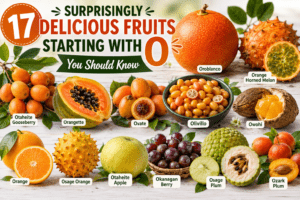
The best-known fruit starting with O is the orange. Other valid examples include olive, Ogen melon, Ogeechee lime, oil palm fruit, Olallieberry, Opal apple, Opuntia fruit, Orangelo, Oregon grape, Oroblanco, Ortanique, Osteen mango, Otaheite gooseberry, oval kumquat, and O’Henry peach.
Current list-style competitors commonly publish between 14 and 34 examples, but they often mix culinary fruits, botanical fruits, and named cultivars without clearly separating them.
| Fruit | Typical flavor | Best use |
| Orange | Sweet and tangy | Fresh, juice, desserts |
| Olive | Savory after curing | Salads, tapenade, oil |
| Okra | Mild and grassy | Stews, roasting, frying |
| Ogen melon | Sweet and aromatic | Chilled snacks, fruit salad |
| Ogeechee lime | Sharp and acidic | Drinks and preserves |
| Oil palm fruit | Rich and oily | Extracted cooking oils |
| Olallieberry | Sweet-tart | Pies, jam, fresh eating |
| Opal apple | Crisp and sweet | Snacks and salads |
| Opuntia fruit | Mildly sweet | Fresh, juice, sorbet |
| Orangelo | Sweet citrus | Juice and salads |
| Oregon grape | Very tart | Jelly, syrup, preserves |
| Oroblanco | Sweet, low-acid citrus | Fresh eating |
| Ortanique | Rich and sweet-tart | Juice and segments |
| Osteen mango | Sweet and smooth | Fresh eating and salsa |
| Otaheite gooseberry | Intensely sour | Pickles and chutney |
| Oval kumquat | Sweet peel, tart flesh | Whole snack, marmalade |
| O’Henry peach | Sweet and juicy | Fresh eating and baking |
Why Some Fruits Starting With O Look Like Vegetables
Botanical and culinary language don’t always agree. Botanically, fruits develop from flowers and contain seeds. In the kitchen, people usually reserve “fruit” for sweet or tart produce.
That’s why okra can correctly appear on a botanical fruit list even though nobody expects it in a fruit salad.
For search intent, the clearest approach is to include both groups and label them honestly. It prevents cultivars, berries, hybrids, and savory seed pods from being presented as though they were exactly the same thing.
Common Fruits Starting With O
1. Orange
Orange is the easiest answer. Sweet oranges include familiar types such as navel, Valencia, and blood orange. They work in breakfasts, salads, cakes, sauces, marinades, and drinks.
One medium orange provides about 66 calories, 2.8 grams of fiber, and a substantial amount of vitamin C. Whole fruit also retains more fiber than orange juice.
Orange earns the top spot because it is affordable, widely available, and useful without a complicated recipe. Add segments to yogurt, grate zest into cake batter, or squeeze the juice into a simple homemade dressing.
2. Olive
An olive is a drupe, the same broad stone-fruit structure found in peaches and cherries. Fresh olives are extremely bitter, so they are normally cured before eating or pressed for olive oil.
That processing detail matters. Olives picked directly from a tree don’t taste like the jarred version. Curing turns them into the salty, savory ingredient used in Mediterranean salads, breads, pasta dishes, pizzas, and tapenade.fruit starting O
3. Okra
Okra is botanically a fruit because its pod develops from a flower and holds seeds. In cooking, however, it behaves like a vegetable.
Its natural mucilage thickens gumbo, soups, and stews. Roasting, grilling, air-frying, or quickly sautéing okra creates a drier texture that many people find more enjoyable. Competitor food guides include it because of its botanical classification.
Rare and Unusual Fruits Starting With O
4. Ogen Melon
Ogen melon, sometimes called Ha’Ogen, is a small muskmelon with pale green flesh, a fragrant aroma, and gentle sweetness. It was selected and popularized in Israel during the twentieth century.
Think of it as a more aromatic alternative to an ordinary cantaloupe. Serve it chilled, pair it with fresh mint, or add it to a fruit salad where its delicate perfume won’t be hidden beneath heavy syrup.
5. Ogeechee Lime
Despite its name, Ogeechee lime is not a true citrus lime. It is the acidic red fruit of the Ogeechee tupelo tree, which grows in parts of the southeastern United States.
USDA and university sources describe the fruit as edible, sharply acidic, and suitable as a lime substitute in beverages, preserves, and other recipes.
This is one of the most interesting fruits beginning with O because its common name suggests citrus, while the plant belongs to an entirely different botanical group.
6. Oil Palm Fruit
Oil palm fruit grows in dense bunches of reddish-orange, purple, or dark fruits. Its flesh and kernel are processed into different oils, so people usually encounter it as an ingredient rather than a whole snack.
It belongs on this list because of its culinary and agricultural importance, especially in parts of Africa and Southeast Asia. Still, it should be described honestly: oil palm fruit is not a typical lunchbox fruit.
7. Olallieberry
Olallieberry is a dark caneberry hybrid related to blackberries. It has a juicy, sweet-tart flavor that suits pies, cobblers, jams, syrups, smoothies, and fresh desserts.
It can be difficult to find outside the regions where it is grown. When available, use it much like a blackberry. Its bright acidity is especially useful in desserts because it prevents the final dish from tasting excessively sweet.
8. Opal Apple
Opal is a yellow apple cultivar developed from Golden Delicious and Topaz parentage. Its flesh is crisp, sweet, mildly acidic, and naturally slower to brown after cutting than many ordinary apples.
This quality makes Opal apples convenient for lunchboxes, cheese boards, fruit platters, and salads. Opal is also a good reminder that some fruits beginning with O are named cultivars rather than completely separate fruit species.
9. Opuntia Fruit
Opuntia is a cactus genus whose edible fruit is commonly called prickly pear or cactus pear. Depending on the species and variety, the fruit may appear green, yellow, orange, red, or purple.
The flesh is usually mildly sweet and can be eaten fresh or transformed into juice, syrup, jelly, jam, or sorbet. National Park Service resources confirm that many prickly pear fruits are edible and have long been used as food.
Handle uncleaned fruit carefully. Tiny outer bristles and spines can irritate the skin, so buying properly cleaned fruit is often the easiest option.
10. Orangelo
Orangelo, sometimes called chironja, is associated with orange and grapefruit parentage. Its flavor generally falls between the two fruits.
It tends to be sweeter and less bitter than many grapefruits, yet slightly sharper and more complex than a regular sweet orange. This balance makes it particularly suitable for juice, citrus salads, marinades, and refreshing desserts.
11. Oregon Grape
Oregon grape is not a true grape. It is a dark blue berry produced by an evergreen shrub with holly-shaped leaves.
Oregon State University describes the raw berries as quite tart and recommends using them in jams and jellies. Their natural sharpness can also work in syrups, sauces, and sweetened preserves.
The word “grape” describes the clustered appearance of the berries. It does not mean the plant is closely related to the grapes commonly sold in supermarkets.
12. Oroblanco
Oroblanco is a seedless grapefruit-pummelo hybrid developed at the University of California. It is sweet, juicy, and lower in acid than many traditional grapefruits.
That makes it an excellent choice for people who enjoy citrus but dislike the bitterness of regular grapefruit. Remove the thick peel and membranes before eating the pale, juicy segments.
One caution is important. Grapefruit and grapefruit juice can affect how certain medicines work. Anyone taking medication that carries a grapefruit warning should ask a pharmacist or medical professional whether grapefruit-like hybrids are appropriate.
13. Ortanique
Ortanique is a tangor, meaning it belongs to the mandarin and sweet-orange hybrid group. It is known for juicy flesh, a rich citrus aroma, and a pleasantly balanced sweet-tart taste.
The University of California Citrus Variety Collection identifies Ortanique among its recognized citrus accessions.
Its peel can be tighter than that of a clementine, but the flavor usually makes the extra effort worthwhile. Enjoy the segments fresh or squeeze the fruit for aromatic juice.
14. Osteen Mango
Osteen is a mango cultivar that originated in Florida and later became commercially important in southern Europe, particularly Spain.
Research describes it as a productive mango with attractive color, marketable size, good pulp quality, and relatively uniform fruit. Its smooth, sweet flesh is best eaten fresh, added to fruit platters, or used in mango salsa.
Because Osteen is a cultivar rather than a separate species, its availability depends heavily on location and harvest season.
15. Otaheite Gooseberry
Otaheite gooseberry, also called star gooseberry or Malay gooseberry, produces small, ribbed, pale yellow fruits.
The fruit is edible but sharply acidic. For that reason, it is often more enjoyable in chutney, pickles, syrup, jam, candy, or preserves than eaten plain.
Trying one raw may be a face-puckering experience. However, that same strong acidity adds brightness and balance when the fruit is cooked with sugar, salt, or spices.
16. Oval Kumquat
Oval kumquat, commonly associated with the Nagami type, is a small citrus fruit that can be eaten whole.
Its thin peel is sweet and aromatic, while the inner flesh is noticeably tart. Eating the peel and flesh together creates the fruit’s characteristic sweet-sour balance. fruit starting O
Wash kumquats thoroughly before eating. They can also be sliced into salads, simmered into marmalade, candied, baked into cakes, or used as a colorful garnish. The University of California maintains Nagami and other kumquat types in its citrus collection.
17. O’Henry Peach
O’Henry is a large, yellow-fleshed freestone peach. The word “freestone” means the flesh separates relatively easily from the pit, making the fruit convenient for slicing, grilling, canning, and baking.
University of California horticultural guidance identifies O’Henry as a large, yellow-fleshed, high-quality peach cultivar.
Its firm, sweet flesh works well when eaten fresh or baked into pies and cobblers. Choose fruit with a noticeable peach aroma and slight softness near the stem. A completely hard peach usually needs additional ripening time.
Is Osage Orange an Edible Fruit Starting With O?
Osage orange appears in many long competitor lists. Botanically, it is certainly a fruit beginning with O, but it should not be presented beside oranges and peaches as a normal edible fruit.
The large, wrinkled fruit is generally considered inedible. It also contains milky latex that may irritate the skin.
That distinction matters. A trustworthy alphabet guide should separate “technically a fruit” from “commonly eaten as fruit” instead of chasing the largest possible number.
How to Choose the Best O Fruit
For a school worksheet or alphabet game, use orange, olive, Opal apple, Osteen mango, oval kumquat, and O’Henry peach. They are relatively easy to explain, spell, and illustrate. fruit starting O
For adventurous eating, try Oroblanco, Ogen melon, Opuntia fruit, Olallieberry, or Otaheite gooseberry.
Oregon grape and Ogeechee lime make more sense in preserves and drinks than as raw snacks. Oil palm fruit is most important for the oils extracted from it, while okra belongs mainly in savory cooking.
A useful rule is to check whether each name refers to a species, cultivar, hybrid, or common nickname. That one step separates a reliable fruit guide from a copied alphabetical list.
Suggested Image ALT Text
- “Fresh orange slices and rare fruits starting with O”
- “Oroblanco, oval kumquat, Opal apple, and Osteen mango”
- “Edible fruits beginning with the letter O alphabet chart”
- “Sweet and sour fruit varieties starting with O”
- “Orange, olive, Ogen melon, and prickly pear fruit display”
FAQs About Fruit Starting With O
What is the most common fruit starting with O?
Orange is the most common and recognizable answer. It is widely available and can be eaten fresh or used in juice, desserts, salads, sauces, marinades, and savory dishes.
Are olives really fruits?
Yes. Olives are drupes, commonly known as stone fruits. They are normally cured before eating because raw olives contain compounds that make them intensely bitter.
Is okra a fruit or a vegetable?
Botanically, okra is a fruit because its seed-containing pod develops from a flower. In culinary language, it is treated as a vegetable because it is savory and commonly used in main dishes.
What rare fruit starts with O?
Oroblanco, Otaheite gooseberry, Olallieberry, Ogen melon, and Ogeechee lime are good rare examples. Availability varies according to climate, growing region, season, and local produce markets.
Which fruit starting with O is the sweetest?
Ripeness and variety affect sweetness, but Ogen melon, Opal apple, Osteen mango, O’Henry peach, and Oroblanco are among the sweeter choices on this list.
Which O fruit is best for making jam?
Oregon grape, Olallieberry, Otaheite gooseberry, Ogeechee lime, and oval kumquat are excellent candidates. Their natural acidity helps balance the sugar used in jams, jellies, and preserves.
What citrus fruits begin with O?
Orange, Orangelo, Oroblanco, Ortanique, Orlando tangelo, and oval kumquat are citrus examples beginning with O. Some are recognized species or groups, while others are named hybrids or cultivars.
Which fruit starting with O is suitable for children?
Orange segments, peeled Opal apple slices, ripe Osteen mango, and soft O’Henry peach are approachable options. Pits, hard seeds, tough peel, and other choking hazards should be removed according to the child’s age.
Conclusion
A fruit starting with O can be as ordinary as an orange or as unexpected as an Ogeechee lime. The strongest answers include familiar fruits, named cultivars, citrus hybrids, wild berries, and botanical fruits such as okra.
The goal isn’t merely to collect as many names as possible. A genuinely helpful guide explains what each fruit is, how it tastes, how people use it, and whether it is actually suitable for eating.
Start with orange for the easiest answer. Choose Oroblanco or oval kumquat for an unusual citrus experience, Ogen melon for fragrance, Osteen mango for tropical sweetness, or Oregon grape for homemade preserves.
The letter O may have fewer famous fruits than A or P, but its list is certainly not boring.