

Receiving an unexpected call from 8033299791 can naturally make you cautious. You may wonder who owns the number, why the caller is trying to reach you, whether the call is legitimate, or whether answering could expose you to a scam.
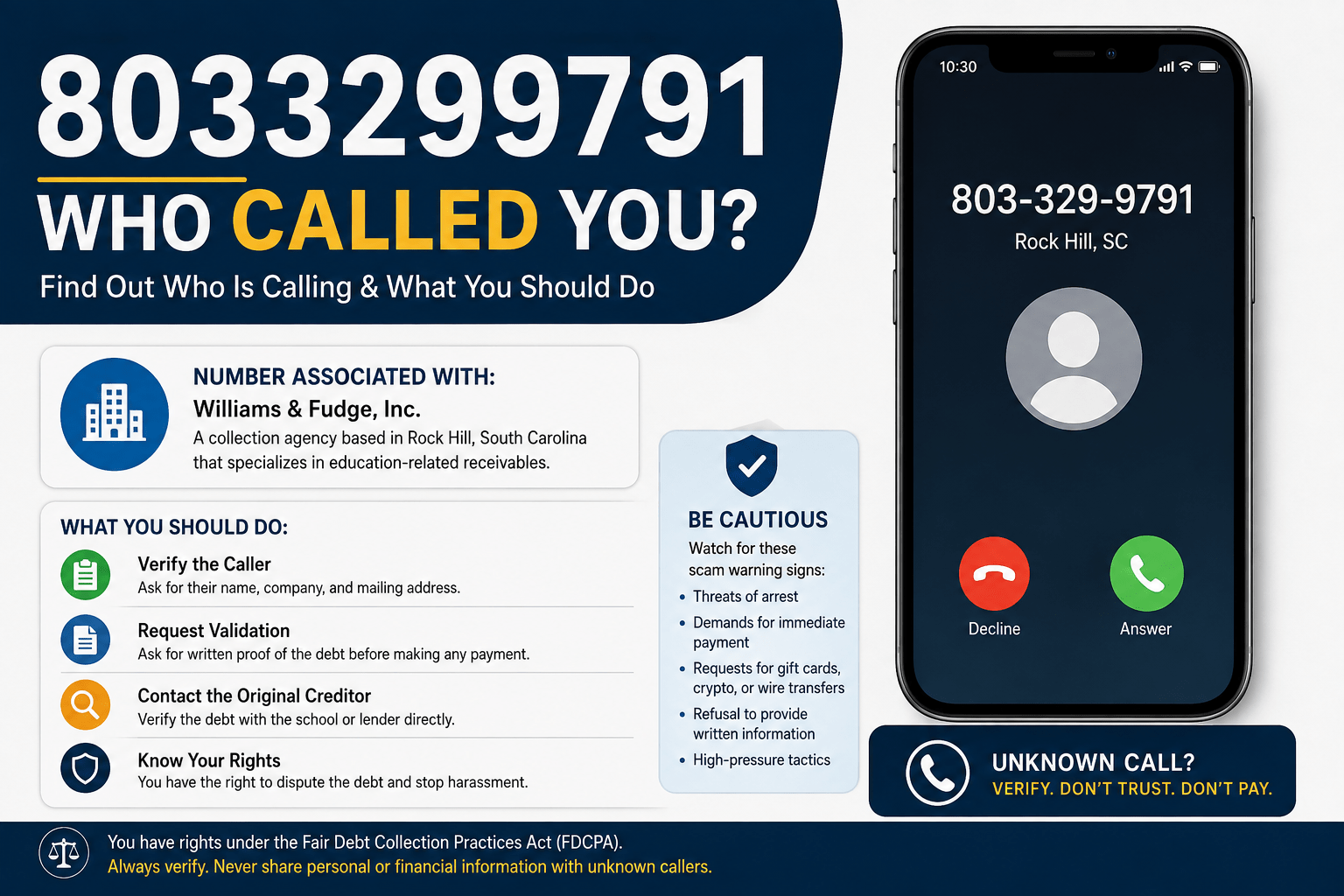
Publicly available business and government records connect 803-329-9791 with Williams & Fudge, Inc., a collection company based in Rock Hill, South Carolina. A South Carolina government contract record lists Williams & Fudge at 300 Chatham Avenue in Rock Hill and identifies (803) 329-9791 as its telephone number. The Better Business Bureau also displays the same number on the company’s business profile. mber appearing to belong to a real company does not automatically prove that every call displaying it is genuine. Caller ID information can be manipulated through a practice known as spoofing. Therefore, you should verify the caller independently before sharing personal information or making a payment.
This guide explains what is publicly known about 8033299791, why the number may be calling, how to recognize warning signs, and what steps you can take to protect yourself.
Who Does 8033299791 Belong To?
Search results and public business records associate 8033299791 with Williams & Fudge, Inc.
Williams & Fudge describes itself as a family-owned company founded in 1986 that serves the higher-education community. Its services focus on recovering education-related receivables for colleges and other institutions. tates that the accounts it handles may include:
- Unpaid college tuition
- Perkins loans
- Campus-based institutional loans
- Private education loans
- Nursing and health-profession loans
- Unpaid room and board charges
- Library fines
- Parking charges
- Other institutional receivables
Therefore, a call from a person claiming to represent Williams & Fudge may relate to a college, university, education loan, campus balance, or another account assigned for collection.
This does not mean that you necessarily owe the debt. Records can contain errors, accounts may be assigned to the wrong person, and scammers can impersonate legitimate organizations. Verification should always come before payment.
Is 8033299791 a Scam Number?
Based on available public records, 803-329-9791 is associated with an established collection company rather than an anonymous or unlisted caller. The number appears in a South Carolina government vendor record and on a BBB business profile. it would be inaccurate to conclude that every call displaying 8033299791 is automatically safe.
The Federal Communications Commission explains that caller ID spoofing allows a caller to falsify the information appearing on a recipient’s phone. A scammer could therefore make a call appear to originate from a legitimate company, government agency, bank, or local business. lusion is:
8033299791 is publicly linked to a real collection company, but any individual call should still be independently verified.
Do not rely only on the name or phone number shown on your screen.
Why Might 8033299791 Be Calling You?
There are several possible reasons you may receive a call from this number.
An Education-Related Account
Williams & Fudge primarily works with educational institutions. The call may concern an unpaid tuition balance, institutional loan, campus fee, room-and-board charge, or another education-related receivable. longing to Someone Else
Collection calls sometimes reach the wrong person because of outdated phone records, recycled mobile numbers, similar names, or incorrect contact information.
You should not assume responsibility for a debt simply because a caller has your number.
An Old or Forgotten Balance
The account may relate to a school you attended years ago. Before acknowledging or paying an old debt, request complete information about the creditor, balance, account history, and relevant dates.
The FTC notes that the statute of limitations for collecting a debt through legal action varies by debt type and state. In some states, making a payment or acknowledging an old debt in writing may restart the limitations period. or Impersonation Call
The caller may be using a legitimate company’s number without authorization. This is why independently contacting the company through a verified channel is safer than immediately returning the incoming call.
What to Do When 8033299791 Calls
You do not need to panic, argue, or pay immediately. Follow a structured verification process instead.
1. Ask the Caller to Identify the Company
Request the caller’s:
- Full name
- Company name
- Department
- Mailing address
- Direct callback extension
- Name of the original creditor
- General reason for the call
Do not provide your Social Security number, banking details, card number, online passwords, or one-time verification codes.
2. Do Not Confirm Sensitive Details Immediately
A caller may ask you to confirm your date of birth, address, Social Security number, school history, or account information.
It is reasonable to ask the caller to explain what information is already on file before you reveal additional details. Never provide a full Social Security number or payment information merely to discover why someone called.
3. Request Debt Validation Information
When a debt collector first contacts a consumer, it is generally required to provide certain validation information during the initial communication or within five days. This information normally includes the creditor’s name, the amount claimed, and instructions explaining how to dispute the debt. otice in writing before discussing payment.
A proper validation notice should help you understand:
- Who currently claims the debt
- Who the original creditor was
- The amount being claimed
- How the amount was calculated
- How to dispute the debt
- Where to send a written dispute
4. Verify the Company Independently
Do not use a callback number supplied only through an unexpected voicemail or text message.
Look up the company through an independently verified business listing or its official website. Williams & Fudge’s official website lists its Rock Hill address and a separate main contact number, 1-800-849-9791. verified main number and asking whether the company attempted to reach you can reduce the risk of responding to an impersonator.
5. Contact the Original Creditor
Contact the college, university, lender, or institution named by the caller using contact information from its official website or your original documents.
Ask whether:
- The account belongs to you
- The balance is accurate
- The account was assigned to Williams & Fudge
- The institution still owns the debt
- Payments should be made through the institution or the collector
The FTC recommends checking directly with the original creditor when you receive a collection call about a debt you do not recognize. Written Call Log
Record the following information after each interaction:
- Date and time
- Number displayed
- Caller’s name
- Company claimed
- Account or reference number
- Original creditor named
- Amount requested
- Payment method requested
- Threats or promises made
- Copies of letters, emails, texts, and voicemails
A written record can be useful if you need to dispute the account or submit a complaint.
A Safe Script for Answering the Call
You can use this response without admitting that the debt belongs to you:
“Please provide your full name, company name, mailing address, the name of the original creditor, and written validation information for the account. I will review the documentation and contact the company through an independently verified number. I am not authorizing a payment during this call.”
This response keeps the conversation controlled and avoids making an immediate financial commitment.
Warning Signs of a Fake Debt Collection Call
Even when the caller ID displays 8033299791, end the call if the person:
- Refuses to identify the company
- Will not provide a mailing address
- Refuses to send validation information
- Demands immediate payment
- Threatens arrest or criminal charges
- Claims police are already on the way
- Uses abusive or intimidating language
- Requests gift cards, cryptocurrency, or wire transfers
- Asks for online banking credentials
- Demands a one-time password sent to your phone
- Tells you not to contact the original creditor
- Pressures you to keep the call secret
The FTC identifies refusal to provide contact information, pressure tactics, debts the consumer does not recognize, and threats of arrest as common warning signs of fake collectors. debt does not need to be paid through gift cards, cryptocurrency, or secret transfers.
Can You Dispute a Debt Connected to 8033299791?
Yes. Receiving a collection call does not remove your right to question the account.
After receiving validation information, consumers generally have 30 days to dispute all or part of the debt in writing. When a timely written dispute is submitted, the collector generally must stop collection activity until it provides verification. dispute can request:
- The original creditor’s name
- The original account number
- An itemized balance
- The date of the last payment
- Documents connecting you to the account
- Evidence that the collector is authorized to collect it
- Correction of inaccurate personal information
Keep a copy of everything you send. When mailing a dispute, using a trackable delivery method can help prove when it was received.
What If the Debt Is Not Yours?
Tell the collector clearly that you believe it has contacted the wrong person and that you dispute responsibility for the account.
Do not provide unnecessary personal data to prove that you are not the debtor. Ask the collector to update its records and communicate with you in writing.
Common causes of wrong-person collection calls include:
- Recycled phone numbers
- Family members with similar names
- Incorrect contact data
- Identity theft
- Outdated school records
- Data-entry errors
You may also review your credit reports for unfamiliar accounts. If the debt appears there incorrectly, dispute it separately with the credit-reporting company that displays it.
Can You Stop Calls From 803-329-9791?
You may block the number on your phone, but blocking alone does not resolve a legitimate account. It only prevents calls from that particular number from reaching you.
For a more complete approach:
- Determine whether the debt belongs to you.
- Request written validation.
- Dispute inaccurate information.
- Ask the collector to communicate in writing.
- Preserve records of all interactions.
- Report harassment or deception.
The FTC states that consumers can send a written request instructing a debt collector to stop contacting them. However, stopping communication does not erase a valid debt, and the collector may still use other lawful methods, such as notifying the consumer about specific legal action. Collectors Are Not Allowed to Do
Debt collectors cannot legally use harassment, deception, or unfair treatment to force payment. The FTC emphasizes that collectors may not harass consumers, lie about the debt, or treat them unfairly, even when a real debt is owed. so generally cannot disclose your debt to relatives, friends, coworkers, or employers. They may contact another person in limited circumstances to obtain your location or contact information, but federal law generally restricts them from revealing the debt itself. conduct involving:
- Repeated calls intended to harass
- Threats of violence
- False claims of being a government official
- False arrest threats
- Public disclosure of the debt
- Misrepresentation of the balance
- Contact at prohibited times or locations
- Continued collection after a qualifying written dispute without verification
Where to Report a Problem
When you believe a collector or impersonator has acted illegally, you may submit a complaint to:
- The Consumer Financial Protection Bureau
- The Federal Trade Commission
- The Federal Communications Commission for spoofed or unwanted calls
- Your state attorney general
- Your state’s financial-services or collection-agency regulator
The FCC accepts complaints concerning unwanted calls and caller ID spoofing, while the CFPB and FTC provide complaint and consumer-protection resources for debt collection matters. fication Checklist for 8033299791
Before paying anyone who calls from 8033299791, confirm all of the following:
- The caller provided a real company name.
- You received written validation information.
- The original creditor recognizes the account.
- The amount matches the creditor’s records.
- The collector is authorized to handle the account.
- You contacted the company through an independently verified channel.
- The caller did not demand an unusual payment method.
- You understand whether the debt is current, disputed, or potentially time-barred.
- Any settlement agreement is provided in writing before payment.
Failing any one of these checks does not automatically prove fraud, but it is a reason to pause and investigate further.
Conclusion
Public records associate 8033299791, formatted as 803-329-9791, with Williams & Fudge, Inc., a Rock Hill, South Carolina company that handles education-related receivables. Government and BBB records support that connection. ssociation does not guarantee that every incoming call displaying the number is authentic. Caller ID can be spoofed, account records can be incorrect, and legitimate company names can be used in impersonation scams.
The safest response is to avoid immediate payment, request written debt validation, independently contact the company and original creditor, keep detailed records, and dispute any account you do not recognize. A genuine collector should be able to provide clear documentation without relying on threats, secrecy, or high-pressure payment demands.
Frequently Asked Questions
Who called me from 8033299791?
Public business records connect 8033299791 with Williams & Fudge, Inc., a collection company based in Rock Hill, South Carolina. The company primarily serves colleges and other higher-education institutions. 791 a legitimate phone number?
The number appears in a South Carolina government vendor record and on the BBB profile for Williams & Fudge. However, you should still verify each call independently because caller ID numbers can be spoofed. liams & Fudge calling me?
The company may be trying to discuss an education-related balance such as unpaid tuition, an institutional loan, room and board, parking charges, library fines, or another account assigned by a school. all 803-329-9791 back?
Instead of relying only on the incoming number, contact Williams & Fudge through independently verified information and ask whether the company attempted to reach you. This helps protect against caller ID spoofing.
Should I pay the caller immediately?
No. Request written validation information and independently confirm the account with the original creditor before providing payment details.
What information should a debt collector provide?
A collector generally must provide information identifying the creditor, the amount claimed, and your right to dispute the debt during the initial communication or shortly afterward. ute the debt?
Yes. Consumers generally have 30 days after receiving validation information to submit a written dispute. A timely dispute generally requires the collector to pause collection until it provides verification. 33299791 keeps calling the wrong person?
Tell the caller that the person sought cannot be reached at your number and request that the record be corrected. Avoid providing sensitive personal information merely to prove that you are not the debtor.
Can a debt collector threaten to arrest me?
A collector cannot lawfully threaten arrest merely to force payment of a consumer debt. Threats involving police, jail, or immediate criminal charges are major warning signs of an abusive or fake collection call. k 8033299791?
Yes, you can block the number through your phone settings or carrier. However, blocking calls does not resolve a valid debt or correct an account assigned to the wrong person.
Where can I complain about the calls?
Depending on the problem, complaints may be submitted to the CFPB, FTC, FCC, your state attorney general, or the relevant state collection-agency regulator. This article provides general informational content and is not legal or financial advice. Debt-collection rights and limitation periods may vary by state and by the type of account involved.*