

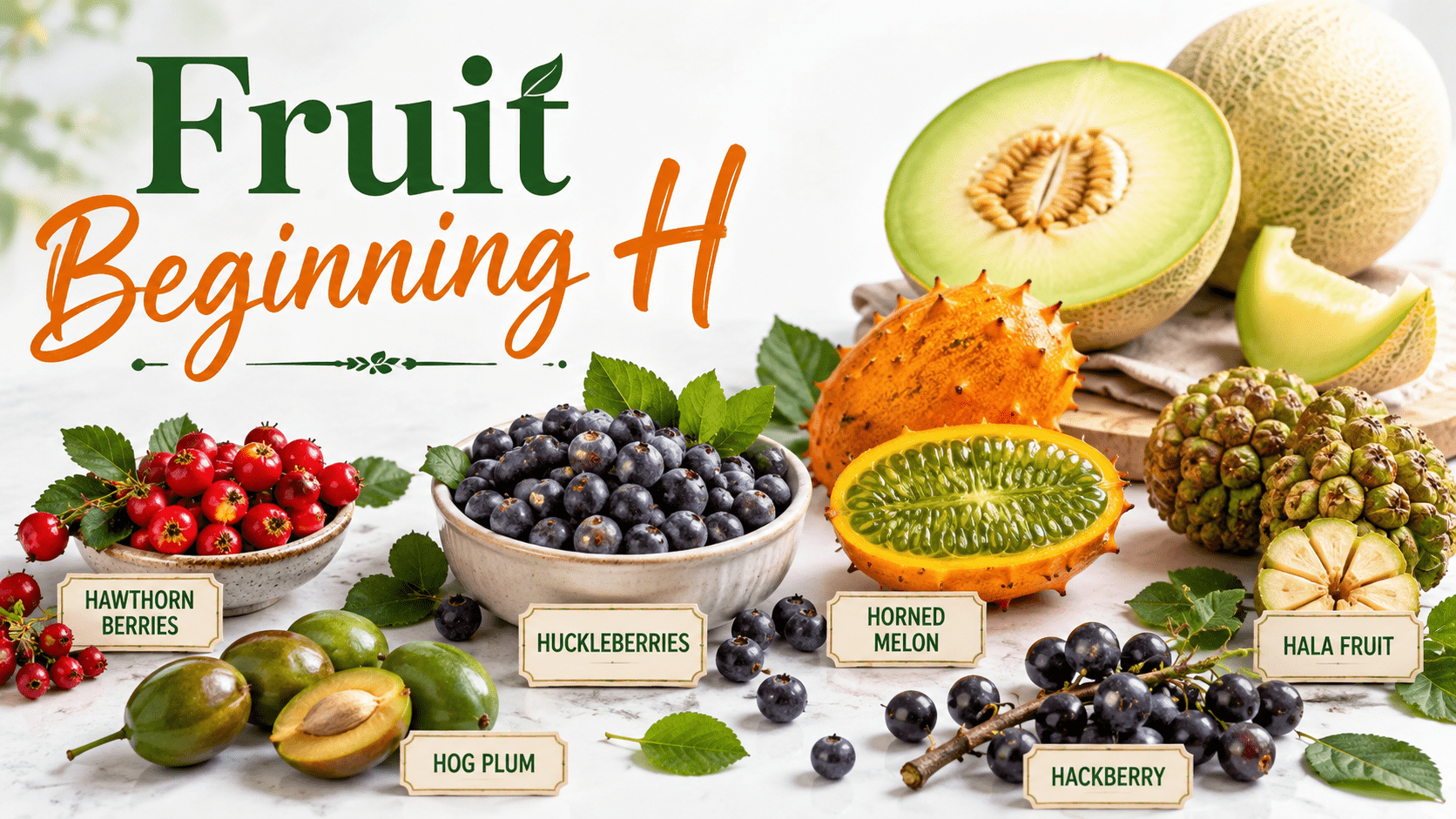
fruit beginning h? Honeydew probably comes to mind first. After that, things become a little trickier.
The letter H includes far more edible fruits than most people realize. Some are familiar supermarket choices, while others grow in tropical forests, cold northern gardens, Pacific islands, or Japanese citrus orchards. There are berries, melons, apples, citrus hybrids, and even a few foods commonly treated as vegetables.
This guide covers 19 genuine fruits that begin with H. More importantly, it explains their flavors, textures, origins, and practical culinary uses instead of giving you a padded list of unfamiliar names.
Quick List of Fruit Beginning With H
| Fruit name | Fruit type | Typical flavor |
| Honeydew melon | Melon | Mild, sweet and refreshing |
| Honeycrisp apple | Apple cultivar | Crisp, juicy and sweet-tart |
| Highbush blueberry | Berry | Sweet with light acidity |
| Huckleberry | Wild berry | Sweet-tart and earthy |
| Hardy kiwi | Kiwiberry | Sweet and tropical |
| Honeyberry | Edible honeysuckle berry | Tart, sweet and berry-like |
| Hackberry | Small stone fruit | Sweet, dry and nutty |
| Hawthorn berry | Pome fruit | Tart, mealy or mildly sweet |
| Horned melon | Tropical melon | Mild, citrusy and cucumber-like |
| Hala fruit | Tropical compound fruit | Sweet and fragrant |
| Hawaiian mountain apple | Tropical tree fruit | Crisp, juicy and delicate |
| Hog plum | Stone fruit | Tart to sweet-tart |
| Huito | Tropical berry | Sour and strongly flavored |
| Hachiya persimmon | Persimmon cultivar | Rich and honey-sweet when ripe |
| Hassaku | Japanese citrus | Sweet-tart with mild bitterness |
| Hyuganatsu | Japanese citrus | Fragrant, sweet and acidic |
| Heirloom tomato | Botanical fruit | Sweet, savory and acidic |
| Husk tomato | Physalis fruit | Sweet-tart and tropical |
| Hazelnut | Dry botanical fruit | Rich, buttery and nutty |
Current high-ranking pages include between 15 and more than 30 H fruit names. However, some count honeyberry and haskap separately even though both names generally refer to forms of Lonicera caerulea. Others list generic honeysuckle berries without explaining that not every honeysuckle species is edible.
Why Fruit Lists Beginning With H Can Be Confusing
Fruit classification depends on context. In botany, a fruit is a seed-bearing structure that develops from the ovary of a flowering plant. Culinary language is different. It usually describes sweet or tart produce eaten raw or used in desserts.
That is why tomatoes and hazelnuts can appear in an alphabetical fruit list. A tomato is botanically a fruit, although cooks normally use it like a vegetable. A hazelnut is also a type of dry fruit, but most people simply call it a nut.
Cultivars create another grey area. Honeycrisp apples and Hachiya persimmons are not separate fruit species. They are named varieties. Still, they are valid answers when someone asks for a fruit name that begins with H.
Familiar Fruits Beginning With H
1. Honeydew Melon
Honeydew is the easiest H fruit to find in an ordinary supermarket. A ripe melon usually has smooth, pale skin and juicy light-green flesh. Its sweetness is gentle rather than overpowering, which makes it useful in fruit salads, cold drinks, breakfast bowls, and frozen desserts.
Serve honeydew properly chilled with lime juice or fresh mint. That small touch gives its mild flavor considerably more personality. The World Cancer Research Fund also includes honeydew in its alphabetical guide to culinary fruits.
2. Honeycrisp Apple
Honeycrisp is an apple cultivar known for its loud crunch and balanced sweet-tart flavor. It contains plenty of juice, so it works particularly well as a fresh snack.
Thin slices hold up nicely in salads and cheese boards. Honeycrisp can also be baked, although its juicy flesh may create more liquid than firmer cooking apples. Unlike a separate species, Honeycrisp is simply one recognizable variety within the wider apple family.
3. Highbush Blueberry
Highbush blueberries are among the most commercially important cultivated blueberries. The plants are native to eastern North America and are grown for their edible blue-black berries.
Their flavor varies with ripeness and cultivar. Some berries are richly sweet, while others carry noticeable acidity. Use them fresh, frozen, baked into muffins, blended into smoothies, or simmered into a quick compote.
4. Heirloom Tomato
An heirloom tomato is a botanical fruit beginning with H, even though it sits in the vegetable section of most supermarkets.
“Heirloom” describes traditionally preserved tomato varieties rather than one specific fruit. Shapes, colors, and flavors can vary dramatically. Some are deeply ribbed and intensely savory, while others are yellow, purple, green, or almost black.
They taste best in simple dishes where their natural flavor remains noticeable, such as salads, sandwiches, bruschetta, and fresh salsa.
Berries and Small Fruits That Start With H
5. Huckleberry
Huckleberries are closely related to blueberries, although they are usually gathered from wild or semi-wild plants rather than large commercial farms.
Their flavor is often stronger and more complex than that of an ordinary blueberry. Oregon State University recommends using huckleberries in pies, muffins, breads, jams, jellies, syrups, and other recipes that normally call for blueberries.
Fresh huckleberries can be difficult to find outside their growing regions. Frozen berries or preserves are often more realistic options.
6. Hardy Kiwi
Hardy kiwi, also called kiwiberry, looks like a miniature smooth-skinned kiwifruit. Unlike fuzzy supermarket kiwi, it doesn’t normally need peeling.
The University of Minnesota describes kiwiberries as grape-sized fruits with thin skin and a flavor similar to fuzzy kiwi, though often a little sweeter.
Eat them whole, slice them into yogurt, or add them to a fruit platter. The smooth exterior and bite-sized shape make them especially convenient.
7. Honeyberry or Haskap
Honeyberry and haskap are usually names for edible forms of Lonicera caerulea. The elongated blue fruit looks like a blueberry that has been gently stretched.
Its flavor can suggest blueberry, raspberry, and currant at the same time. Utah State University describes ripe haskap fruit as deeply blue inside and outside, with a mixed raspberry, blueberry, and currant flavor.
Honeyberries work in jam, sauce, baked goods, yogurt, and smoothies. Remember, though, that this doesn’t make every honeysuckle berry safe to eat.
8. Hackberry
Hackberries are small fruits produced by trees in the Celtis genus. They contain a relatively large hard seed surrounded by a thin layer of sweet flesh.
The texture is drier and crunchier than a blueberry or grape. Some people describe the combination of sweet pulp and hard seed as slightly date-like or nutty.
Hackberries are more important as wild food and wildlife forage than as commercial produce. Proper identification is essential before eating any unfamiliar wild fruit.
9. Hawthorn Berry
Hawthorn fruits, often called haws, grow on trees and shrubs in the Crataegus genus. Different species produce fruits with noticeably different textures and flavors.
Some are dry and mealy, while others are tart or pleasantly sweet. North Carolina State University notes that several hawthorn species produce edible fruits suitable for eating raw, cooking, drying, pies, and preserves.
Hawthorn is especially useful for jelly because its tartness works well with added sugar.
Rare and Tropical Fruit Beginning With H
10. Horned Melon
Horned melon is also called kiwano, jelly melon, or African horned cucumber. It has a bright orange shell covered in dramatic spikes and a green, jelly-like interior.
The fruit is native to tropical and southern Africa, and its accepted botanical name is Cucumis metuliferus.
Its flavor is mild, with notes often compared to cucumber, lime, banana, or zucchini. Scoop out the pulp and use it in drinks, yogurt, salsa, fruit salads, or desserts.
11. Hala Fruit
Hala fruit grows on Pandanus tectorius, a striking tropical tree found across Hawaii and other Pacific regions.
The fruit is made from numerous wedge-shaped sections called keys. Its appearance falls somewhere between a pineapple and a brightly colored pinecone. The University of Hawaii notes that hala fruit has traditionally been eaten in several forms, while the tree’s leaves are widely used for weaving.
It is fibrous and requires more effort to eat than a mango or banana, so it remains a regional specialty rather than a global supermarket fruit.
12. Hawaiian Mountain Apple
Hawaiian mountain apple is a tropical fruit from Syzygium malaccense. Depending on the variety, its skin may appear crimson, pink, pale green, or white.
The flesh is crisp, pale, watery, and pleasantly mild. University of Hawaii material describes the fruit as juicy with a delicate flavor, while also noting that it bruises easily and is highly perishable.
It is best eaten fresh soon after harvesting. It can also be used in sauces, preserves, pickles, and jelly.
13. Hog Plum
The name hog plum is used for more than one plant, which can cause confusion. It may refer to tropical Spondias fruits or to certain native North American plums.
Tropical hog plums generally have yellow or reddish skin, edible pulp, and a large fibrous stone. Their taste ranges from mellow to tangy. University of Florida sources describe hog plums as suitable for raw eating, juice, jelly, pies, and preserves.
Because the common name covers different species, checking the scientific name is worthwhile.
14. Huito
Huito, also called jagua or genipap, is the fruit of Genipa americana. Kew Science identifies its natural range as southern Mexico through tropical America and confirms its use as food.
Ripe huito has a sour, strongly flavored pulp. It is more commonly processed into drinks, syrups, jelly, wine, preserves, or desserts than eaten as an everyday fresh snack.
Unripe huito is also known for producing a dark blue-purple natural pigment.
Japanese Citrus and Persimmon Fruits Beginning With H
15. Hachiya Persimmon
Hachiya is an acorn-shaped astringent persimmon. It may look ready when its skin turns orange, but eating it while firm creates an intensely dry, puckering sensation.
It should be allowed to soften until the flesh feels almost like gel. At that stage, the pulp becomes rich, smooth, and remarkably sweet. University of California guidance recommends fully ripening Hachiya persimmons before eating or using their soft pulp in baking, smoothies, and fruit leather.
16. Hassaku
Hassaku is a Japanese citrus fruit with characteristics associated with pomelo and mandarin ancestry.
It has a thick peel, firm segments, bright acidity, and a slight bitterness. The University of California Riverside Citrus Variety Collection classifies Hassaku among its pummelo hybrids.
It can be eaten fresh, added to salads, or used in marmalade and citrus desserts. Removing the thick membranes generally improves the eating experience.
17. Hyuganatsu
Hyuganatsu is another Japanese citrus listed in the University of California Riverside collection among pummelo-related hybrids.
Its yellow rind and fragrant acidity may suggest a grapefruit or lemon, but the flesh is usually gentler and more aromatic. Traditionally, some of the white pith is left attached because it can soften the fruit’s sharpness.
Serve thin slices with a little sugar, use the juice in dressings, or add segments to seafood and green salads.
Unusual Botanical Fruits Beginning With H
18. Husk Tomato
Husk tomato is a broad common name associated with fruits in the Physalis genus, including tomatillos and ground cherries.
These fruits develop inside papery husks. Ripe ground cherries are generally small, golden, sweet, and suitable for eating raw, cooking, or drying.
Only properly identified, fully ripe fruits should be eaten. North Carolina State University warns that unripe Physalis fruits and other plant parts may be poisonous.
19. Hazelnut
A hazelnut is botanically a dry fruit containing one seed, although culinary language places it firmly in the nut category.
Its rich, buttery flavor appears in praline, chocolate spreads, cakes, biscuits, nut butter, and savory sauces. Toasting hazelnuts deepens their aroma and makes their thin brown skins easier to remove.
It may not belong in a conventional fruit salad, but it is still a technically accurate answer to an alphabet-based fruit question.
How to Choose the Best H Fruit
Choose honeydew, Honeycrisp, blueberries, or heirloom tomatoes when you need something familiar and easily available.
Hardy kiwi, honeyberry, and huckleberry are excellent choices for berry lovers. Horned melon provides the most dramatic appearance, while Hachiya persimmon offers one of the richest flavors—but only after complete ripening.
Hala fruit, huito, and Hawaiian mountain apple may require a tropical produce seller or regional market. Hassaku and Hyuganatsu are more likely to appear at Japanese grocery stores during their harvest seasons.
For wild berries, never rely on a common name or online photograph alone. Correct species identification matters more than adding another unusual fruit to your tasting list.
Suggested Image ALT Text
- “Fresh fruits beginning with H arranged on a wooden table”
- “Honeydew, huckleberry and horned melon fruits starting with H”
- “Rare tropical fruit beginning with H including hala and huito”
- “Hachiya persimmon and Hassaku Japanese citrus fruit”
- “Alphabetical chart of edible fruits that start with H”
FAQs About Fruit Beginning With H
What is the most common fruit beginning with H?
Honeydew melon is probably the most recognizable answer. It is widely sold, easy to prepare, and suitable for snacks, fruit salads, smoothies, cold drinks, and desserts.
What sweet fruit starts with H?
Honeydew, Honeycrisp apple, ripe Hachiya persimmon, hardy kiwi, honeyberry, and ground cherry can all taste sweet. Hachiya persimmons are particularly rich when allowed to become completely soft.
What tropical fruit begins with H?
Hala fruit, horned melon, Hawaiian mountain apple, hog plum, and huito are tropical examples. Their availability varies considerably by country and season.
Are haskap and honeyberry different fruits?
They are generally treated as names for edible selections or varieties of Lonicera caerulea. Using both as separate list entries can make an H fruit list appear longer than it really is.
Is a horned melon safe to eat?
Yes, cultivated horned melon is an edible fruit. Most people cut it in half and scoop out the green pulp and seeds. Its spiky exterior should be handled carefully.
Is every honeysuckle berry edible?
No. Honeyberry is produced by edible forms of Lonicera caerulea, but the common name “honeysuckle” covers many species. Never assume an unidentified honeysuckle berry is safe merely because honeyberries are edible.
Is Hachiya persimmon edible while firm?
Hachiya persimmon is extremely astringent while firm. It should normally be left at room temperature until it becomes very soft and nearly translucent.
Which H fruit is best for jam?
Huckleberry, honeyberry, hawthorn, hog plum, and mountain apple all work well in jam or jelly. Tart fruits are particularly useful because their acidity balances added sugar.
Conclusion
Finding a fruit beginning with H is easier once you look beyond honeydew. The letter includes familiar choices such as Honeycrisp apples and highbush blueberries, alongside unusual fruits such as hala, huito, Hassaku, and horned melon.
The most useful fruit lists don’t simply chase a large number. They explain whether each name represents a species, cultivar, regional nickname, botanical fruit, or genuinely practical food.
Begin with honeydew for something familiar, try hardy kiwi for easy snacking, choose Hachiya persimmon for intense sweetness, or open a horned melon when you want a fruit that becomes an instant conversation starter.