

The CARR contracted ARR definition SaaS teams generally use is the annualized value of recurring revenue covered by signed customer contracts, including subscriptions that are active today and contracts scheduled to begin later.
CARR gives founders, finance leaders, investors, and revenue teams a forward-looking view of contracted recurring business. It answers a different question from standard ARR: not simply “What recurring revenue is live?” but “What recurring revenue has already been contractually secured?”
However, CARR is not calculated identically by every SaaS company. To report it responsibly, a business must document exactly which contracts, expansions, churn events, usage commitments, and future start dates are included.
CARR quick facts
- Full name: Contracted Annual Recurring Revenue
- Common synonym: Committed Annual Recurring Revenue
- Metric type: Point-in-time SaaS operating metric
- Core purpose: Measure active and contractually secured recurring revenue
- Standard formula: Live ARR + contracted ARR not yet live
- Usually excluded: One-time fees, services, overages, pipeline, and unsigned renewals
- Best used with: ARR, revenue, churn, backlog, and CARR-to-ARR conversion
What Is CARR in SaaS?
CARR stands for Contracted Annual Recurring Revenue. It represents recurring subscription revenue supported by executed customer agreements, whether the associated product or service is already live or will become active at a future date.
The SaaS Metrics Standards Board defines CARR as contracted annual recurring revenue that may be either in production or not yet in production. It also distinguishes CARR from ARR and notes that committed ARR is commonly used as a synonym for contracted ARR.
Consider an enterprise software company that signs a $120,000 annual subscription agreement in September, but the customer will not go live until December.
Before the December launch:
- The contract can contribute $120,000 to CARR.
- It normally does not contribute to live ARR yet.
- It is not recognized revenue merely because the agreement has been signed.
This timing distinction makes CARR particularly useful for enterprise SaaS companies with lengthy procurement, onboarding, integration, or deployment cycles.
What Does CARR Actually Measure?
CARR measures the annualized recurring value of contractual customer commitments at a specific date.
It is a snapshot rather than a period-based revenue measurement. Revenue describes economic activity over a month, quarter, or year, while CARR describes the contracted recurring run rate at a particular moment.
A well-defined CARR metric can include:
- Recurring revenue from active subscriptions
- Signed subscriptions with future start dates
- Contracted expansions that have not taken effect
- Signed add-ons, modules, or additional seats
- Contractually guaranteed minimum usage commitments
- Annualized recurring value from eligible multiyear agreements
CARR should not include sales opportunities that are merely likely to close. A verbal commitment, late-stage opportunity, unsigned order form, or forecast category is pipeline—not contracted recurring revenue.
Contracted ARR vs. Committed ARR
The terms contracted ARR and committed ARR are often used interchangeably. Both generally describe recurring revenue that has been secured through a binding agreement, including amounts that are not yet live.
The terminology becomes confusing because some companies use “committed ARR” as a net forward-looking metric that subtracts known future churn and downgrades. Others use the SaaS Metrics Standards Board approach, under which churn is removed when it contractually takes effect rather than when advance notice is received.
Neither label should be presented without a written calculation policy.
A company reporting CARR should disclose:
- Whether future churn is deducted immediately or on its effective date
- Whether contracted future expansions are included
- How ramped multiyear contracts are annualized
- How cancellable contracts are treated
- Whether usage-based minimum commitments qualify
- Which contract status represents a binding agreement
This prevents management, investors, and board members from interpreting the same number in different ways.
CARR Formula
The widely referenced formula is:
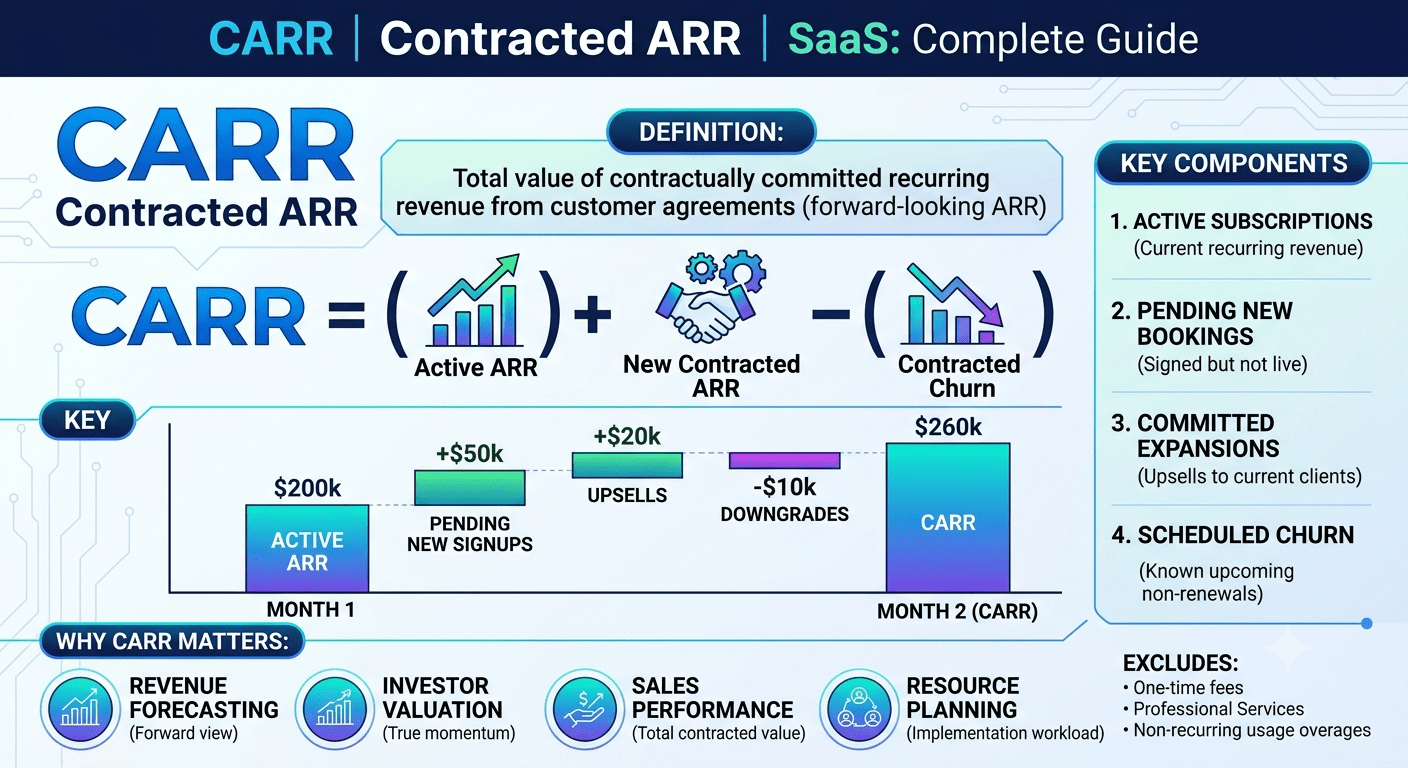
CARR = Live ARR + Contracted ARR Not Yet Live
When live ARR is calculated from monthly recurring revenue:
CARR = (MRR × 12) + Contracted ARR Not Yet Live
This is the formula published by the SaaS Metrics Standards Board. Its “contracted but not yet recognized ARR” component covers signed recurring revenue that has not entered production or the current MRR base.
For more detailed internal reporting, the formula can be expanded:
Gross CARR = Live ARR + Signed New ARR Not Yet Live + Contracted Future Expansion ARR
Some companies also calculate a net committed version:
Net Committed ARR = Gross CARR − Confirmed Future Churn − Contracted Future Downgrades
The second formula can be useful for forecasting, but it should not silently replace a gross CARR definition. Label the two measurements separately when both are reported.
How to Calculate CARR Step by Step
1. Establish the Measurement Date
CARR must be calculated as of a specific date, such as:
- January 31
- Quarter-end
- Fiscal year-end
- The date of a board report
- The closing date of a financing process
Without a measurement date, the figure cannot be reproduced or audited.
2. Calculate Live ARR
Start with the recurring revenue associated with subscriptions that are currently active.
A common formula is:
Live ARR = Current MRR × 12
For example, if current eligible MRR is $200,000:
$200,000 × 12 = $2,400,000 live ARR
Standard ARR generally excludes contracts that are signed but not yet live. It also excludes professional services and other nonrecurring revenue.
3. Identify Signed Contracts That Are Not Live
Find all executed subscription contracts with a future service commencement date.
Each contract should satisfy the company’s documented eligibility requirements. At a minimum, confirm that:
- The agreement has been signed by authorized parties.
- The recurring price is enforceable.
- The start date or activation conditions are identifiable.
- The contract has not been terminated or superseded.
- Any cancellation right has been evaluated.
- The value is not already included in live ARR.
4. Annualize the Recurring Contract Value
Normalize eligible contracts to an annual amount.
Examples:
- $10,000 monthly subscription = $120,000 contracted ARR
- $30,000 quarterly subscription = $120,000 contracted ARR
- $240,000 recurring value over two equal years = $120,000 contracted ARR
- $60,000 six-month nonrenewing agreement = $120,000 annualized run rate only if the company’s policy permits short-term contracts to be annualized
That final example requires caution. Annualizing a short, nonrenewing contract can make the recurring base appear more durable than the underlying commitment.
5. Add Contracted Future Expansions
Include signed increases that will take effect later, provided they are incremental and contractually enforceable.
Examples include:
- Additional licenses
- New product modules
- Upgraded subscription tiers
- Contracted price increases
- Additional locations or business units
- Guaranteed minimum consumption increases
Only include the incremental increase. If a customer’s subscription will rise from $100,000 to $140,000, the expansion component is $40,000—not $140,000.
6. Apply the Churn Policy
Under one approach, known future churn remains in CARR until the contract expires because the revenue is still contractually valid at the measurement date. The SaaS Metrics Standards Board follows this treatment.
Under a net committed approach, formally confirmed future churn and signed downgrades are deducted immediately to produce a more conservative forward view. Stripe’s committed ARR methodology describes this treatment.
Choose one policy, document it, and apply it consistently.
7. Reconcile the Result
The final CARR balance should reconcile to customer-level contract records.
Finance should be able to explain every movement through a CARR bridge:
Ending CARR = Beginning CARR + New CARR + Expansion − Contraction − Churn
Also track transfers from not-yet-live CARR into live ARR. That movement should not increase total CARR because it changes the revenue’s status, not the total contracted value.
CARR Calculation Example
Assume a B2B SaaS company has the following balances on June 30:
| Component | Annualized Value |
|---|---|
| Active subscription ARR | $2,400,000 |
| Signed new contracts awaiting launch | $360,000 |
| Contracted future expansions | $90,000 |
| Confirmed future churn | $120,000 |
| Signed future downgrades | $30,000 |
Using the gross CARR definition:
Gross CARR = $2,400,000 + $360,000 + $90,000
Gross CARR = $2,850,000
Using a net committed ARR definition:
Net Committed ARR = $2,850,000 − $120,000 − $30,000
Net Committed ARR = $2,700,000
The company could therefore report:
- Live ARR: $2.40 million
- Gross CARR: $2.85 million
- Net committed ARR: $2.70 million
- Contracted ARR awaiting activation: $450,000
Reporting the components makes the figure far more useful than presenting a single unexplained headline number.
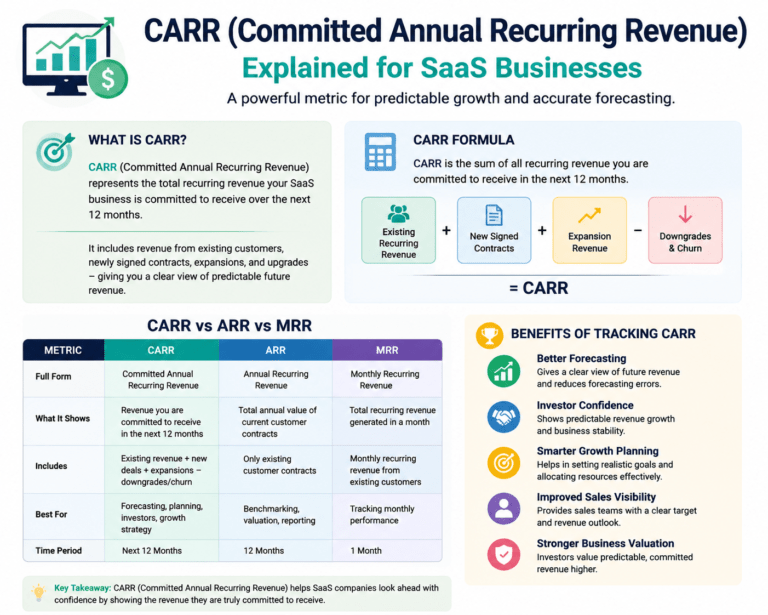
CARR vs. ARR
ARR and CARR are related, but they are not interchangeable.
| Category | ARR | CARR |
| Full name | Annual Recurring Revenue | Contracted Annual Recurring Revenue |
| Primary view | Current recurring run rate | Contractually secured recurring run rate |
| Includes active subscriptions | Yes | Yes |
| Includes signed future starts | No | Yes |
| Includes unsigned pipeline | No | No |
| Includes one-time services | No | No |
| Timing | Point in time | Point in time |
| Main use | Current operating scale | Forward revenue visibility |
| Key risk | May understate signed future growth | May overstate growth that is slow to activate |
ARR reflects active subscriptions and normally excludes deals that have been signed but are not yet generating recurring revenue. CARR adds eligible contracts that are signed but waiting to go live.
A healthy SaaS company should usually monitor both.
ARR tells management what is live. CARR shows how much additional recurring value has already been secured and may enter ARR later.
CARR vs. Bookings
Bookings measure sales activity during a period. CARR measures a recurring revenue balance at a point in time.
A bookings figure may contain:
- Full multiyear contract value
- Subscription revenue
- Implementation fees
- Training fees
- Professional services
- Hardware
- Other nonrecurring charges
CARR should include only the annualized recurring subscription component. Bookings do not have a universally consistent definition and should not be used as a synonym for CARR.
Example
Suppose a customer signs a three-year agreement containing:
- $100,000 recurring subscription revenue per year
- $25,000 one-time implementation fee
- $10,000 one-time training fee
The possible measurements are:
- Total contract value: $335,000
- Bookings: Potentially $335,000, depending on company policy
- CARR contribution: $100,000
- One-time revenue included in CARR: $0
The full contract value should not be added to CARR.
CARR vs. ACV, TCV, Backlog, and Revenue
| Metric | What It Measures | Typical Time Perspective |
| CARR | Annualized recurring value of signed contracts | Point in time |
| ARR | Annualized recurring value currently live | Point in time |
| ACV | Average or annual value of a contract | Contract-based |
| TCV | Total value across the complete contract term | Full contract term |
| Bookings | Value of contracts signed during a period | Period-based |
| Backlog | Contracted value not yet recognized as revenue | Future delivery |
| Revenue | Value recognized from delivered goods or services | Period-based |
CARR should not be treated as recognized revenue. A signed contract may enter CARR before implementation, invoicing, service delivery, or revenue recognition begins.
It is therefore possible for CARR to grow rapidly while reported revenue changes slowly. That gap can be legitimate, but it can also expose implementation delays or weak contract quality.
What Should Be Included in CARR?
Include revenue when it is:
- Recurring
- Contractually enforceable
- Supported by a signed agreement
- Annualized using a documented method
- Not already duplicated in live ARR
- Expected to take effect under the contract’s current terms
Eligible examples can include signed subscriptions, contracted renewals, future-dated upgrades, committed add-ons, and recurring minimum-spend obligations.
What Should Be Excluded from CARR?
Unsigned Pipeline
Do not include verbal agreements, proposals, letters of intent that are not binding, or opportunities marked “commit” in a CRM forecast.
Sales confidence is not a contract.
One-Time Fees
Exclude:
- Implementation
- Migration
- Consulting
- Training
- Custom development
- Setup charges
- Hardware
- One-time support projects
CARR is intended to isolate recurring contractual value. Industry definitions consistently separate it from nonrecurring services and setup charges.
Uncommitted Usage Revenue
Usage-based revenue should only contribute to CARR when a recurring minimum amount is contractually guaranteed.
Variable consumption above that minimum should generally be excluded. If no minimum commitment exists, the business may have no qualifying CARR for that usage component.
Full Multiyear Contract Value
A three-year, $900,000 subscription does not automatically add $900,000 to CARR.
If the recurring value is $300,000 per year, its basic CARR contribution is $300,000. CARR annualizes recurring value rather than counting the entire contract term.
Automatic Renewals Without a Clear Policy
An automatic renewal may be contractually enforceable, cancellable with notice, or practically uncertain.
Document whether auto-renewal periods enter CARR before the cancellation window closes. Do not apply different treatment depending on whether including a renewal improves the reported result.
Inflationary or Expected Price Increases
An anticipated price rise is not CARR unless the increase is already part of the signed agreement.
Forecasted expansion belongs in a plan or forecast, not contracted ARR.
How to Handle Multiyear SaaS Contracts
Flat multiyear contracts are straightforward.
A three-year agreement with $120,000 of recurring subscription value each year contributes $120,000 to CARR.
Ramped contracts require greater care. Consider this schedule:
| Contract Year | Recurring Value |
| Year 1 | $100,000 |
| Year 2 | $150,000 |
| Year 3 | $200,000 |
Possible methods include:
Current or First-Year Contracted Value
CARR contribution: $100,000
This is usually the most conservative presentation for near-term operating visibility.
Average Annual Contract Value
CARR contribution:
($100,000 + $150,000 + $200,000) ÷ 3 = $150,000
This can support long-range planning, but it may overstate the amount expected during the first year.
Exit-Year Value
CARR contribution: $200,000
This method is aggressive because it pulls a later contractual value into the current headline metric. It should not be used without prominent labeling and a clear business rationale.
The SaaS Metrics Standards Board recommends aligning CARR with the contracted subscription amount applicable to each year rather than automatically using the full multiyear value.
The most defensible policy is to use the recurring value applicable to the next 12 months, then disclose any alternative normalization used for planning.
How to Calculate CARR for Usage-Based SaaS
Usage-based pricing creates a distinction between committed and variable revenue.
Suppose a customer contract contains:
- $60,000 annual platform fee
- $40,000 annual minimum usage commitment
- Estimated overage revenue of $75,000
The potential CARR contribution is:
$60,000 + $40,000 = $100,000
The estimated $75,000 of overages should not be included because it is not contractually guaranteed.
This approach prevents optimistic usage forecasts from being presented as secured recurring revenue. Contracted minimums can qualify, while uncommitted consumption normally cannot.
Why CARR Matters to SaaS Companies
It Reveals Signed Growth Before Activation
A company may close several large enterprise contracts that require months of implementation.
ARR will not show their value immediately. CARR allows leadership to distinguish a weak sales pipeline from strong sales performance waiting on deployment.
It Improves Capacity Planning
Future-start contracts can create upcoming demand for:
- Implementation specialists
- Customer success managers
- Cloud infrastructure
- Security reviews
- Technical integrations
- Support capacity
CARR can help teams plan for those obligations before the customers go live.
It Connects Sales and Finance
Sales teams often focus on bookings, while finance teams focus on recurring revenue and recognized revenue.
CARR provides a bridge by isolating the annualized recurring component of signed business. This makes it easier to reconcile CRM data with billing, subscription, and financial systems.
It Exposes Operational Bottlenecks
Rising CARR alongside flat ARR may signal that contracts are being signed but not activated.
Possible causes include:
- Slow implementation
- Integration complexity
- Insufficient onboarding staff
- Customer readiness problems
- Product configuration issues
- Weak handoffs between sales and delivery
The metric becomes more valuable when the business tracks how quickly not-yet-live CARR converts into active ARR.
CARR-to-ARR Conversion
CARR-to-ARR conversion measures whether contracted recurring revenue is successfully becoming live recurring revenue.
A simple cohort-based formula is:
CARR-to-ARR Conversion Rate = Contracted ARR Activated ÷ Eligible Not-Yet-Live CARR
If $500,000 of eligible contracted ARR was awaiting activation and $400,000 went live within the expected period:
$400,000 ÷ $500,000 = 80% conversion
Do not evaluate this percentage without considering implementation timelines. A self-service SaaS product may activate contracts in days, while complex enterprise software can require several months.
Useful supporting metrics include:
- Median days from signature to go-live
- Percentage activated on schedule
- Delayed CARR value
- CARR older than 90, 180, or 365 days
- Cancellation before activation
- Implementation capacity
- Conversion rate by customer segment
- Conversion rate by sales representative
- Conversion rate by product
A growing balance of old, unconverted CARR is a warning sign. It can indicate low-quality bookings, unrealistic activation assumptions, or customers that signed without being prepared to deploy.
How to Implement CARR Reporting
Create a Formal Metric Policy
Define the metric in writing before building a dashboard.
The policy should specify:
- Contract eligibility
- Required signatures
- Treatment of cancellation clauses
- Future-start contract treatment
- Renewal treatment
- Churn timing
- Expansion and downgrade timing
- Usage-based commitments
- Currency conversion
- Multiyear normalization
- Data ownership
- Reporting frequency
Definitions vary across companies, making comparisons unreliable when the underlying methodology is not disclosed.
Establish a Contract-Level Data Model
Each recurring contract record should contain fields such as:
| Field | Purpose |
| Customer ID | Prevent duplication |
| Contract ID | Create an audit trail |
| Signature date | Confirm execution timing |
| Service start date | Separate live and future ARR |
| Contract end date | Identify expiration |
| Recurring annual value | Calculate CARR |
| One-time value | Exclude nonrecurring revenue |
| Minimum commitment | Support usage-based calculations |
| Cancellation terms | Evaluate contract strength |
| Expansion effective date | Time future increases |
| Churn effective date | Apply the chosen churn policy |
| Currency | Standardize reporting |
| ARR status | Classify live, future, churned, or cancelled |
Avoid calculating CARR from CRM opportunity amounts alone. Opportunity data often includes one-time services, full contract value, estimated usage, and inconsistent close-date assumptions.
Connect the Source Systems
Reliable CARR reporting often requires data from:
- CRM
- Contract lifecycle management
- Billing platform
- Subscription management
- ERP or accounting system
- Data warehouse
- Customer implementation system
The signed contract should remain the source of truth for contractual commitment. Billing data should confirm what is live, while CRM data can explain the sales origin.
Build a Monthly CARR Bridge
Track movements from one reporting date to the next:
| Movement | Effect |
| New signed recurring contracts | Increase |
| Contracted expansion | Increase |
| Contracted downgrade | Decrease |
| Churn | Decrease |
| Cancellation before launch | Decrease |
| Foreign-exchange movement | Policy-dependent |
| Go-live transfer | No total CARR change |
The go-live transfer is especially important. When $100,000 moves from future-start CARR to live ARR, total CARR should remain unchanged unless another contract event occurs.
Reconcile CARR Regularly
CARR should be reviewed monthly or, at minimum, quarterly. The SaaS Metrics Standards Board recommends regular point-in-time calculation so period-over-period growth can be evaluated consistently.
A monthly control process should identify:
- Duplicate contracts
- Expired agreements still included
- Cancelled deals
- Missing amendments
- Incorrect start dates
- One-time fees classified as recurring
- Contracts that failed to activate
- Currency inconsistencies
- Unexpected CARR-to-ARR conversion delays
Common CARR Reporting Mistakes
Calling CARR “ARR”
This makes the current recurring base appear larger than it is.
Report live ARR and contracted ARR separately. Investors and operators need to see how much revenue is active versus waiting to go live.
Including Pipeline
A high-probability opportunity is still not contracted revenue.
Require a signed, binding agreement before adding recurring value to CARR.
Counting Total Contract Value
Adding all years of a multiyear contract inflates the annualized metric.
Normalize the recurring component to one year using a consistent policy.
Including Professional Services
Implementation and consulting fees may be valuable, but they are not recurring subscription revenue.
Keep them in bookings, TCV, or services revenue—not CARR.
Ignoring Cancellation Rights
A signed agreement with a broad termination-for-convenience clause may not carry the same economic certainty as a non-cancellable commitment.
Segment or disclose cancellable CARR when it is material.
Using Exit-Year Pricing
Reporting the highest future year of a ramped agreement can exaggerate near-term scale.
Use next-12-month or first-year contracted value for the primary metric, and show later ramps separately.
Deducting Churn Inconsistently
One month, the company removes churn when notice arrives. The next month, it waits until the effective date.
That inconsistency can manipulate growth rates. Choose either a contractual effective-date approach or a net committed approach and apply it every period.
Ignoring Contracts That Never Go Live
A signed deal should not remain in not-yet-live CARR indefinitely without investigation.
Create aging buckets and require operational review when activation exceeds the expected timeline.
Reporting CARR Without a Definition
A number labeled “CARR” is not self-explanatory.
Include the formula, measurement date, material policy choices, and reconciliation to live ARR in board and investor materials.
Recommended CARR Dashboard
A practical executive dashboard should show:
- Ending live ARR
- Ending gross CARR
- Net committed ARR, if used
- Not-yet-live contracted ARR
- New CARR signed
- Contracted expansion
- Contracted downgrade
- Churn
- CARR growth rate
- ARR growth rate
- CARR-to-ARR conversion
- Median signature-to-live time
- Aged unconverted CARR
- Cancellable CARR
- Usage-minimum CARR
- Largest future-start contracts
Add filters for customer segment, region, product, contract size, sales team, and expected go-live month.carr contracted arr definition saas
The dashboard should allow users to move from the headline number to individual contracts. A metric that cannot be traced back to its source records will eventually lose credibility.
When CARR Is Most Useful
CARR is especially useful when a SaaS company has:
- Enterprise customers
- Long onboarding cycles
- Future-dated contracts
- Complex integrations
- Large implementation queues
- Multiyear subscription agreements
- Signed expansions that begin later
- Contracted usage minimums
- Significant differences between bookings and live ARR
It is less informative for businesses where subscriptions activate immediately and can be cancelled at any time. In that model, CARR and ARR may be nearly identical, or the contractual commitment may be too weak to provide meaningful additional visibility.carr contracted arr definition saas
Questions to Ask When Reviewing CARR
Before relying on a reported CARR number, ask:
- What is the exact formula?
- What date does the balance represent?
- How much of CARR is currently live?
- How much is waiting to activate?
- Are signed future expansions included?
- Are future churn and downgrades deducted?
- Are any contracts cancellable before launch?
- Are one-time fees excluded?
- How are ramped contracts annualized?
- Does usage-based CARR include only minimum commitments?
- How long does CARR usually take to convert into ARR?
- How much CARR is overdue for activation?
- Can the balance be reconciled to customer contracts?
- Has the calculation policy changed?
These questions reveal both the quantity and quality of contracted recurring revenue.
Frequently Asked Questions
What is the simple definition of CARR?
CARR is the annualized recurring value of signed customer contracts, including active subscriptions and eligible contracts that have not started yet.
What does CARR stand for in SaaS?
CARR stands for Contracted Annual Recurring Revenue. Some companies use the term Committed Annual Recurring Revenue for the same or a closely related metric.
Is CARR the same as ARR?
No. ARR generally measures recurring subscriptions that are currently active. CARR adds recurring revenue from eligible signed contracts that have not yet gone live.
Is CARR the same as revenue?
No. CARR is an operating metric based on annualized contractual commitments. Revenue is recognized over a reporting period as the company delivers the applicable goods or services.
Is CARR the same as bookings?
No. Bookings may include total multiyear value, services, setup charges, and other nonrecurring amounts. CARR includes only the eligible annualized recurring component.
Can CARR be lower than ARR?
Yes. This can happen under a net committed definition when confirmed future churn and downgrades exceed signed future-start contracts and expansions.
Under a gross definition that adds not-yet-live contracted ARR to live ARR without immediately subtracting future churn, CARR will generally be equal to or greater than ARR.
Does CARR include renewals?
Signed renewals can be included. Unsigned or merely expected renewals should not be treated as contracted revenue.
Automatic renewals require a consistent policy based on enforceability, cancellation rights, and the company’s contract terms.
Does CARR include usage-based revenue?
Only the contractually guaranteed recurring minimum should normally be included. Variable overages and estimated consumption should be excluded.
Should CARR include future price increases?
Yes, when the increase is explicitly contracted and included according to the company’s documented annualization method.
Expected increases that have not been contractually agreed should be excluded.
How often should CARR be calculated?
Monthly calculation is preferable for operating management. At minimum, it should be calculated consistently at each quarterly reporting date.
Is CARR a standardized accounting metric?
No. CARR is a SaaS operating metric rather than a standardized financial statement measure, and company methodologies can differ. Clear disclosure and consistent application are therefore essential.
Final Takeaway
The CARR contracted ARR definition SaaS leaders should use is the annualized recurring value of enforceable customer contracts, covering both live subscriptions and eligible recurring contracts that have not yet started.
The calculation itself is simple:
CARR = Live ARR + Contracted ARR Not Yet Live
The difficult part is maintaining disciplined inclusion rules. A credible CARR metric excludes pipeline, one-time services, uncommitted usage, and inflated multiyear values while clearly explaining how future churn, expansions, renewals, and ramped contracts are handled.
When reported alongside ARR, revenue, churn, and CARR-to-ARR conversion, contracted ARR becomes more than an impressive growth number. It becomes a reliable view of secured SaaS revenue, implementation performance, and the quality of future growth.