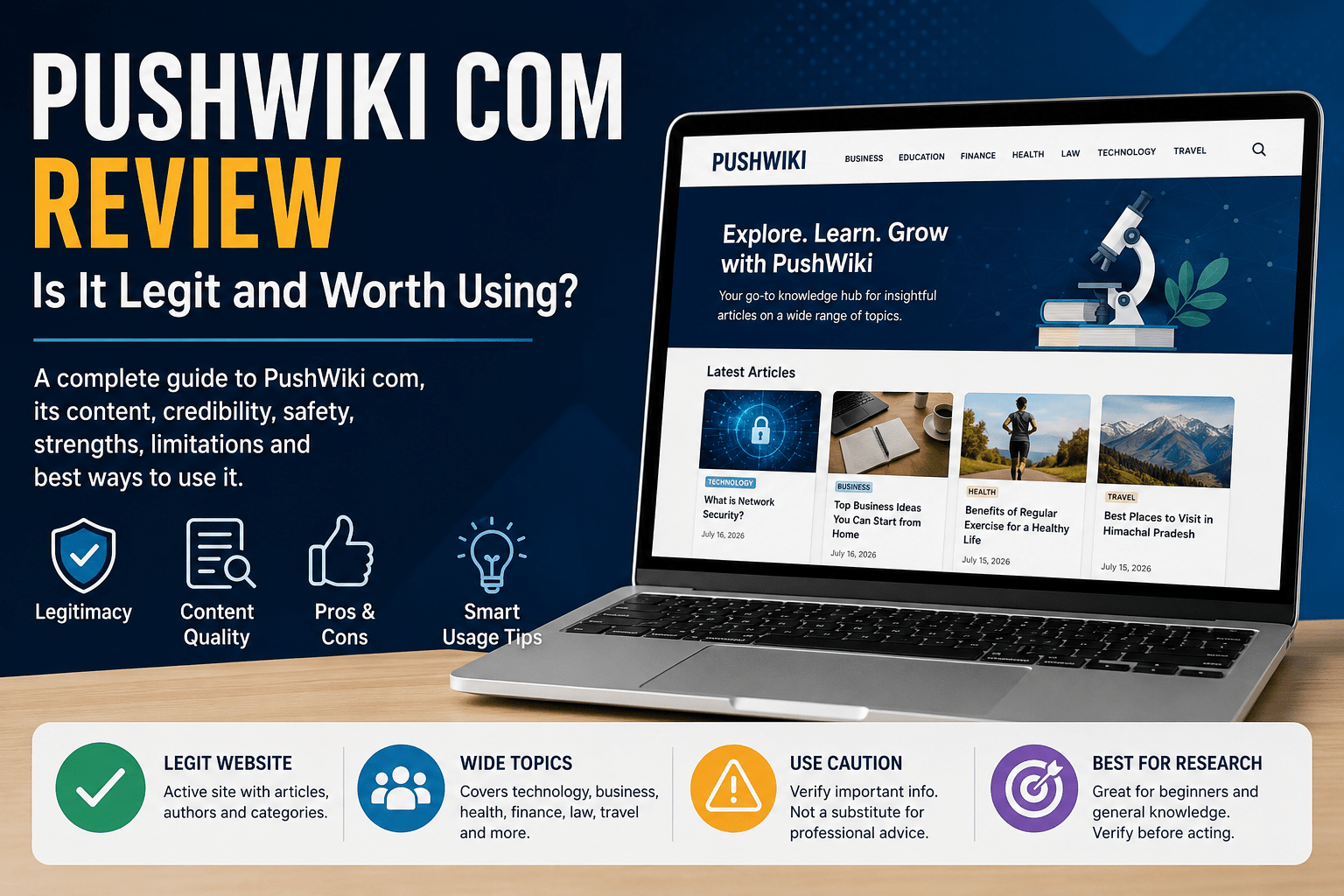
People searching for pushwiki com usually want to know what the website offers, whether its articles are trustworthy, and whether it is safe to use. The platform presents itself as a collaborative knowledge resource, but its visible structure is closer to a multi-topic online magazine than a traditional community-edited wiki.
PushWiki publishes articles across technology, business, education, finance, health, law, travel, digital marketing, lifestyle, and several smaller categories. Its content can be useful for quick introductions, but readers should verify important claims before using them for medical, legal, financial, security, or purchasing decisions.
pushwiki com at a Glance
| Feature | Details |
|---|---|
| Website | pushwiki.com |
| Platform type | Multi-topic informational blog |
| Access | Free to browse |
| Main subjects | Technology, business, education, health, law, finance and travel |
| Content style | Short explainers, guides and commercial-topic articles |
| Named contributors | Devin Haney and Shivi Hyde, plus a generic publishing account |
| Best use | Understanding basic concepts and finding research starting points |
| Main concern | Limited editorial, ownership and author-credential transparency |
| Overall assessment | Useful for low-stakes reading, but not a final authority |
What Is pushwiki com?
PushWiki is an informational publishing website containing articles on a wide range of subjects. Its homepage describes the platform as a collaborative knowledge community designed to make information easier and faster to understand.
Despite that description, the public website does not operate like a conventional wiki. Visitors are presented with completed blog posts, publication dates, categories, bylines and comment areas rather than visible editing tools, revision histories or contributor discussions.
A more accurate description would be:
PushWiki is a general-interest content website that publishes beginner-friendly articles, practical guides and search-focused explainers.
That distinction matters because the word “wiki” can create expectations of community review, transparent revisions and collective fact-checking. Readers should assess each PushWiki article as an individual blog post rather than assuming it has been reviewed by a large contributor community.
Is pushwiki com the Same as push-wiki.com?
No. This is one of the most important details for anyone researching the website.
pushwiki.com is a broad informational blog covering technology, business, education, finance, health, law, travel and other subjects. push-wiki.com, with a hyphen, is a separate technology and artificial-intelligence website that identifies itself as a Tech and AI Information Hub curated by an individual named Martin.
Before reading a review, opening a link or citing an article, check the exact domain in the browser address bar. Many online reviews mix the two websites together, which can lead to inaccurate conclusions about their owners, content and purpose.
What Topics Does PushWiki Cover?
The main navigation presents seven broad sections:
- Business
- Education
- Finance
- Health
- Law
- Technology
- Travel
The complete category archive is considerably wider. It also includes Digital Marketing, Blog, Lifestyle, Crypto, Entertainment, Fashion, Pets, Trading, Online Game and other smaller sections. Technology and digital marketing contain some of the largest article collections.
Technology
Technology is one of the platform’s most developed areas. Topics include network security, artificial intelligence, cloud infrastructure, website development, virtual reality and software tools.
For example, the site has published articles on network security and hyperconverged infrastructure. These pages may help beginners understand terminology, but technical instructions should still be checked against official documentation before they are applied to production systems.
Business and Digital Marketing

Business coverage includes software comparisons, debt management, home-based businesses, delivery services, telephone tools and digital operations.
The subjects are practical, but the category does not follow one clearly defined specialist focus. Some articles introduce particular companies or services, making it important to distinguish independent analysis from promotional content.
Education
The education section covers areas such as memory techniques, website creation, augmented reality and virtual reality in learning.
These articles are generally best suited to introductory reading. Students should follow any useful concepts with textbooks, research papers or institutional sources before using them in formal academic work.
Health
Health-related posts discuss exercise, mental well-being, medical technology, artificial intelligence in diagnostics, nanotechnology and beauty services.
Health information requires a higher standard of evidence than an ordinary lifestyle article. PushWiki’s visible author pages do not provide detailed clinical credentials or clearly identify qualified medical reviewers, so its health content should not be used for diagnosis or treatment decisions.
Law and Finance
The law and finance categories include subjects that may affect personal rights, taxes, investments or business obligations.
Readers should pay close attention to dates and jurisdictions. A general article cannot replace legislation, regulatory guidance, a qualified accountant or advice from a licensed legal professional.
Travel and Lifestyle
Travel coverage includes guides to Indian rail travel, street food, monsoon travel, Himachal Pradesh and destinations for first-time visitors. These pages are easy to browse and can provide inspiration, although practical details such as prices, schedules, entry rules and local conditions should be checked separately.
Is pushwiki com Legit?
PushWiki is a real, accessible publishing website with an active article archive, identifiable categories, publication dates and contributor bylines. At the time of this review, its homepage displayed posts published as recently as July 16, 2026.
However, “legit” can mean several different things:
- Does the website exist and publish accessible content? Yes.
- Is every article independently verified? That is not publicly demonstrated.
- Are all authors established specialists? Detailed credentials are not clearly displayed.
- Should every recommendation be trusted automatically? No.
- Is it suitable for casual research? In many cases, yes.
A website can be genuine without being authoritative in every subject it covers. PushWiki should therefore be judged article by article.
Is pushwiki com Safe to Browse?
For ordinary reading, the website behaves like a standard content blog. Visitors can open articles without encountering a visible subscription requirement or mandatory account-registration process.
That does not guarantee that every external website linked within an article is equally trustworthy. PushWiki itself states that its community is not responsible for external-site content, so readers should treat outbound links as separate destinations.
Use standard browsing precautions:
- Confirm that the domain is exactly pushwiki.com.
- Avoid downloading unexpected files.
- Inspect unfamiliar links before opening them.
- Never enter payment or personal information solely because an article recommends a service.
- Research a company independently before making a purchase.
- Keep your browser and security software updated.
How Trustworthy Is the Content?
Trustworthiness varies by topic and article. PushWiki’s greatest strength is readability, while its most important weakness is limited transparency around expertise, sourcing and commercial relationships.
Experience
Strong experience signals include original photographs, test results, screenshots, interviews, measurements and clear descriptions of how a product or process was evaluated.
These signals are not consistently visible across PushWiki’s content. Many articles explain a topic effectively, but readers may not be shown whether the writer personally tested a tool, visited a location or worked professionally in the relevant field.
Expertise
The website attributes many posts to Devin Haney and Shivi Hyde. Their public author pages primarily function as article archives and do not display substantial biographies, professional qualifications or defined specialist roles.
A byline shows who published an article, but it does not automatically establish subject expertise. This becomes especially important when one contributor writes across unrelated areas such as technology, health, travel, pets and business.
Authoritativeness
PushWiki covers many subjects rather than building its entire identity around one specialist field. Broad coverage can attract more readers, but it also makes consistent expert oversight more difficult.
Technology appears to be one of the stronger areas by article volume. Even there, complex cybersecurity or infrastructure recommendations should be compared with vendor documentation, recognized technical standards and experienced professionals.
Trustworthiness
Positive trust signals include:
- Visible publication dates
- Named bylines on many posts
- A searchable archive
- Clear category navigation
- Free access to articles
- A public contact email
Areas requiring improvement include:
- Detailed author credentials
- A clearly identified owner or editorial team
- A published corrections policy
- Consistent references to primary evidence
- Clear explanations of review methods
- Visible sponsorship and commercial-disclosure labels
The Commercial-Content Question
PushWiki’s homepage includes a reference to Rank Up Bytes, described there as a digital marketing agency offering guest-posting and link-building services. This suggests that contributed or commercially connected content may form part of the website’s publishing model.
Guest posts are not automatically unreliable. A contributed article can still be accurate and valuable when it is properly reviewed, sourced and disclosed.
The real issue is transparency. When an article recommends a specific product, company or service, readers should look for answers to the following questions:
- Was the article sponsored?
- Did the company pay for a link?
- Was the product tested?
- What alternatives were evaluated?
- Does the author receive a commission?
- What evidence supports the recommendation?
When those answers are missing, treat the recommendation as a lead to investigate rather than a final buying decision.
Advantages of pushwiki com
1. Beginner-Friendly Writing
Articles generally use direct language, descriptive headings and short sections. This makes complicated subjects more approachable for readers without specialist knowledge.
2. Broad Topic Selection
Visitors can explore several subjects on one website instead of switching between multiple niche blogs. The range is particularly useful for casual browsing and early-stage research.
3. Free Access
The visible content can be read without a paywall. That makes it accessible to students, researchers and general readers who only need a quick overview.
4. Useful Starting Vocabulary
An introductory article can teach readers the basic terms needed to conduct better research elsewhere. Knowing the correct terminology often makes official documents and specialist resources easier to understand.
5. Simple Navigation
The homepage, category pages and search box make it relatively easy to locate recent or related posts. The design follows a familiar online-magazine structure.
Limitations of pushwiki com
1. It Is Not a Traditional Wiki
The website’s branding may lead visitors to expect open editing and public revision histories. Those features are not visibly available.
2. Author Expertise Is Unclear
Contributor pages show published posts but provide limited information about qualifications, experience or professional affiliations.
3. Sourcing Is Inconsistent
Some posts may mention reliable organizations, while others make confident claims without clearly linking to primary evidence.
4. The Editorial Focus Is Very Broad
A website covering cybersecurity, medical technology, travel, pets, gambling, business and law needs strong subject-specific review systems. PushWiki does not clearly explain how different categories are checked.
5. Commercial Relationships Need Clearer Disclosure
Company-focused articles and the homepage’s guest-posting reference create questions about how promotional content is selected and labeled.
6. High-Stakes Topics Require External Verification
Health, financial, legal and security information can cause real harm when it is outdated, incomplete or applied in the wrong context.
When Should You Use PushWiki?
| Your Goal | Is PushWiki Suitable? | Recommended Next Step |
| Learn a basic definition | Yes | Confirm important details elsewhere |
| Understand unfamiliar terminology | Yes | Continue with specialist sources |
| Find general travel inspiration | Yes | Verify current local information |
| Choose expensive software | Partly | Compare independent tests and user feedback |
| Configure cybersecurity systems | Partly | Follow official technical documentation |
| Make an investment decision | No, not alone | Check filings, regulators and qualified advisers |
| Diagnose a medical condition | No | Consult a licensed healthcare professional |
| Interpret a legal obligation | No | Check current law and obtain professional advice |
| Cite a university assignment | Usually not ideal | Use original research and authoritative publications |
How to Verify a PushWiki Article
Step 1: Identify the Type of Claim
Ask whether the article is presenting:
- A basic definition
- A measurable fact
- A personal opinion
- A product recommendation
- A medical or legal claim
- A prediction
- A company’s marketing statement
Definitions are relatively easy to verify. Recommendations and high-stakes claims require much stronger evidence.
Step 2: Check the Publication Date
Technology, law, finance, travel and health information can become outdated quickly. A clearly written article may still be unreliable if its facts no longer reflect current rules, products or research.
Step 3: Inspect the Sources
Look for links to original documentation rather than other general blogs. Strong sources include official agencies, recognized standards bodies, peer-reviewed studies, regulatory documents and manufacturer specifications.
Step 4: Research the Author
Check whether the author has relevant education, professional experience or a history of work in the subject.
A person who regularly publishes online is not necessarily an expert in every topic they cover.
Step 5: Look for Commercial Motives
Be cautious when an article repeatedly promotes one company, places a commercial link near the beginning or makes strong recommendations without explaining the selection process.
Step 6: Compare Independent Sources
Search for the same claim on at least two authoritative websites. Do not count pages that repeat identical wording as independent confirmation.
Step 7: Use the Appropriate Expert
Online research can help you prepare better questions, but it should not replace professional support when health, money, legal rights or digital security are involved.
Common Mistakes to Avoid
Confusing Similar Domains
Do not assume pushwiki.com and push-wiki.com belong to the same organization. The hyphen changes the domain and leads to a different website.
Assuming “Wiki” Means Community-Edited
A name is branding, not proof of an editorial model. Look for visible editing tools, revision logs and contributor policies before treating any platform as a collaborative wiki.
Trusting a Claim Because It Sounds Confident
Clear writing can make weak evidence appear convincing. Always judge the source behind the statement, not just the tone used to present it.
Treating a Byline as Proof of Expertise
An author name improves accountability, but qualifications and relevant experience still matter.
Using General Articles as Academic Sources
PushWiki may help you understand a topic, but academic work should normally cite the original study, law, dataset, standard or expert publication.
Following Commercial Links Without Research
A linked company may be legitimate, unsuitable, overpriced or unrelated to the article’s strongest evidence. Review it independently.
Who Will Find PushWiki Most Useful?
PushWiki is most suitable for:
- Casual readers exploring unfamiliar subjects
- Students beginning preliminary research
- Bloggers searching for topic ideas
- Professionals learning basic terminology outside their field
- Travelers looking for general inspiration
- Consumers creating an initial list of products or services to compare
It is less suitable as a standalone resource for:
- Medical treatment decisions
- Legal interpretation
- Tax planning
- Investment strategies
- Cybersecurity deployment
- Academic citation
- Expensive purchasing decisions
Final Verdict: Is pushwiki com Worth Visiting?
pushwiki com is worth visiting when you need a quick, readable introduction to a subject. Its strongest qualities are accessible writing, broad coverage, free browsing and a straightforward layout.
Its weaknesses are more significant when the stakes are high. Limited author credentials, inconsistent sourcing, unclear editorial oversight and insufficient commercial disclosure mean that readers should not treat every article as independently verified expert guidance.
The best approach is simple: use pushwiki com to understand basic ideas, identify useful terminology and plan your next research step. For anything involving health, law, finance, cybersecurity or substantial spending, confirm the information with primary sources and qualified professionals.
Frequently Asked Questions
What is pushwiki com used for?
PushWiki is used for reading general-interest articles, beginner guides and explainers across technology, business, education, health, finance, law, travel and related subjects.
Is pushwiki com a real website?
Yes. It is an active informational website with category archives, dated articles, contributor pages and a public contact email.
Is PushWiki a real wiki?
Not in the conventional community-editing sense. Its visible pages operate more like an editorial blog or online magazine than an openly editable encyclopedia.
Is pushwiki com free?
Its publicly visible articles can be accessed without a displayed paywall or mandatory membership requirement.
Can I trust its technology guides?
They may be useful for learning basic concepts. Configuration instructions, security recommendations and software claims should be checked against official technical documentation.
Can I use PushWiki for health advice?
Use it only for general background reading. Do not use a PushWiki article to diagnose symptoms, select medication or delay professional medical care.
Can I cite PushWiki in academic work?
It is usually better to locate and cite the original research, official report or authoritative source behind the claim. Your institution’s citation rules should determine whether a general blog is acceptable.
Who writes for pushwiki com?
Many visible posts are attributed to Devin Haney and Shivi Hyde, while some newer content uses a generic publishing account. Their author pages list articles but provide limited professional background information.
Does PushWiki publish sponsored articles?
The homepage references guest-posting and link-building services, which may indicate that contributed or commercial content forms part of its publishing model. Individual articles should be checked for clear sponsorship or partnership disclosures.
What is the difference between pushwiki.com and push-wiki.com?
They are separate domains. Pushwiki.com is a broad, multi-category informational website, while push-wiki.com presents itself as a technology and artificial-intelligence publication.