


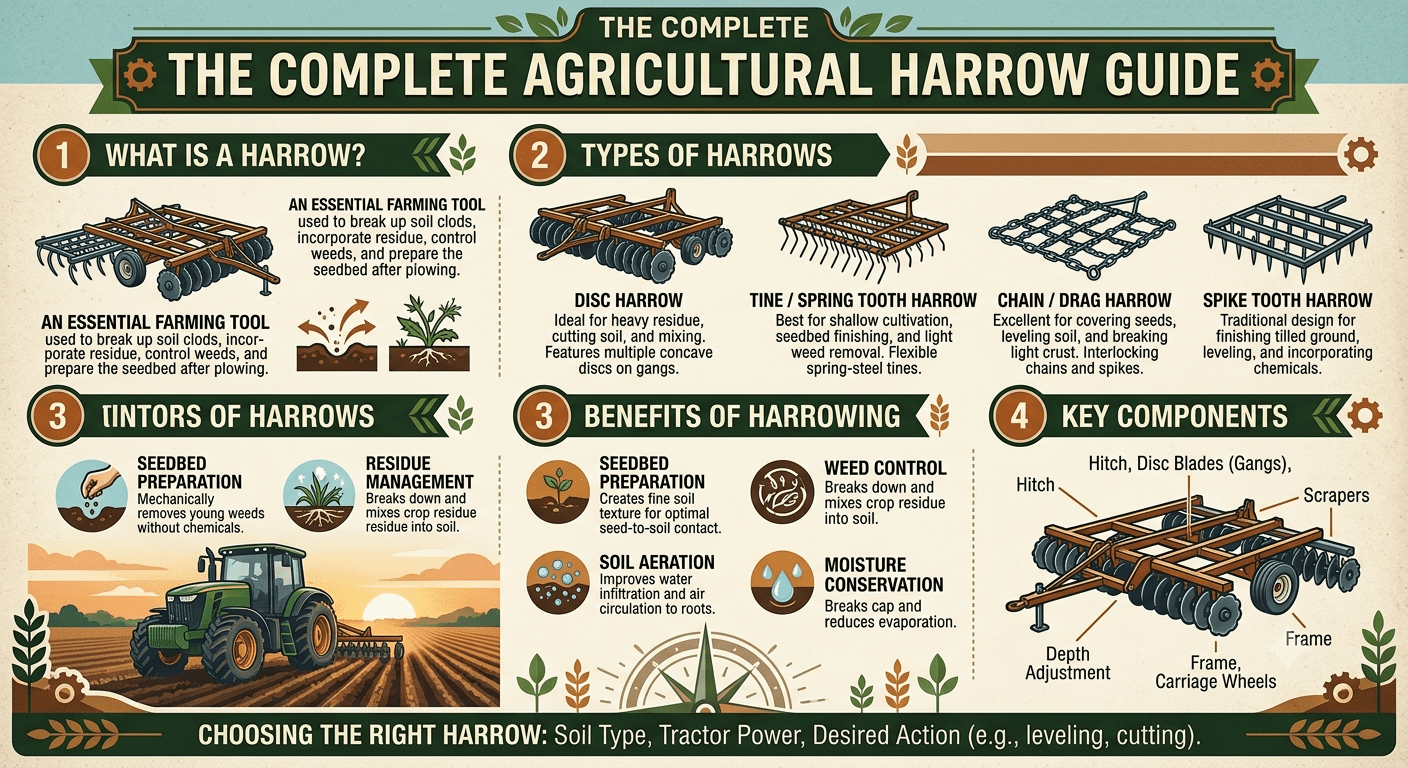
The term messeregge refers to an agricultural harrowing or scarifying implement used to work the surface of soil or grassland. Although it is sometimes translated literally as “knife harrow,” established German-English dictionaries also translate it as scarifier or pasture harrow.
That distinction matters. A messeregge is not one universally standardized machine with an identical design across every manufacturer. It is better understood as a category of agricultural equipment that uses cutting, scratching, or scarifying elements to improve the condition of a field’s upper surface.
Quick Facts About messeregge
| Feature | Practical meaning |
|---|---|
| Primary context | Agriculture and grassland management |
| Common English translations | Scarifier, pasture harrow, knife harrow |
| Typical purpose | Surface cultivation, sward renovation, leveling, or seedbed preparation |
| Common working elements | Blades, knives, teeth, tines, or scarifying sections |
| Suitable land | Grassland, pasture, cultivated fields, or specialist crop systems |
| Mounting options | Tractor-mounted, front-mounted, rear-mounted, or combined equipment |
| Main limitation | It cannot replace deep cultivation or solve severe soil compaction |
| Buying priority | Match the machine to the intended field operation—not the name alone |
What Does messeregge Mean?
Messeregge is a German agricultural noun. The word is commonly associated with a harrow or scarifier whose working elements cut, scratch, or disturb the ground surface.
Langenscheidt classifies the term under agriculture and translates it as “scarifier.” LEO provides “pasture harrow” as another English equivalent. These translations show why English descriptions of the machine can vary between suppliers and regions.
The word is often separated into:
- Messer: knife or cutting element
- Egge: harrow
“Knife harrow” is therefore a useful literal explanation, but it should not be treated as the only correct English name. In real machinery catalogues, the design and intended application provide more useful information than the translation alone.
Is messeregge a Real Agricultural Machine?
Yes. Messeregge is an established agricultural equipment term rather than a new digital concept, communication framework, or internet expression.
Agricultural machinery manufacturer Rolmet, for example, lists Messeregge among the equipment it produces for farms, particularly within a product range focused on potato-growing operations.
Some online articles incorrectly describe the word as:
- A messaging application
- A communication philosophy
- An exhibition-stand component
- A knife edge used in cooking
- A fictional or cultural expression
Those interpretations are generally caused by spelling similarities or speculative content. Unless a particular company has adopted the word as a brand name, its clearest established meaning remains agricultural.
How a messeregge Works
A messeregge is pulled or carried across the field so its working elements interact with the uppermost layer of vegetation or soil. Depending on the machine, those elements may scratch the surface, loosen dead material, break small crusts, level irregularities, or create conditions for seed establishment.
The exact action depends on four variables:
- The design of the working elements
- The pressure applied to the ground
- The machine’s forward speed
- Current soil and vegetation conditions
A light setting may comb through a grass sward and redistribute loose material. A more aggressive configuration may expose soil, break a shallow surface crust, or prepare a finer tilth for overseeding.
Grassland and Pasture Action
On established pasture, a grassland-oriented messeregge can disturb matted vegetation, spread loose material, and create limited areas of exposed soil. This can support renovation when the existing sward is open enough for new seed to reach the ground.
The Northern Ireland Department of Agriculture, Environment and Rural Affairs notes that grass harrows can create an appropriate tilth before overseeding when clear ground is already visible. It also emphasizes the importance of seed-to-soil contact and suitable moisture conditions.
Cultivated-Soil Action
On cultivated land, a more robust messeregge may be used for shallow surface preparation. Its purpose is generally refinement rather than deep restructuring.
Possible results include:
- Breaking smaller surface clods
- Leveling minor ridges
- Disturbing emerging shallow-rooted weeds
- Mixing limited surface residue
- Preparing the upper layer before planting
- Supporting another implement in a combined pass
A messeregge should not automatically be described as a substitute for a cultivator, power harrow, disc harrow, or subsoiler. Each machine works at a different intensity and depth.
Main Uses of a messeregge
1. Grassland Renovation
Grassland can become thin, uneven, or covered by dead vegetation. A pasture-oriented messeregge may help open the sward before overseeding and improve the likelihood that seed reaches the soil.
Harrowing may also contribute to weed-management programs in established swards, although its effectiveness depends on the weed species, growth stage, soil condition, and wider management plan. AHDB notes that harrowing can be effective in some established grassland situations.
2. Overseeding Preparation
Broadcasting seed into dense vegetation often produces disappointing establishment because too little seed reaches the ground. A suitable harrowing pass can create small areas of tilth and reduce surface obstruction.
Successful overseeding still depends on:
- Adequate soil moisture
- Suitable fertility
- Reduced competition from the existing sward
- Appropriate seed selection
- Sufficient establishment time
- Good seed-to-soil contact
The messeregge prepares conditions; it does not compensate for poor timing or unsuitable agronomy.
3. Surface Leveling
Some designs can reduce small hoof marks, molehills, loose ridges, and minor surface irregularities. The achievable result depends on the machine’s weight and configuration.
Deep ruts, severe livestock damage, or structural compaction require a different corrective approach.
4. Light Seedbed Preparation
A field-oriented messeregge can refine an already cultivated surface before planting. It may work independently or form part of a combined front- and rear-mounted setup.
This application is most appropriate when deep soil movement is unnecessary and the objective is a consistent surface.
5. Residue Distribution
Loose vegetation, manure deposits, or light crop residue can become concentrated in patches. Some harrow configurations help redistribute this material across a wider area.
Heavy, wet, or tangled residue may clog lighter machines. In these conditions, a specialist rake, mulcher, or residue-management implement may be more appropriate.
messeregge vs. Other Harrows
| Machine | Working action | Typical strength | Main limitation |
| Messeregge | Cuts, scratches, combs, or scarifies the surface | Versatile shallow treatment | Meaning and design vary by manufacturer |
| Chain harrow | Flexible dragging and combing action | Pasture maintenance and spreading loose material | Limited penetration |
| Tine harrow | Uses rigid or spring tines | Weed disturbance and seedbed refinement | Can pull up residue or plants |
| Disc harrow | Uses angled concave discs | Strong cutting and soil mixing | Greater disturbance and draft demand |
| Power harrow | PTO-driven rotating tines | Intensive seedbed preparation | Higher complexity and energy requirement |
| Subsoiler | Loosens deeper compacted layers | Structural compaction treatment | Not intended for surface finishing |
The closest comparison depends on the particular messeregge being evaluated. A light grassland model may resemble a pasture harrow, while a heavier blade-equipped version may operate more like a shallow cultivator.
Benefits of Using a messeregge
Controlled Surface Disturbance
A messeregge is generally chosen when the operator wants to affect the surface without carrying out full-depth cultivation. This makes it useful for renovation and finishing operations.
Flexible Field Applications
Depending on its construction, the same general equipment category can be used for pasture maintenance, overseeding preparation, surface leveling, or shallow soil refinement.
Compatibility With Combined Operations
Some machines can be fitted to the front of a tractor while another implement operates behind it. Other models incorporate rollers, leveling components, or seeding equipment.
Combining operations may be practical, but only when the tractor has adequate lifting capacity, hydraulic capability, visibility, and weight distribution.
Potential Improvement in Seed Establishment
Where a harrow creates appropriate tilth and improves seed contact with the soil, it can support overseeding. Government agricultural guidance stresses that competition, fertility, moisture, and post-sowing management remain decisive.
Limitations to Understand
A messeregge is not the right solution for every field problem.
It may perform poorly when:
- The ground is waterlogged
- Vegetation is excessively dense
- Crop residue is long and tangled
- The soil is baked extremely hard
- Deep compaction is restricting roots
- Large stones obstruct the working elements
- Deep ruts require major leveling
- The machine is too light for the intended task
It can also cause unnecessary damage when used too aggressively. Excessive surface disturbance may uproot desirable plants, expose too much soil, accelerate moisture loss, or create opportunities for weeds.
How to Choose the Right messeregge
Define the Primary Job
Begin with the field problem—not the machine’s advertised features.
Clarify whether the principal objective is:
- Pasture maintenance
- Sward opening
- Overseeding preparation
- Residue distribution
- Weed disturbance
- Surface leveling
- Shallow seedbed preparation
- Integration with a planter or roller
A model optimized for grassland may not provide the soil-working action needed for cultivated fields.
Examine the Working Elements
Look closely at the shape, spacing, flexibility, and replaceability of the ground-contact components.
Ask the supplier:
- Are the elements designed for grassland or cultivated soil?
- Can their pressure or angle be adjusted?
- Are reversible or replaceable wear parts available?
- How do the elements behave in residue?
- Are different configurations offered?
Avoid purchasing solely from a photograph. Two machines with similar frames can produce very different field results.
Match the Working Width to the Tractor
A wider messeregge can cover more ground per pass, but it also increases weight, draft demand, transport width, and turning requirements.
Check:
- Tractor horsepower recommendations
- Front- or rear-linkage capacity
- Hydraulic connections
- Transport dimensions
- Folding mechanism
- Axle-load limits
- Ballast requirements
The manufacturer’s specifications should take priority over informal horsepower estimates.
Consider Ground-Pressure Adjustment
Adjustability is one of the most useful features on a multipurpose harrow. It allows the operator to respond to variations in soil firmness, sward density, and surface condition.
Adjustment may be provided through:
- Linkage position
- Gauge wheels
- Hydraulic pressure
- Spring tension
- Working-element angle
- Additional ballast
- Roller settings
More adjustment is not automatically better. Controls should be durable, repeatable, and easy to verify.
Check Wear-Part Availability
A low purchase price can become expensive when replacement components are unavailable. Confirm the cost and lead time for wearing parts before ordering.
Consider the availability of:
- Ground-working elements
- Mounting hardware
- Springs
- Bushes
- Bearings
- Hydraulic components
- Roller scrapers
- Frame sections
Machines sold through an established local dealer may provide better long-term value than an unsupported import.
Evaluate Transport and Storage
Folding wings reduce road width but add hinges, locking systems, and hydraulic components. Rigid machines are simpler, although they can become impractical at larger working widths.
Measure gateways, sheds, transport routes, and storage space before selecting a model.
When Should a messeregge Be Used?
The best timing depends on the intended operation.
For grassland renovation, the surface should generally be firm enough to carry machinery without rutting but receptive enough for the implement to create the required effect. Overseeding should not be carried out in dry conditions that are unlikely to support seedling survival.
Avoid fieldwork when:
- Wheels are leaving deep marks
- Soil is smearing rather than crumbling
- Plants are being uprooted excessively
- Residue is repeatedly blocking the machine
- Dust indicates extreme surface dryness
- Wildlife or environmental restrictions apply
Local stewardship agreements may restrict harrowing on protected grassland, archaeological features, or during sensitive wildlife periods. Current land-management requirements should therefore be checked before work begins.
Safe Operating Principles
A messeregge is heavy agricultural machinery with moving, cutting, or spring-loaded components. Operators should follow the manufacturer’s manual and applicable farm-safety rules.
Essential precautions include:
- Keep bystanders away from the work area
- Lower and secure the machine before inspection
- Disengage power and stop the tractor before clearing material
- Never work beneath unsupported equipment
- Check hydraulic hoses and locking devices
- Replace damaged guards and warning labels
- Use approved transport locks on public roads
- Confirm that folding sections are fully secured
- Wear appropriate protective equipment during maintenance
Repairs involving structural welding, hydraulic systems, or tensioned assemblies should be completed by a competent technician.
Common Buying Mistakes
Treating Every messeregge as the Same Machine
The term covers different equipment configurations. Always compare the working elements, weight, adjustment system, and intended land type.
Buying Excessive Working Width
A machine that strains the linkage, creates transport problems, or requires excessive ballast will not deliver efficient field performance.
Ignoring Soil and Residue Conditions
Light grassland harrows may not penetrate hard cultivated ground. Heavy blade-based machines may be unnecessarily aggressive on delicate pasture.
Assuming It Will Fix Compaction
Surface scarification cannot correct a restrictive layer located deeper in the soil profile. Confirm the depth and cause of compaction before selecting machinery.
Overlooking Replacement Parts
Wear components are part of the machine’s lifetime cost. Obtain parts prices and supplier details before purchasing.
Expecting One Pass to Solve Every Problem
Field condition should be assessed after a test area. Increasing aggressiveness without checking the result can damage desirable plants or overwork the soil.
Questions to Ask a Supplier
Before requesting a quotation, ask:
- What is the machine’s primary intended application?
- What soil and grassland conditions suit it?
- What is its operating and transport width?
- What tractor capacity is required?
- How is working pressure adjusted?
- Which components are considered wear parts?
- Can replacement parts be supplied locally?
- Is a demonstration available?
- What warranty covers the frame and hydraulic system?
- Does the machine meet local road and machinery regulations?
A supplier should be able to explain the field action clearly. Vague claims such as “improves soil health” or “works in every condition” are not substitutes for technical specifications.
Frequently Asked Questions
What is messeregge in English?
The most established translations are scarifier and pasture harrow. “Knife harrow” is also used as a literal description, particularly for machines fitted with cutting-style working elements.
Is a messeregge used only on pasture?
No. Some models are intended for grassland, while others are incorporated into machinery for cultivated fields or specialist crops. Manufacturer terminology and specifications should be checked carefully.
Can it be used before overseeding?
A suitable grass harrow can help create tilth and improve seed contact where the existing sward is sufficiently open. Moisture, fertility, competition, and subsequent management remain essential.
Does a messeregge remove weeds?
It may disturb certain shallow or young weeds, but results vary. Established perennial weeds, deep-rooted species, and severe infestations usually require an integrated management plan.
Can it replace a power harrow?
Usually not. A power harrow provides more intensive, PTO-driven cultivation, while most messeregge applications involve shallower and less aggressive surface work.
Is a messeregge suitable for no-till land?
Not automatically. Some no-till standards restrict shallow cultivation machinery, although particular straw harrows or rear-facing tines may be permitted. The requirements of the relevant farming program must be checked before use.
How often should it be used?
There is no universal schedule. Use should be based on field condition and a defined agronomic objective rather than routine calendar passes.
Final Verdict
A messeregge is a genuine agricultural harrowing or scarifying implement used primarily for controlled surface treatment. Depending on its design, it may support pasture renovation, overseeding, residue distribution, surface leveling, or shallow seedbed preparation.
The most important buying lesson is to look beyond the name. Identify the exact field problem, examine the machine’s working elements, confirm tractor compatibility, and assess local parts support. When selected for a clear purpose and used under suitable conditions, a messeregge can be a valuable part of an efficient field-management system.