


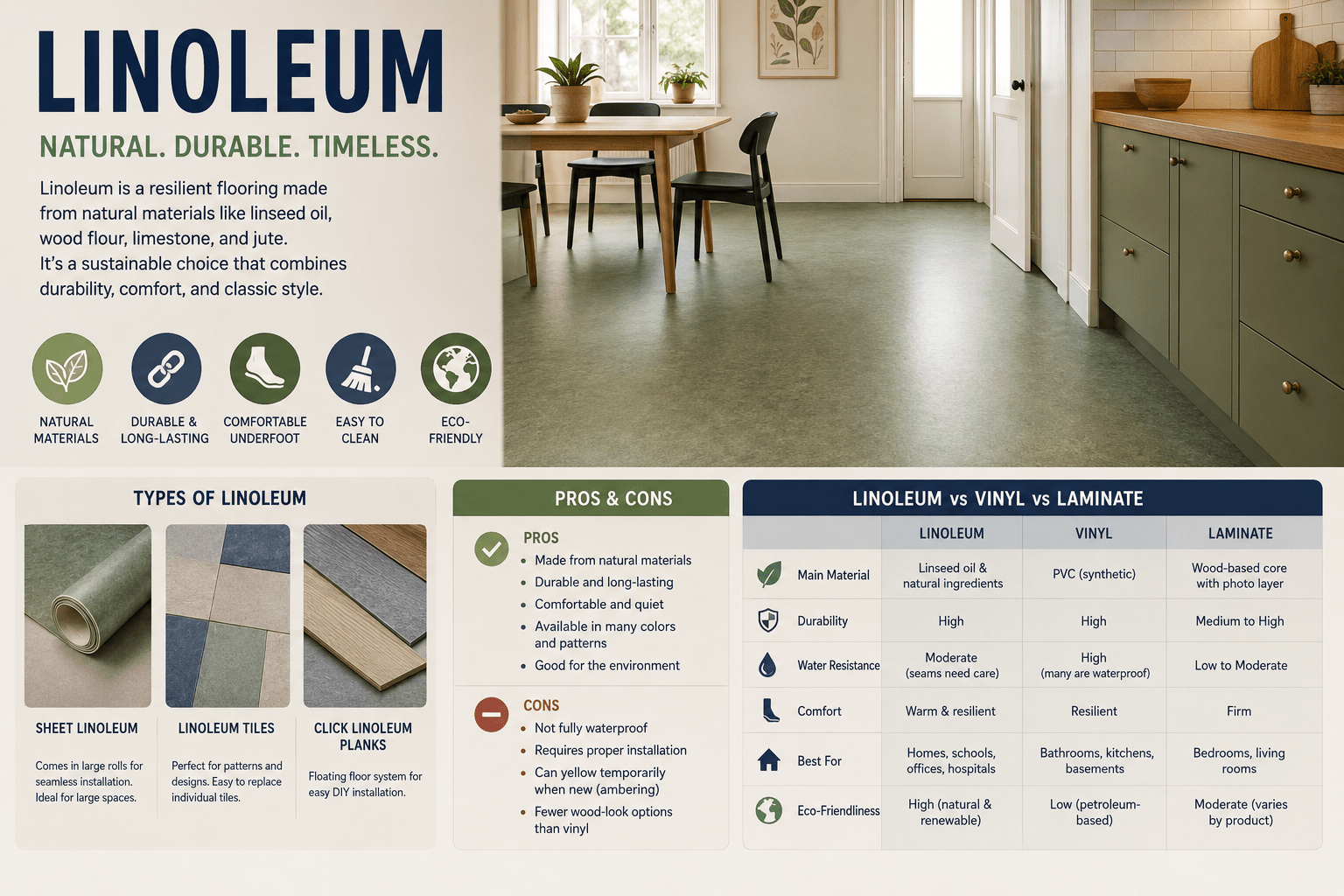
Linoleum is one of the oldest resilient flooring materials still in widespread use—and one of the most misunderstood. Often confused with vinyl, genuine linoleum is a distinct floor covering made primarily from materials such as linseed oil, wood flour, limestone, resins, pigments, and a jute backing.
For homeowners, renovators, designers, and property managers, its appeal is straightforward: linoleum combines durability, comfort underfoot, distinctive color, and a largely bio-based material composition. The challenge is choosing the right format, installing it correctly, and understanding where it performs better—or worse—than alternatives such as vinyl, laminate, and tile.
Linoleum at a glance
- Material: Resilient flooring made largely from natural raw materials
- Common formats: Sheet, tile, and plank
- Best for: Kitchens, hallways, living spaces, offices, schools, and many commercial interiors
- Key strength: Durable surface with a warm, resilient feel
- Main limitation: Moisture at seams, edges, or beneath the floor must be carefully controlled
- Maintenance: Regular dry cleaning plus damp cleaning with an appropriate neutral-pH product
- Often confused with: Vinyl flooring
What Is Linoleum?
Linoleum is a resilient surface material developed in the 19th century and traditionally manufactured by combining oxidized linseed oil with ingredients such as wood flour, pine rosin, limestone, and pigments. The mixture is formed into flooring, commonly over a jute backing.
That composition is what separates genuine linoleum from vinyl. Although both belong to the broad resilient-flooring category and can look similar after installation, they use fundamentally different materials and manufacturing methods.
What Is Linoleum Made Of?
Exact formulations vary by manufacturer and product line, but common ingredients include:
- Linseed oil, produced from flax seeds
- Wood flour
- Pine rosin or other resins
- Limestone
- Mineral or other pigments
- Jute, commonly used as the backing material
Forbo, one of the major contemporary linoleum manufacturers, describes its Marmoleum products as using linseed oil, wood flour, limestone, rosin, pigments, and jute.
This material profile is a significant reason linoleum has regained attention among buyers looking beyond petroleum-heavy flooring products.
Is Linoleum the Same as Vinyl?
No. Calling every flexible sheet floor “linoleum” is one of the most common flooring mistakes.
Vinyl flooring is generally PVC-based, while genuine linoleum relies substantially on materials such as linseed oil, wood flour, limestone, and resins. Armstrong Flooring likewise distinguishes the two as separate resilient flooring products rather than interchangeable names for the same material.
Linoleum vs. Vinyl vs. Laminate
| Feature | Linoleum | Vinyl | Laminate |
|---|---|---|---|
| Primary construction | Linseed oil and other largely natural ingredients | PVC-based resilient flooring | Wood-fiber core with decorative surface |
| Feel underfoot | Resilient and relatively warm | Resilient; varies by construction | Firmer |
| Water tolerance | Good surface resistance, but installation details matter | Often excellent; some products marketed as waterproof | Highly product-dependent |
| Design approach | Integral color, marbled and graphic patterns | Extremely broad printed designs | Often imitates wood or stone |
| Installation | Sheet, glue-down tile, or click systems | Sheet, glue-down, or click | Usually floating/click |
| Repair considerations | Local damage may be less conspicuous on some products | Depends heavily on wear layer and construction | Damaged boards generally require replacement |
| Sustainability profile | Strong bio-based-material potential | Primarily synthetic | Varies significantly by core and manufacturing |
| Best fit | Natural-material-focused interiors and long-term resilient flooring | Maximum design flexibility and moisture resistance | Affordable wood-look installations |
There is no universal winner. The better choice depends on the room, moisture exposure, installation method, design priorities, maintenance expectations, and the technical specifications of the exact product.
Types of Linoleum Flooring
Choosing the correct format matters almost as much as choosing the material itself.
Sheet Linoleum
Sheet linoleum comes in large rolls and creates a relatively continuous floor with fewer joints.
Its biggest advantage is seam reduction. Fewer seams can make cleaning easier and reduce the number of vulnerable transitions across a large space.
Sheet installation, however, requires precision. Cutting, fitting, adhesive application, rolling, seam treatment, and substrate preparation leave relatively little room for DIY error.
Best for:
- Large kitchens
- Hallways
- Commercial spaces
- Healthcare and educational interiors
- Projects where minimizing seams is important
Linoleum Tiles
Tiles provide a modular alternative to sheet flooring. They make geometric layouts easier and may allow an individual damaged section to be replaced without disturbing an entire room.
They also introduce more seams, making precise installation and routine spill management particularly important.
Best for:
- Patterned floors
- Smaller rooms
- Renovations requiring modular installation
- Projects where individual-piece replacement is valuable
Click or Floating Linoleum Planks and Tiles
Some contemporary systems combine a linoleum wear surface with a rigid backing and click-lock installation.
These products can be much more approachable for competent DIY installers because the flooring does not necessarily require full-spread adhesive. Installation requirements still vary, so expansion gaps, subfloor tolerances, underlayment rules, and moisture limitations should come directly from the product instructions.
Best for:
- DIY-oriented renovations
- Bedrooms and living spaces
- Projects where floating installation is desirable
Pros and Cons of Linoleum
Advantages
Durability: Properly specified and maintained linoleum can provide long service life in both residential and high-traffic commercial environments.
Comfort: Its resilient construction is generally more forgiving underfoot than hard ceramic or stone surfaces.
Material composition: Genuine products rely heavily on renewable or abundant raw materials such as linseed oil, wood flour, limestone, and jute.
Design versatility: Modern linoleum is available in solid, marbled, linear, graphic, tile, plank, and sheet formats rather than only the vintage patterns many people associate with it.
Repair-friendly appearance: Because the visual structure of many linoleum products is not simply a photographic print beneath a clear wear layer, ordinary wear can age differently from printed synthetic floors.
Commercial track record: Linoleum remains in use in demanding environments such as schools, healthcare facilities, offices, hospitality interiors, and public buildings.
Disadvantages
Installation can be demanding: Sheet linoleum in particular rewards professional-grade substrate preparation and fitting.
Moisture must be managed: Standing water, wet seams, poorly sealed edges, and moisture migrating through a subfloor can create problems.
Initial color can be misleading: New linoleum may display temporary yellowing or ambering caused by oxidation during manufacturing.
Fewer photorealistic designs: Buyers wanting an exact imitation of rare hardwood or natural stone usually find more options in vinyl or laminate.
Product availability varies: The selection at a typical home-improvement store may be narrower than the selection of luxury vinyl flooring.
Where Does Linoleum Work Best?
Linoleum performs particularly well when the room needs a resilient, cleanable surface without the cold, rigid feel of stone or ceramic.
Kitchens
A kitchen is one of the classic applications.
Linoleum is comfortable for long periods of standing, easy to sweep, and suitable for routine damp cleaning. Promptly wipe up spills rather than allowing water to remain around seams, appliance connections, walls, or cabinet edges.
Living Rooms and Bedrooms
Linoleum is less common here than hardwood or carpet, but modern colors and click systems make it a viable choice.
It works particularly well in interiors where easy cleaning, low visual clutter, bold color, or a mid-century aesthetic is desirable.
Hallways and Entry Areas
These spaces benefit from linoleum’s resilience, but grit is the enemy of almost any floor finish.
Use effective entrance mats and vacuum or sweep frequently. Tiny pieces of sand and grit can behave like abrasive material under shoes.
Bathrooms
Use more caution.
Linoleum can tolerate normal cleaning and incidental moisture, but a conventional installation should not automatically be treated as a waterproof system. In areas exposed to frequent water, use a flooring system specifically approved by its manufacturer for that application.
Forbo, for example, recommends dedicated safety flooring for wet environments rather than assuming standard linoleum is the correct product for every wet-area installation.
Basements
The deciding factor is often not the visible flooring—it is the concrete beneath it.
Before installing linoleum over a slab, verify moisture conditions and follow the flooring and adhesive manufacturer’s limits. A basement that looks dry can still transmit enough vapor through concrete to compromise an adhesive installation.
Commercial Spaces
Linoleum’s commercial history remains relevant because offices, schools, medical facilities, retail environments, and public buildings subject flooring to repeated foot traffic and intensive maintenance.
Manufacturers currently offer sheet, tile, acoustic, conductive, sports, and other specialized linoleum products for different commercial applications.
How to Choose the Right Linoleum
A color sample should be near the end of the decision process, not the beginning.
1. Match the Format to the Room
Choose sheet when seam reduction and large-area performance matter.
Choose tile when patterns, modular replacement, or visual flexibility matter.
Choose click flooring when installation simplicity is a major priority and the specific product is approved for the room.
2. Check the Product’s Intended Use
Do not assume every linoleum product has the same performance characteristics.
Check:
- Residential or commercial classification
- Total thickness
- Surface finish
- Slip resistance
- Castor-chair suitability
- Underfloor-heating compatibility
- Acoustic performance
- Wet-area restrictions
- Required adhesive
- Subfloor moisture limits
- Warranty conditions
A specification sheet is more useful than a showroom label.
3. Request a Physical Sample
Computer screens are unreliable for flooring color because lighting, monitor settings, room orientation, and surrounding materials all alter perception.
Linoleum adds another wrinkle: freshly manufactured material can temporarily show a yellow or amber cast.
4. Understand Temporary “Ambering”
During the manufacturing and curing process, oxidation of linseed oil can produce what manufacturers call drying-room yellowing, stove yellowing, or ambering.
This temporary tint fades after exposure to light and is not necessarily a defect. Forbo notes that the effect may disappear rapidly in bright daylight but can take longer under weaker artificial light.
That means a newly opened blue, gray, or pale sample may not initially represent its final installed color.
Practical tip: expose a sample to normal daylight before making a final color decision.
5. Evaluate the Whole Flooring System
A floor is not just the material visible from above.
Performance also depends on:
- Subfloor
- Moisture mitigation, when required
- Primer
- Leveling compound
- Adhesive
- Seam treatment
- Transitions
- Perimeter detailing
- Cleaning products
Choosing premium linoleum but pairing it with poor substrate preparation is a false economy.
How Linoleum Installation Works
Installation varies substantially by format and manufacturer. Always use the installation instructions supplied for the exact product rather than applying generic flooring rules.
Start With the Subfloor
The substrate should be sound, smooth, appropriately dry, and suitable for the adhesive or floating system being installed.
Small ridges, cracks, adhesive residue, fastener heads, or patching irregularities may remain visible through resilient flooring, especially sheet products.
Test Concrete for Moisture
Do not determine slab moisture by touching the floor or looking for visible dampness.
Professional flooring specifications can set limits for relative humidity, moisture-vapor emission, and substrate pH. Forbo, for example, publishes different allowable moisture and pH conditions depending on the adhesive system being used.
The lesson is simple: the adhesive specification is part of the flooring specification.
Follow Acclimation Requirements
Some flooring products need time in the installation environment before fitting.
Do not invent your own acclimation period. Follow the stated temperature, humidity, storage, and conditioning requirements for the product.
Use the Correct Adhesive
“Flooring adhesive” is not a universal substance.
Manufacturers specify adhesives based on the material, backing, substrate, moisture conditions, format, and application. Substituting an unapproved adhesive can create bond failure even when the linoleum itself is perfectly sound.
Roll the Floor Correctly
Glue-down linoleum typically needs to be pressed into the adhesive using procedures specified by the manufacturer.
Insufficient transfer between the adhesive and backing can cause bubbles, loose areas, or telegraphing.
Treat Seams and Edges Seriously
Edges around walls, penetrations, cabinets, floor drains, doors, and adjoining materials are frequent failure points.
Professional sheet installations may use tightly cut seams or other manufacturer-approved seam techniques. Commercial projects may have additional requirements depending on hygiene, traffic, or moisture exposure.
DIY or Professional Installation?
Click-format linoleum can be realistic for an experienced DIYer.
Sheet linoleum is another matter. A seemingly small cutting error can ruin a large piece of material, while poor adhesive technique may not reveal itself until the floor has already been installed.
Consider professional installation when:
- The room has complicated geometry
- Sheet goods are being used
- The substrate needs extensive leveling
- Concrete moisture is a concern
- Multiple seams are required
- The warranty imposes installation conditions
- The room is commercial or heavily trafficked
The best installer is not simply someone who “does floors.” Ask specifically about experience with linoleum, because techniques learned on click vinyl or laminate do not automatically transfer.
How to Clean Linoleum
A simple maintenance routine is usually more effective than aggressive periodic cleaning.
Routine Cleaning
- Sweep, dust-mop, or vacuum loose debris.
- Clean spills promptly.
- Damp-mop when necessary.
- Use a cleaner approved for the product.
- Avoid leaving excess water on the floor.
Forbo recommends neutral-pH cleaning products for its contemporary linoleum flooring systems.
Avoid Over-Wetting
More water does not mean a cleaner floor.
Excess liquid can work into seams, perimeter gaps, damaged areas, or substrate interfaces. Use enough moisture to clean the surface without flooding it.
Be Careful With Harsh Cleaners
Do not assume that bleach, strong alkaline degreasers, abrasive powder, solvent, steam, or homemade chemical mixtures are suitable.
Check the manufacturer’s maintenance instructions before using an unfamiliar product, particularly on flooring with a factory-applied surface treatment.
Protect Furniture Contact Points
Use appropriate floor protectors beneath chair and furniture legs.
Dragging heavy furniture can cause damage that routine foot traffic would never create. Lift large objects when possible rather than sliding them across the floor.
Can Linoleum Be Repaired?
Minor surface marks may sometimes be less conspicuous than comparable damage to a printed flooring surface, but repair options depend on the product and severity.
For localized damage to modular tile or plank flooring, replacing the affected section may be possible. Sheet repairs require more skill because a patch must align visually and remain secure around its perimeter.
Before attempting sanding, refinishing, sealing, polishing, or applying a restoration coating, consult the manufacturer’s maintenance system. Modern factory finishes may require different treatment from historic linoleum.
How Much Does Linoleum Cost?
There is no useful universal price for linoleum because project cost depends heavily on product type, location, substrate condition, installation method, room geometry, and labor.
When comparing quotes, separate the project into five cost categories:
- Flooring material
- Removal and disposal of the old floor
- Subfloor preparation
- Adhesive, underlayment, or moisture-control products
- Installation labor and finishing details
The third category is the one buyers most often underestimate.
A low flooring price does not help much if a concrete slab needs extensive grinding, patching, leveling, or moisture mitigation. Conversely, an expensive product over a well-prepared substrate may be relatively straightforward to install.
Compare Installed Cost, Not Box Price
If linoleum costs more per square foot than another material, that difference alone does not establish which floor offers better value.
Consider:
- Expected service life
- Maintenance requirements
- Ease of localized repair
- Replacement disruption
- Environmental priorities
- Comfort
- Design longevity
- Commercial-use suitability
A floor replaced twice is not necessarily cheaper than one that costs more initially but remains serviceable much longer.
Is Linoleum Environmentally Friendly?
Linoleum has a credible sustainability case, but environmental claims should still be evaluated product by product.
Its key raw materials can include linseed oil from flax, wood flour, limestone, rosin, and jute. Some modern manufacturers also publish Environmental Product Declarations and detailed material-health documentation.
Rather than relying on vague labels such as “green” or “eco-friendly,” compare measurable documentation.
Look for:
- Environmental Product Declarations (EPDs)
- Material ingredient disclosures
- Indoor-air-emissions certifications
- Renewable material content
- Manufacturing energy information
- Product lifespan
- Adhesive emissions
- End-of-life options
- Manufacturer take-back or recycling programs, if available
The most sustainable floor is not automatically the one with the most natural-looking marketing. Longevity, replacement frequency, installation materials, maintenance, and eventual disposal all matter.
Common Linoleum Buying Mistakes
Mistake 1: Accidentally Buying Vinyl
If material composition matters to you, verify the technical data sheet.
The words “sheet flooring” or “resilient flooring” do not prove that a product is linoleum.
Mistake 2: Choosing From an Unconditioned Sample
Temporary ambering can affect the initial appearance of genuine linoleum.
Allow samples to receive adequate light before rejecting a color that appears more yellow than expected.
Mistake 3: Ignoring the Subfloor Budget
Resilient flooring reveals poor preparation.
Include patching, leveling, moisture testing, and possible remediation when comparing project quotes.
Mistake 4: Assuming It Is Waterproof
Surface spills and permanently wet environments are not the same condition.
Verify wet-area approval rather than assuming that every resilient floor can function as a waterproof membrane.
Mistake 5: Hiring an Installer Without Linoleum Experience
Ask what linoleum brands and formats the installer has worked with recently.
Experience installing luxury vinyl plank is useful, but it does not automatically establish expertise with glue-down sheet linoleum.
Mistake 6: Using a Stronger Cleaner “For Better Results”
Aggressive chemicals can create more problems than they solve.
Start with the maintenance system recommended for the flooring rather than treating linoleum like ceramic tile.
Mistake 7: Ordering Exactly the Room Area
Cuts, pattern direction, damaged pieces, room geometry, and future repairs can require additional material.
Calculate waste based on the format and layout rather than buying exactly the measured square footage.
Linoleum Design Ideas
Contemporary linoleum can do much more than recreate a vintage kitchen.
Use One Color Across Connected Rooms
Running the same flooring through several spaces can make smaller interiors feel calmer and more continuous.
This approach works especially well in apartments, modern homes, studios, and open-plan living areas.
Create Borders and Insets
Tile or precisely cut sheet material can create borders, pathways, geometric fields, or contrasting zones.
Unlike flooring that attempts to imitate another material, linoleum often looks best when its graphic character is used deliberately.
Pair Muted Flooring With Natural Materials
Soft gray, clay, olive, ochre, and neutral linoleum tones combine well with:
- Natural wood
- Painted cabinetry
- Stainless steel
- Plywood
- Cork
- Plaster
- Simple stone surfaces
Embrace Color
One of linoleum’s strongest design advantages is color.
Rather than automatically choosing imitation oak or stone, consider whether a saturated or softly marbled floor could become part of the architecture instead of merely copying another surface.
Linoleum for Historic Homes
Linoleum can be an excellent fit for period renovations, but “historic-looking” and historically accurate are not always the same.
Older installations included patterned sheets, borders, geometric motifs, and richly colored designs. If authenticity matters, research the building’s era and look for archival photographs or physical evidence before choosing a pattern.
When restoring original material, consult a conservation professional before stripping coatings or using aggressive chemicals. Historic flooring may have undergone decades of repairs and maintenance that require a different approach from new material.
Questions to Ask Before Buying
Use this checklist when speaking with a flooring retailer or installer:
- Is this genuine linoleum or vinyl?
- Who manufactures it?
- Is it sheet, tile, glue-down plank, or floating flooring?
- Is it approved for my room?
- What subfloor preparation is required?
- Does the concrete need moisture testing?
- Which adhesive is approved?
- Is professional installation recommended?
- How should seams and edges be treated?
- What cleaner should I use?
- Is a factory finish already applied?
- What voids the warranty?
- Can individual damaged areas be repaired or replaced?
- Are technical data sheets, EPDs, or material disclosures available?
- How much extra material should I keep after installation?
A seller who can answer these questions clearly is more valuable than one who only discusses color and price.
Frequently Asked Questions About Linoleum
Is linoleum waterproof?
Linoleum should not automatically be considered a waterproof flooring system.
The surface can handle ordinary cleaning and incidental spills, but seams, edges, penetrations, adhesives, backing materials, and the substrate all influence performance. For consistently wet spaces, use a product and installation system specifically approved for that environment.
Is linoleum good for kitchens?
Yes. Kitchens are one of its strongest residential applications because the material is resilient, cleanable, and relatively comfortable underfoot.
Wipe up spills promptly and pay particular attention to areas around sinks, dishwashers, refrigerators, and exterior doors.
Is linoleum better than vinyl?
Neither material is universally better.
Choose linoleum when its material composition, distinctive appearance, and long-established resilient-flooring performance align with your priorities. Choose vinyl when extreme design variety or a particular waterproof construction is more important.
Is Marmoleum the same as linoleum?
Marmoleum is a brand of linoleum made by Forbo, not a generic name for every linoleum product.
Forbo currently offers Marmoleum in sheet, tile, and plank formats for a range of residential and commercial applications.
Why does new linoleum sometimes look yellow?
Linseed-oil oxidation during manufacturing can cause temporary drying-room yellowing or ambering.
Exposure to light causes the tint to fade, revealing the intended color.
Can you steam-clean linoleum?
Do not use a steam cleaner unless the flooring manufacturer explicitly approves it.
Steam combines heat and moisture, which can create unnecessary risk at seams, edges, adhesives, and damaged surface areas.
Can linoleum go over existing flooring?
Sometimes, but only when the existing floor and substrate meet the requirements of the new system.
Flatness, stability, height transitions, moisture, surface contamination, old adhesives, and the condition of the existing material all need to be evaluated.
Does linoleum need waxing?
Not necessarily.
Many modern products have factory-applied surface treatments and manufacturer-specific maintenance systems. Forbo, for example, markets contemporary Marmoleum finishes designed for routine maintenance without an initial polymer-floor-finish application.
How to Decide if Linoleum Is Right for You
Linoleum deserves serious consideration when you want a resilient floor with a distinctive design language and substantial natural-material content.
It is particularly compelling when you value:
- Long-term flooring rather than trend-driven replacement
- Comfortable resilient surfaces
- Bold or architectural color
- A largely bio-based material composition
- Commercially proven flooring technology
- Sheet flooring with relatively few seams
- A surface that does not need to imitate wood or stone to look intentional
Look elsewhere when your overriding priority is the easiest possible DIY installation, highly realistic photographic wood designs, or a flooring system engineered specifically for constant wet exposure.
The key is to compare products based on their actual technical characteristics rather than assumptions attached to the material name.
Final Thoughts
Modern linoleum is not simply the old-fashioned kitchen flooring many people remember. It is a mature resilient-flooring category available in contemporary colors, sheets, tiles, and planks, with applications ranging from homes to demanding commercial interiors.
Its best results come from informed specification: verify that you are buying genuine linoleum, choose the right format, prepare the substrate carefully, control moisture, follow the approved installation system, and maintain the surface with appropriate products. Do those things well, and linoleum can be a practical, visually distinctive, and durable flooring choice for years to come.