
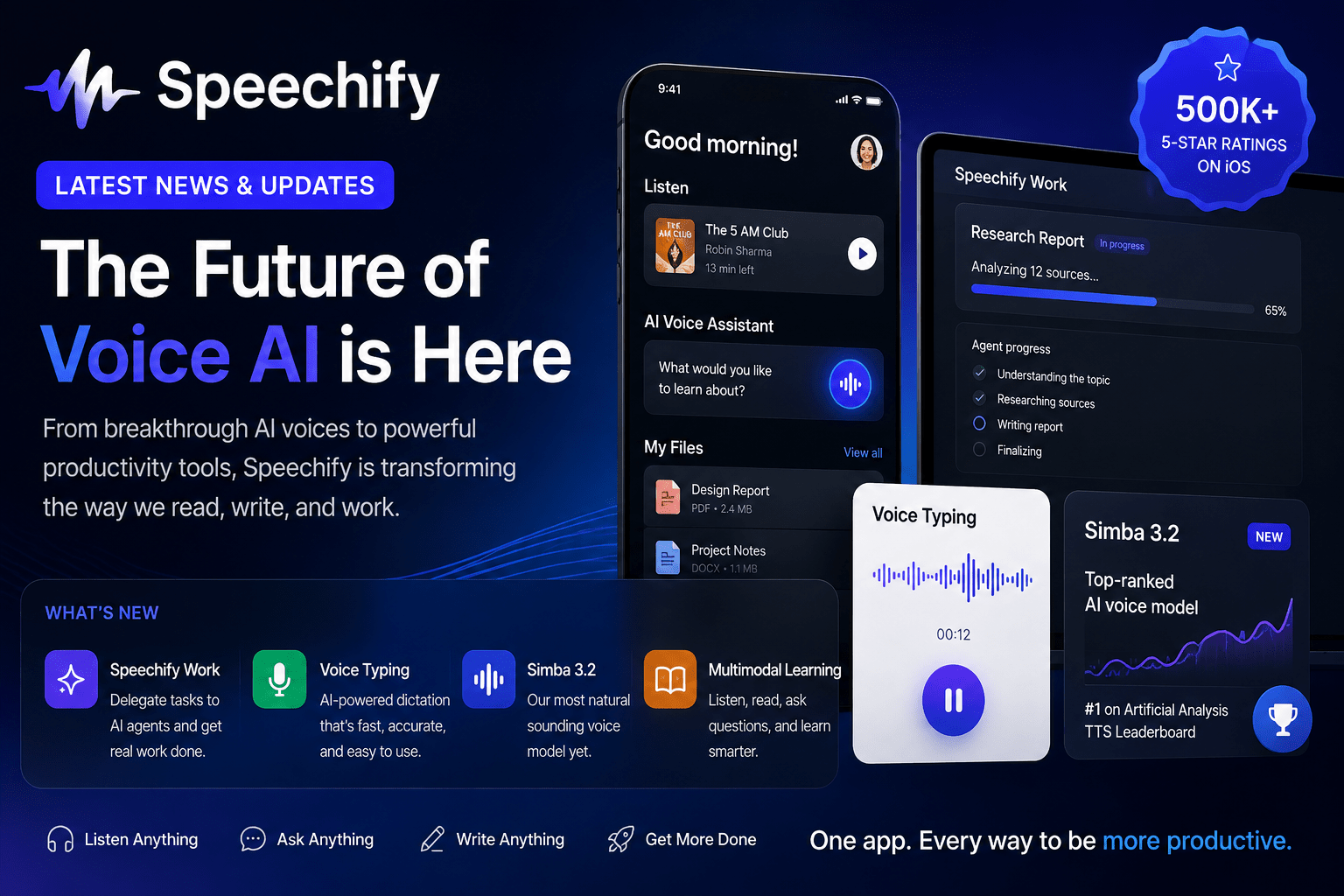
The latest Speechify news tells a bigger story than a routine stream of app updates. Speechify, once known primarily as a text-to-speech reader, is rapidly repositioning itself around voice AI, dictation, autonomous work agents, AI-generated podcasts, and professional productivity.
That shift accelerated throughout 2026. Speechify launched new voice-typing tools, introduced Speechify Work, expanded its Simba voice-model family, appeared at Microsoft Build, and continued adding capabilities intended to move the platform beyond simply reading text aloud.
This guide covers the most important developments, separates company announcements from independent evidence, and explains what Speechify’s recent moves actually mean for users, businesses, and the increasingly competitive voice-AI market.
Speechify News: Quick Facts
| Topic | Latest Development |
|---|---|
| Latest major consumer milestone | Speechify announced that it crossed 500,000 five-star iOS App Store ratings in July 2026 |
| Latest major AI model | Simba 3.2, released in July 2026 |
| Independent voice benchmark | Simba 3.2 has ranked at or near the top of Artificial Analysis’ TTS leaderboards |
| Major productivity launch | Speechify Work launched in June 2026 |
| Voice typing expansion | Speechify launched AI-powered dictation across iOS and Mac in June 2026 |
| Broader company direction | Speechify is evolving from a text-to-speech reader into a voice-first AI productivity platform |
Speechify’s own news feed identifies its July 23 App Store milestone and July Simba announcements among its most recent major updates. Meanwhile, Artificial Analysis independently lists Simba 3.2 among the highest-performing text-to-speech models in its current blind-listener benchmarking.
Latest Speechify News and Major 2026 Updates
Speechify has released products at an unusually fast pace in 2026. The most consequential updates fall into four categories: AI voice generation, dictation, AI agents, and ecosystem expansion.
| Date | Speechify Update | Why It Matters |
| July 23, 2026 | Speechify announces 500,000 five-star iOS ratings | Signals substantial consumer adoption |
| July 2026 | Simba 3.2 gains top-tier TTS benchmark results | Strengthens Speechify’s position as an AI-model developer |
| June 19, 2026 | Fundwell partnership announced | Expands voice agents into business workflows |
| June 11, 2026 | Speechify featured at Microsoft Build 2026 | Raises visibility of its Windows/on-device AI push |
| June 8, 2026 | Speechify Work launches | Moves the product toward agent-based professional work |
| June 5, 2026 | Voice Typing launches on iOS and Mac | Expands Speechify from consuming text into creating it |
| February 23, 2026 | Multimodal learning features launch | Combines listening, documents, Q&A, and summaries |
| February 2026 | AI podcast publishing expands | Turns written material into generated audio experiences |
| January 2026 | Voice AI Assistant rollout accelerates | Establishes Speechify’s broader voice-first AI strategy |
The timeline is significant because these are not isolated feature additions. Collectively, they represent an attempt to build a voice-centric productivity ecosystem around reading, writing, research, communication, and task execution.
Speechify Is No Longer Just a Text-to-Speech App
For years, Speechify’s simplest value proposition was easy to understand: give it text and listen instead of reading.
That positioning changed substantially in 2026.
Speechify announced in February that it was expanding beyond text-to-speech into a broader Voice AI Assistant covering voice typing, AI podcasts, meeting workflows, note-taking, research, and workspace functionality. Later that month, it explicitly described the change as a repositioning into an all-in-one voice AI productivity platform.
From Reading Tool to Voice Interface
The underlying strategic bet appears to be that voice can become both an input and an output layer for computing.
Instead of only asking, “How can AI read this document to me?” Speechify is moving toward questions such as:
- Can users write emails or documents by speaking?
- Can an AI agent research something and return a finished deliverable?
- Can documents become conversational resources?
- Can written material automatically become podcast-style audio?
- Can professional work be initiated through natural-language voice commands?
That is a materially larger market than traditional text-to-speech.
Why This Strategy Matters
Text-to-speech is increasingly available as a built-in feature in operating systems, browsers, AI assistants, and productivity applications. Competing purely on “read this webpage aloud” therefore creates growing commoditization pressure.
Speechify’s answer appears to be vertical integration: develop the underlying voice models while simultaneously building applications around those models.
If successful, Speechify does not have to compete only as a TTS utility. It can compete as an AI productivity platform whose interface happens to be heavily optimized around speech.
Speechify Work Brings AI Agents Into the Platform
One of the biggest pieces of Speechify news in 2026 was the June launch of Speechify Work.
Speechify describes Work as a system in which users can delegate projects to AI agents rather than repeatedly prompting a chatbot. Tasks can include research, reports, and other knowledge-work deliverables, with results returned to the user’s Speechify library.
Chatting With AI vs. Delegating to AI
This distinction matters.
Traditional generative-AI workflows are conversational. A user asks a question, examines the response, corrects it, adds context, requests revisions, and repeats the process.
Agent-oriented software aims to compress that interaction:
Prompt → execution → completed output
Whether the execution quality consistently matches that promise will matter more than the “agent” label itself.
For professionals evaluating Speechify Work, the useful questions are therefore practical ones: How accurately does it follow complex instructions? How well does it use sources? Can outputs be audited? How much revision is still required?
Those metrics will ultimately determine whether Work becomes a substantial productivity product or simply another interface around generative AI.
Voice Typing Is Becoming a Core Part of Speechify
Speechify’s expansion also works in the opposite direction from text-to-speech.
Instead of converting writing into voice, Voice Typing converts voice into writing.
Speechify launched its Voice Typing Dictation product on iOS and Mac on June 5, 2026. The company says its AI cleans spoken input by handling filler words, punctuation, grammar, and formatting while allowing dictation across applications.
Why Dictation Fits Speechify’s Strategy
Dictation makes strategic sense because it closes the voice-productivity loop.
A user could theoretically:
- Speak to create text.
- Use AI to research, rewrite, or analyze that text.
- Listen to documents or results.
- Ask questions about the material.
- Turn the resulting content into another spoken format.
That creates a much stickier ecosystem than a standalone read-aloud application.
It also means Speechify increasingly competes with several categories simultaneously: transcription software, AI assistants, productivity suites, research tools, accessibility software, and conventional text-to-speech applications.
Simba 3.2 Is Speechify’s Most Important AI Voice Development
Speechify’s consumer applications get most of the brand recognition, but its Simba voice models may prove equally important strategically.
Simba 3.2 was released in July 2026, and independent benchmark provider Artificial Analysis currently places it among the strongest text-to-speech models available. On one recent version of the provider-voice leaderboard, Simba 3.2 recorded an Elo score around 1,229 and occupied the top tier alongside Alibaba’s Qwen Audio models and Google’s Gemini TTS technology.
Artificial Analysis also lists Simba 3.2 at approximately $10 per million characters in its benchmark comparison, making the model notable not only for listener preference but for its quality-to-price positioning.
What the AI Voice Rankings Actually Mean
This is an area where readers should interpret headlines carefully.
A first-place leaderboard position does not prove that one model is objectively superior for every possible voice use case. Artificial Analysis calculates rankings from blind listener comparisons, and positions can change as additional votes, models, or releases enter the benchmark.
The stronger conclusion is that Simba 3.2 has become technically competitive with leading speech-generation models from considerably larger AI companies.
That is meaningful.
Why Simba Matters Beyond Speechify’s Reader
A proprietary voice model gives Speechify options.
The company can use Simba inside its consumer products while potentially serving developers and businesses through APIs and voice-agent applications. That allows investments in model quality to improve multiple products instead of a single app.
It also means future Speechify news may increasingly resemble AI-infrastructure news rather than conventional consumer-app news.
Speechify’s Microsoft Build Appearance Signals a Windows Push
Another notable 2026 development came when Speechify was featured during Microsoft Build.
Speechify reported that Microsoft CEO Satya Nadella included the product during the Build 2026 opening keynote, following Speechify’s work on its Windows application and on-device AI capabilities. The company says the Windows development involved collaboration with Microsoft as well as hardware ecosystem companies including Qualcomm, NVIDIA, Intel, and AMD.
The broader context matters: Speechify historically had strong visibility on mobile devices and through browser-based reading workflows. A serious Windows push extends the product toward professional desktop usage, where dictation and workplace AI may have more strategic value.
Partnerships Show Speechify Wants to Become an Ecosystem
Speechify has also been building distribution partnerships rather than relying solely on direct consumer acquisition.
In January 2026, the company announced a partnership with Y Combinator intended to provide companies in the YC ecosystem access to Speechify’s AI Assistant. In February, Speechify announced a Grammarly partnership integrating its text-to-speech capabilities into Grammarly’s broader browser ecosystem.
These announcements suggest that Speechify sees integrations as another growth channel.
That matters because AI productivity is becoming less about isolated apps and more about where an assistant appears inside existing workflows. The tool that requires the least context switching often has an advantage over a technically impressive product that lives in a separate interface.
Speechify’s App Store Presence Remains a Major Asset
Despite its newer AI ambitions, Speechify still has something many AI startups lack: a large existing consumer footprint.
Speechify announced in July 2026 that it had surpassed 500,000 five-star App Store ratings. Apple’s current U.S. App Store listing independently shows roughly 508,000 total ratings and an average score of 4.7 out of 5, although Apple’s figure represents total ratings rather than specifically five-star reviews.
That distinction is worth making because company marketing and marketplace statistics measure slightly different things.
Even so, the underlying point is clear: Speechify enters the AI-assistant race with an established user base rather than starting from zero.
What Independent Testing Says About Speechify
Company announcements explain what Speechify wants its products to do. Independent testing is more useful for understanding where the product actually differentiates itself.speechify news
In an August 2026 comparison, Windows Central tested Speechify against Microsoft Edge’s free Read Aloud capability. The reviewer found Speechify’s voices more natural and praised its handling of complex webpages, particularly its ability to stay focused on primary article content instead of reading unrelated webpage elements.
The same review raised an important counterpoint: users who only need basic webpage narration may struggle to justify paying for a dedicated product when competent free read-aloud features already exist.speechify news
That illustrates Speechify’s central commercial challenge.speechify news
The more Speechify expands into dictation, AI agents, document intelligence, and other workflows, the easier it becomes to justify a premium platform. For users who only want basic TTS, however, free alternatives continue getting better.speechify news
Speechify vs. Basic Read-Aloud Tools
| Capability | Speechify’s Current Direction | Basic Browser or OS TTS |
| Read webpages aloud | Yes | Usually |
| Read PDFs/documents | Yes | Varies |
| Premium natural-sounding AI voices | Major focus | Varies |
| Voice typing | Yes | Often available separately |
| AI document interaction | Yes | Limited or separate |
| AI work agents | Speechify Work | Generally no |
| AI podcast creation | Yes | Generally no |
| Advanced workflow integration | Expanding | Limited |
| Cost advantage | Depends on use case | Free tools often win |
The comparison highlights why evaluating Speechify solely as “a text-to-speech app” is increasingly misleading.
Its strongest competitive argument is becoming consolidation: one environment for reading, speaking, writing, researching, and generating voice content.speechify news
Its weakest value proposition may be the opposite use case—a person who needs only occasional text read aloud.speechify news
Who Should Follow Speechify News Closely?
Speechify’s development is especially relevant to several audiences.speechify news
Knowledge Workers
Speechify Work and voice typing could matter to people who regularly handle research, reports, email, documentation, and long-form information.
The key metric to watch is whether its agent workflows reliably save more time than traditional AI chat interfaces.
Developers Building Voice Products
Simba makes Speechify relevant beyond consumer productivity.
Developers evaluating TTS APIs should compare models using their own material rather than relying entirely on leaderboard rankings. Latency, emotional range, pronunciation, API reliability, licensing requirements, language support, and cost can matter as much as headline Elo scores.
Students and Heavy Readers
Speechify’s original value proposition remains highly relevant: transforming documents, articles, and PDFs into audio.
Its newer multimodal features add document Q&A and summaries, potentially making the platform more useful for working through dense material rather than merely hearing it read aloud.
Accessibility Users
Voice interfaces can substantially change how people interact with written information, particularly when conventional reading or typing workflows are inconvenient.
Users with specific accessibility requirements should still test their actual documents, devices, languages, voices, and workflows before committing to any platform. Accessibility quality is highly contextual and cannot be reduced to a feature checklist.
Content Creators
Speechify’s podcast-generation and voice technology increasingly overlap with content-production workflows.
AI Podcast Publishing, introduced in 2026, lets users transform documents and written content into podcast-style generated audio without a conventional recording process.
What to Watch in the Next Wave of Speechify News
Product announcements alone will not determine whether Speechify’s expansion succeeds. Five areas deserve particular attention.
1. Whether Speechify Work Delivers Reliable Agentic Execution
Many AI companies now describe their software as “agents.”
The meaningful differentiator will be completion quality: can Speechify execute multi-stage work accurately with minimal supervision, or will users still need extensive review and correction?
2. Whether Simba Maintains Its Technical Momentum
Speech AI benchmarks are moving quickly.
Simba 3.2’s current performance is impressive, but Google, Alibaba, Microsoft, ElevenLabs, Cartesia, Inworld, and other voice-AI developers continue releasing new models. A leaderboard advantage can disappear quickly.
3. Pricing and Product Complexity
Adding functionality increases value, but it can also make a previously straightforward product harder to understand.
Speechify will need to communicate clearly which capabilities are free, which require premium access, which belong to business or API products, and where usage limits apply.
4. Cross-Platform Consistency
Speechify now spans web, mobile, Mac, Windows, browser extensions, voice AI, and professional workflows.
The more surfaces a platform supports, the more important consistent functionality becomes. A feature that works beautifully on one device but behaves differently elsewhere can weaken the unified-platform proposition.
5. Privacy and Enterprise Readiness
Voice typing, document processing, meeting tools, research agents, and workplace AI can involve sensitive information.
As Speechify moves deeper into professional workflows, buyers should pay close attention to data handling, retention, security controls, administrative capabilities, and contractual terms—not simply voice quality.speechify news
Common Mistakes When Evaluating Speechify Updates
Treating Company Announcements as Independent Proof
Speechify’s newsroom is useful for identifying launches, partnerships, and corporate milestones.speechify news
Performance claims should still be checked against independent benchmarks, marketplace data, direct testing, or third-party reviews whenever possible.speechify news
Assuming a No. 1 Benchmark Means “Best for Everyone”
Voice quality is subjective and application-specific.
A model preferred in blind listening tests may not be the best model for low-latency agents, audiobooks, specialized terminology, multilingual speech, character voices, or a particular budget.
Comparing Speechify Only With Other TTS Apps
That comparison is increasingly incomplete.
Its competitive set now includes AI assistants, transcription software, productivity platforms, research tools, podcast-generation products, and agentic-work systems.
Ignoring Free Alternatives
Dedicated software should solve a problem better enough to justify its cost.
Windows Central’s recent comparison shows the tradeoff clearly: Speechify can provide a more sophisticated reading experience, while a free browser feature may be entirely sufficient for a user with basic needs.
Frequently Asked Questions About Speechify News
What is the latest Speechify news?
Among Speechify’s latest major announcements are its July 2026 App Store ratings milestone and the performance of its Simba 3.2 voice model. Earlier major 2026 developments include Speechify Work, expanded Voice Typing, Microsoft Build visibility, multimodal learning, AI podcast tools, and a broader Voice AI Assistant strategy.speechify news
Is Speechify still a text-to-speech app?
Yes, but text-to-speech is now only one part of the platform.
Speechify has expanded into voice typing, AI assistants, AI agents, document Q&A, podcast creation, workplace tools, and voice-model development.
What is Speechify Simba 3.2?
Simba 3.2 is a text-to-speech model developed by Speechify’s AI efforts.
It has placed at or near the top of Artificial Analysis’ current TTS leaderboards, where speech samples are compared using blind listener voting.
Is Simba 3.2 the best AI voice model?
It is one of the strongest performers on current Artificial Analysis benchmarks, but “best” depends on the benchmark and use case.
Rankings can also change as additional user votes and competing models enter the leaderboard.
What is Speechify Work?
Speechify Work is an AI-agent product designed around delegation rather than conventional chatbot interactions.
Speechify says users can assign research, reports, and professional tasks to agents and receive completed deliverables inside their Speechify environment.
Is Speechify Voice Typing free?
Speechify announced its June 2026 iOS and Mac Voice Typing launch as offering free, unlimited AI-powered dictation. Specific product availability, platform requirements, premium features, and commercial terms can change, so users should verify the current terms before choosing a plan.
How popular is Speechify on iOS?
Apple’s U.S. App Store currently shows approximately 508,000 ratings with an average of 4.7 stars for Speechify’s main text-to-speech app. Speechify separately announced that it had passed 500,000 five-star ratings in July 2026.
Final Take: What the Latest Speechify News Really Means
The most important conclusion from recent speechify news is not any single feature or product launch. It is the transformation of Speechify’s business from a specialized reading application into a broader voice-first AI platform.
Voice Typing moves Speechify into text creation. Speechify Work pushes it toward autonomous professional tasks. Multimodal document tools expand learning and research, while Simba gives the company its own increasingly competitive voice-model technology.
Independent evidence adds weight to parts of that strategy. Simba 3.2 has performed strongly in third-party voice benchmarks, Apple’s App Store confirms a substantial consumer footprint, and independent testing has highlighted areas where Speechify’s reading experience can outperform free alternatives.
The next question is execution.
Speechify has already demonstrated that it can ship quickly. Its larger challenge is proving that a unified platform built around voice can deliver enough practical value—in reading, writing, research, agents, and professional workflows—to stand out in an AI market where nearly every major technology company is competing for the same daily user attention.