

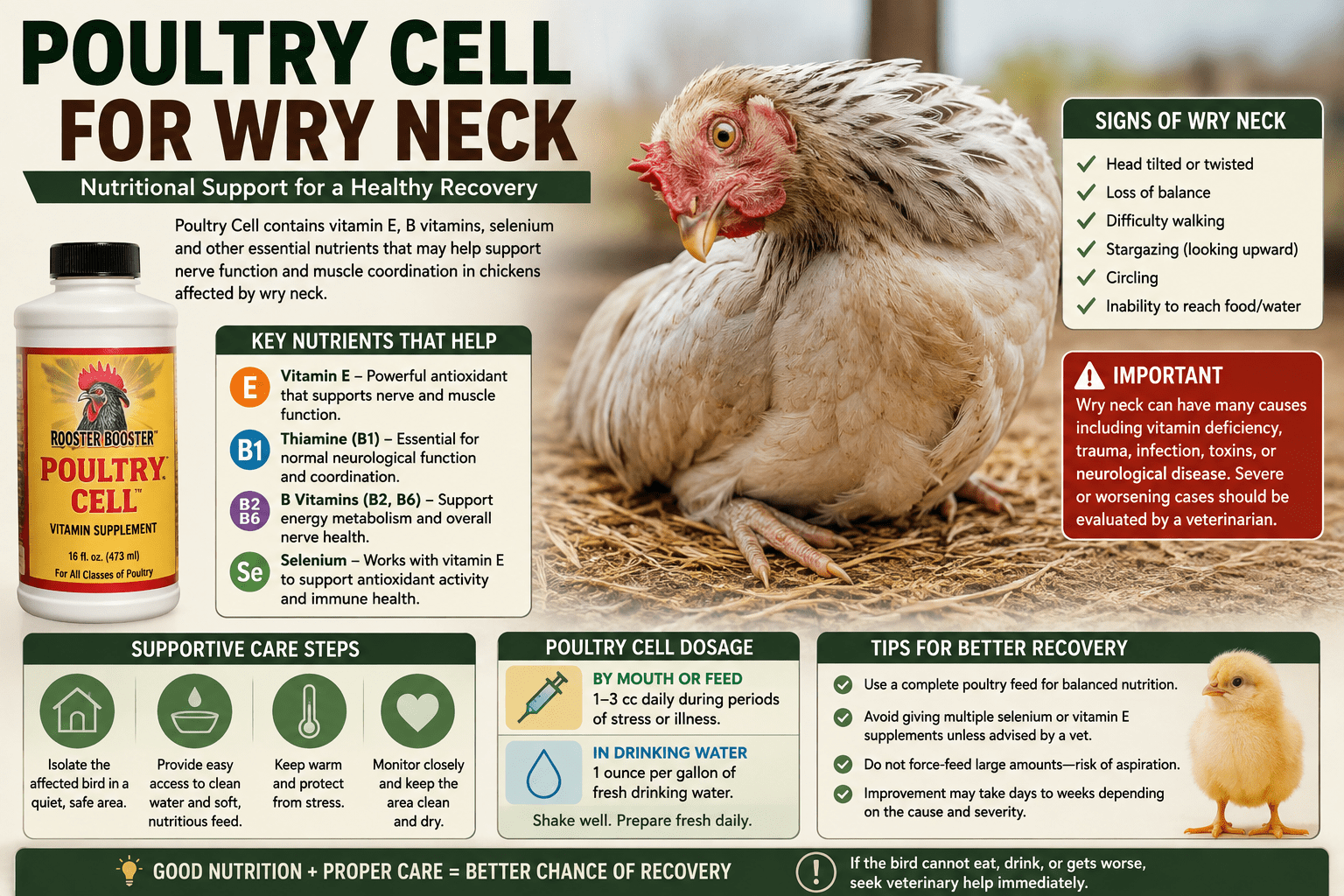
If your chicken suddenly holds its head sideways, twists its neck, looks upward, or struggles to keep its head in a normal position, you may be dealing with wry neck, also called torticollis or stargazing. Many flock owners consider Poultry Cell for wry neck because the supplement contains vitamin E, several B vitamins, selenium, and other nutrients involved in normal nervous-system and muscle function.poultry cell for wry neck
Poultry Cell can be useful when a nutritional deficiency or period of severe stress contributes to the problem. But wry neck is a clinical sign, not a diagnosis, and vitamins will not correct every underlying cause. Trauma, toxins, infections, congenital abnormalities, and other neurological disorders can produce similar symptoms.poultry cell for wry neck
The best approach combines appropriate supplementation with supportive care—and knowing when the bird needs veterinary attention.
Quick Facts
Product: Rooster Booster Poultry Cell
Common use: Nutritional support during illness, stress, molting, and vitamin deficiency
Relevant nutrients: Vitamin E, thiamine (B1), riboflavin (B2), pyridoxine (B6), selenium, and other vitamins/minerals
Manufacturer positioning: Poultry Cell may help birds affected by wry neck or vitamin deficiency.
Important: Wry neck can have non-nutritional causes, so supplements should not replace diagnosis when symptoms are severe, spreading, or persistent.
What Is Wry Neck in Chickens?
Wry neck describes an abnormal head or neck position. Affected chickens may hold their head at an angle, twist it backward, tuck it downward, or repeatedly lose control of the normal neck position.
You may also hear the condition called:
- Torticollis
- Twisted neck
- Crooked neck
- Stargazing
- Limber neck
The terminology can be misleading because wry neck is not one specific disease. It is a neurological or musculoskeletal sign that can develop for several different reasons.
What Wry Neck Can Look Like
Mild cases may involve nothing more than a persistent head tilt. More severely affected chickens may stumble, walk backward, roll over, lose their balance, or become unable to reach food and water.
A bird that cannot control its head can deteriorate quickly from dehydration or inadequate food intake even if the original underlying problem is treatable.
Does Poultry Cell Help Wry Neck?
It can—but primarily when nutritional deficiency or nutritional stress is involved.
Rooster Booster states that Poultry Cell supports poultry during illness and other stressful periods and specifically says the supplement may help with wry neck and vitamin deficiency. The formula contains vitamins A, D and E, essential B vitamins, minerals, amino acids, and iron.
Current product information also lists thiamine, riboflavin, pyridoxine and selenium among its nutrients.
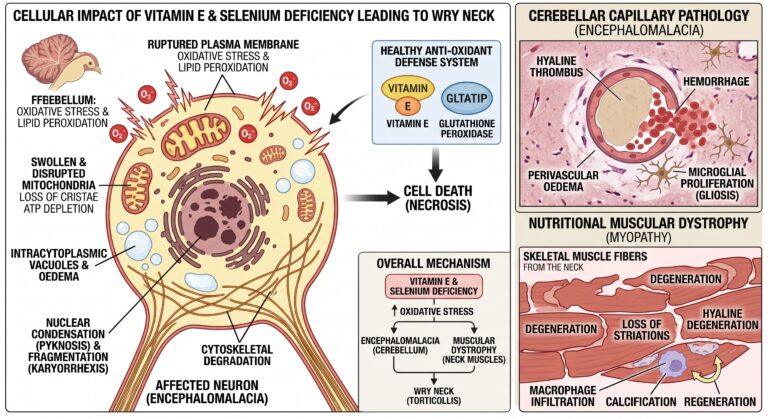
That combination is relevant because both vitamin E deficiency and thiamine deficiency have been associated with neurological abnormalities in poultry, including torticollis and impaired coordination.
Why Vitamin E Matters
Vitamin E functions as an important biological antioxidant. Severe vitamin E deficiency in young chickens can contribute to nutritional encephalomalacia, a disorder involving damage to the cerebellum.
Affected birds can develop ataxia, poor coordination, abnormal movements, and other neurological signs. Vitamin E supplementation may help when deficiency is responsible, although recovery depends partly on how much neurological damage has already occurred.
Why B Vitamins Matter
Thiamine, or vitamin B1, is essential for normal neurological function. Wry neck has been associated with thiamine deficiency as well as vitamin E deficiency.
Poultry Cell contains several B vitamins, including B1, B2 and B6, rather than providing vitamin E alone.
What About Selenium?
Poultry Cell already contains selenium in addition to vitamin E.
Selenium and vitamin E have closely related antioxidant roles, and inadequate selenium can contribute to certain deficiency disorders in poultry. However, selenium is a trace mineral with a relatively narrow safety margin, so adding large amounts of a separate selenium supplement on top of Poultry Cell is not automatically better.
That is an important detail frequently missed in home-treatment discussions.
Poultry Cell vs. Vitamin E Alone for Wry Neck
| Option | Potential Advantage | Main Limitation |
|---|---|---|
| Poultry Cell | Provides vitamin E plus several B vitamins, selenium, minerals and amino acids | Cannot treat every cause of wry neck |
| Vitamin E alone | Directly addresses inadequate vitamin E intake | Does not address possible B-vitamin or other nutritional deficiencies |
| Vitamin E + separate selenium | Sometimes recommended in deficiency protocols | Greater risk of accidentally giving excessive selenium |
| Balanced poultry feed + supportive care | Corrects the overall diet and provides calories/protein | A severely affected bird may not eat enough without assistance |
| Veterinary treatment | Can investigate trauma, infection, toxins and neurological disease | Requires access to an avian or poultry-capable veterinarian |
For many backyard flock situations, the advantage of Poultry Cell is not that it is a magical wry-neck medication. It is that it provides a broader nutritional profile than simply giving one isolated vitamin.
Poultry Cell Dosage for Wry Neck
The current feeding information for Rooster Booster Poultry Cell states:
1–3 cc daily during periods of stress or competition, given orally or mixed with feed. The product can alternatively be mixed at 1 ounce per gallon of drinking water.
Those are the manufacturer’s general feeding directions—not a veterinary prescription specifically tailored to torticollis.
Should You Give Poultry Cell Directly or in Water?
For a healthy flock receiving temporary nutritional support, adding Poultry Cell to drinking water may be convenient.
For a chicken with significant wry neck, however, relying exclusively on medicated water has a practical limitation: the sickest birds may not be able to drink normally.
The manufacturer advises preparing fresh Poultry Cell water daily because some components can settle, and the mixture should be shaken or stirred. Its published water-mixing guidance is approximately consistent with the one-ounce-per-gallon label ratio.
Be More Careful With Chicks
Do not simply assume that an adult dose should be given to a tiny chick.
Age, body size, severity, diet, and the amount of supplement already being consumed through water all matter. When treating a very young chick or combining Poultry Cell with additional vitamin E or selenium products, obtain dosage guidance from a poultry-experienced veterinarian whenever possible.
How to Use Poultry Cell for Wry Neck Safely
1. Isolate the Affected Bird
Place the chicken somewhere quiet and protected from flock mates. A bird that cannot balance normally is vulnerable to trampling, pecking, stress, and difficulty competing for food.poultry cell for wry neck
PoultryDVM recommends supportive isolation with easy access to food and water for birds showing wry-neck symptoms.poultry cell for wry neck
Use non-slip bedding and remove high perches or other objects that could cause additional injury.poultry cell for wry neck
2. Make Food and Water Easy to Reach
Position shallow food and water dishes where the chicken can reach them without having to stretch or precisely control its neck.
Moistening the bird’s normal complete poultry feed can create a soft mash that is easier to pick up while still providing balanced nutrition.
Do not replace a nutritionally complete poultry ration with large quantities of treats simply because certain foods contain vitamin E.
3. Follow the Product Label
Shake Poultry Cell well before use and follow the manufacturer’s current directions.
Because formulations and labels can change, the instructions on the bottle you actually purchased should take precedence over dosing recommendations copied from old forum posts.poultry cell for wry neck
4. Be Careful When Syringe-Feeding Liquids
A chicken that cannot position its head normally is at increased risk of inhaling liquid into the airway.
If you must offer liquid manually, deliver tiny amounts at the side of the beak and allow the bird to swallow voluntarily. Never rapidly squirt a syringe of liquid down the throat.poultry cell for wry neck
A bird that cannot swallow reliably needs professional help rather than increasingly aggressive force-feeding.poultry cell for wry neck
5. Continue a Complete Diet
Supplementation should correct a potential gap, not replace proper feed.
Commercial poultry diets are formulated to provide appropriate concentrations of vitamins and minerals. Nutrient requirements vary according to the bird’s age and production stage, which is another reason random combinations of human vitamin tablets, livestock pastes, and poultry supplements can become problematic.
How Long Does Wry Neck Take to Improve?
There is no reliable universal recovery timeline.
If an uncomplicated nutritional deficiency is responsible and irreversible neurological damage has not occurred, correcting the deficiency may produce noticeable improvement. Severe vitamin E deficiency involving encephalomalacia, however, may respond incompletely depending on the extent of damage to the cerebellum.
Recovery also depends on whether the bird remains adequately hydrated and nourished.
Instead of expecting a dramatic overnight cure, watch for functional changes such as:
- Better ability to hold the head normally
- Fewer twisting episodes
- Improved balance
- Independent drinking
- Independent eating
- Greater alertness and normal activity
Small improvements matter. Equally important, lack of progress may indicate that nutritional deficiency is not the primary problem.
Why Poultry Cell Sometimes Doesn’t Fix Wry Neck
One of the biggest mistakes poultry keepers make is assuming that every twisted neck equals vitamin deficiency.
Wry neck can be associated with nutritional disorders, congenital abnormalities, trauma, toxins, infections, parasites and other neurological conditions.
If Poultry Cell is supplying adequate nutrients but the actual problem is head trauma, an infectious disease, or toxin exposure, continuing to increase the supplement is unlikely to address the underlying cause.
Consider the Bird’s History
Ask what changed before symptoms appeared.
Did the chicken recently suffer a fall, peck to the head, predator attack, or collision? Was moldy or spoiled feed available? Was the bird exposed to chemicals, pesticides, contaminated material, or unusual plants?
Also consider whether one bird is affected or several.
A single bird with a previous injury creates a different diagnostic picture from multiple flock members developing neurological symptoms at roughly the same time.
When Wry Neck Requires a Veterinarian
Contact an avian or poultry-experienced veterinarian promptly if the chicken cannot drink, cannot swallow normally, is becoming progressively weaker, repeatedly rolls or convulses, has difficulty breathing, or shows signs of significant trauma.
Veterinary evaluation becomes especially important when multiple chickens develop neurological symptoms, birds are dying unexpectedly, toxin exposure is possible, or the bird improves and then repeatedly relapses.
Those patterns make it particularly important to investigate causes beyond simple nutritional deficiency.
Common Mistakes When Treating Wry Neck
Treating the Symptom as the Diagnosis
“Wry neck” tells you what the neck is doing. It does not tell you why.
Vitamin supplementation can be reasonable supportive care, but persistent neurological disease deserves investigation.
Giving Multiple Selenium Products
Because Poultry Cell already contains selenium, automatically combining it with concentrated selenium preparations can unnecessarily increase total intake.
More supplementation is not always more effective.
Using Vitamins but Ignoring Hydration
A bird may receive perfectly appropriate vitamins and still deteriorate because it cannot drink.
Accessibility of water, food intake, warmth, and protection from injury are fundamental parts of treatment.
Depending on Treats Instead of Complete Feed
Egg, greens, seeds, or other foods can be useful as appetite stimulants, but they should not become the bird’s entire recovery diet.
A complete poultry feed provides a controlled nutrient balance that improvised diets rarely match.
Stopping Observation as Soon as the Neck Straightens
A chicken may regain better neck control before its coordination, strength, or appetite fully returns.
Continue monitoring food consumption, water intake, droppings, balance, body condition, and overall behavior.
Can Wry Neck Be Prevented?
Not every case can be prevented, particularly when trauma, congenital problems, infections, or other neurological disorders are responsible.
Nutritional risk can be reduced by keeping birds on a complete feed appropriate for their life stage, storing feed correctly, and preventing rancidity or spoilage.
Vitamin E requirements vary according to factors including the bird’s age and diet composition. Diets containing unstable fats can increase the risk of vitamin E-related nutritional problems.
Avoid routinely adding numerous supplements to an already balanced diet unless there is a reason to do so. Poultry Cell itself is positioned primarily for periods of illness, molting, stress, or similar increased nutritional demand rather than as a substitute for properly formulated everyday feed.
Frequently Asked Questions About Poultry Cell for Wry Neck
Does Poultry Cell contain vitamin E?
Yes. Poultry Cell contains vitamin E along with vitamins A and D, several B vitamins, minerals, amino acids and other nutrients.
Does Poultry Cell contain selenium?
Yes. Current product information lists selenium and sodium selenite in the formulation.
That matters if you are considering giving a second selenium-containing product at the same time.
Can Poultry Cell cure wry neck?
Not necessarily.
It may help when inadequate nutrient intake contributes to the neurological signs, and the manufacturer specifically identifies wry neck and vitamin deficiency among conditions for which the supplement may provide support.
It cannot be expected to cure torticollis caused by trauma, toxins, infectious disease, congenital abnormalities, or unrelated neurological disorders.
How much Poultry Cell should I give a chicken?
The current product feeding guide lists 1–3 cc per day during periods of stress or competition, either orally or mixed into feed. For flock-water administration, the listed ratio is 1 ounce per gallon.
Very young chicks, severely ill birds, and chickens already receiving additional supplements deserve more individualized guidance.
Should I give extra vitamin E with Poultry Cell?
Poultry Cell already supplies vitamin E, but whether additional therapeutic vitamin E is appropriate depends on the suspected cause, diet, bird size, and severity of the condition.
Rather than stacking several supplements without calculating total intake, consult an avian veterinarian when a bird has significant neurological symptoms.
Should I add selenium separately?
Do not automatically do so.
Poultry Cell already contains selenium. Additional selenium should be used cautiously because excessive intake can become toxic.
Is Poultry Cell better in water or by mouth?
Water administration is convenient when birds drink normally. Direct individual administration makes intake easier to measure but must be done carefully, particularly when wry neck interferes with swallowing.
For severely affected birds, the most important question is not merely which route is easier—it is whether the chicken can swallow safely at all.
The Bottom Line on Poultry Cell for Wry Neck
Poultry Cell for wry neck is a reasonable nutritional-support option because it provides vitamin E, thiamine and other B vitamins, selenium, minerals, and amino acids relevant to normal neurological and metabolic function. The manufacturer also specifically identifies wry neck and vitamin deficiency as situations in which Poultry Cell may help.
The key is recognizing its limitations. Wry neck is a symptom with multiple possible causes, and severe or persistent cases should not be treated indefinitely as a vitamin deficiency without considering trauma, toxins, infection, congenital disease, or other neurological problems.
Use Poultry Cell according to the current label, provide easy access to complete feed and clean water, prevent the bird from injuring itself, and monitor whether function is genuinely improving. When the chicken cannot eat or drink safely, deteriorates, relapses, or other birds become affected, veterinary diagnosis becomes the priority.