

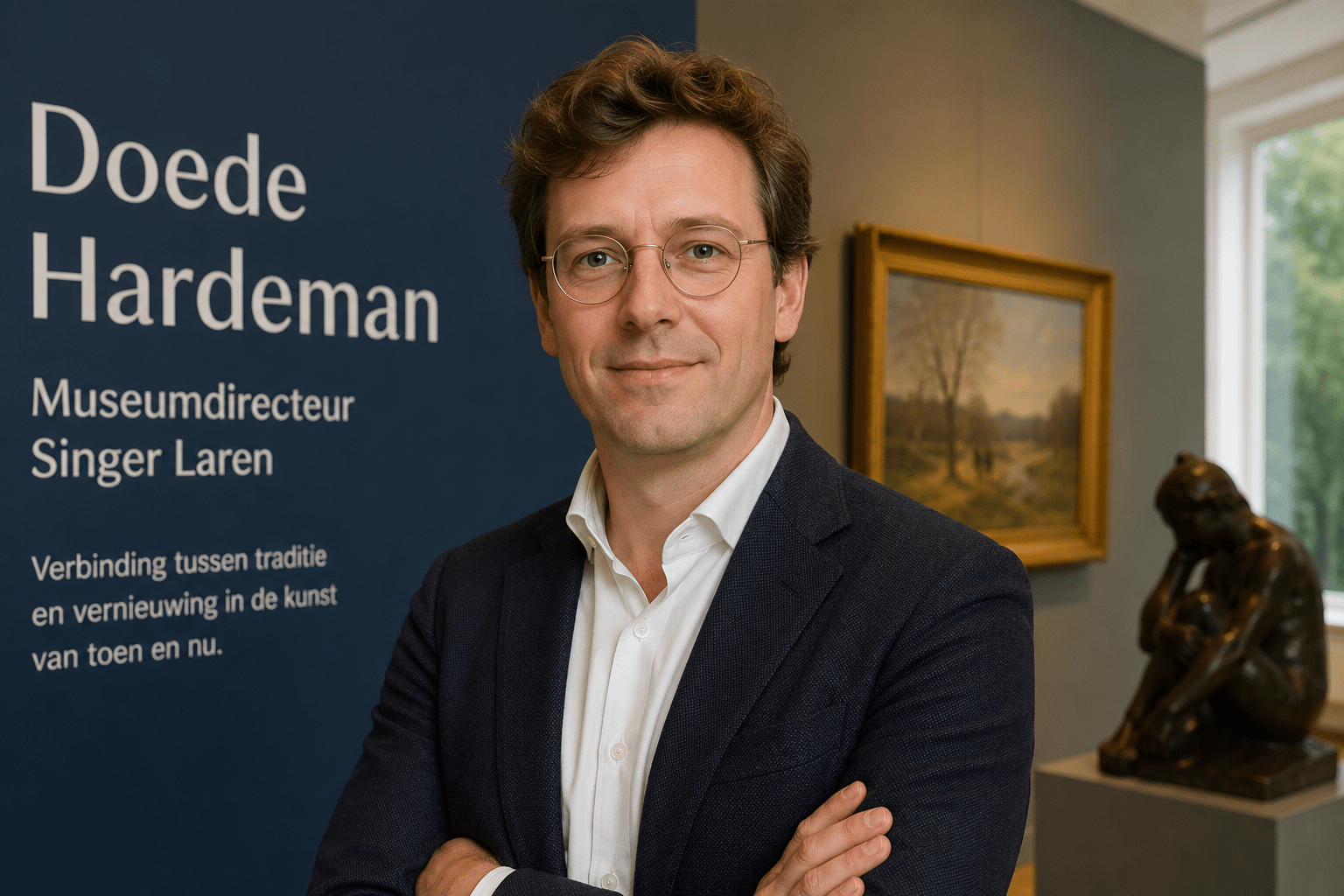
Doede Hardeman is a Dutch art historian, curator and museum leader known for his long career at Kunstmuseum Den Haag and his current position as museum director of Singer Laren.
After joining Kunstmuseum Den Haag in 2006, Hardeman progressed from curator of modern art to Head of Collections. In November 2025, he began a new chapter by taking responsibility for the artistic and museum-focused direction of Singer Laren.
His career has combined exhibition development, collection strategy, art-historical research, publishing and public engagement. That mix helps explain why his appointment at Singer Laren attracted attention within the Dutch museum sector.
Doede Hardeman Quick Facts
| Detail | Information |
|---|---|
| Full name | Doede Hardeman |
| Profession | Art historian, curator and museum director |
| Born | 1980 |
| Current position | Museum director of Singer Laren |
| Position began | November 1, 2025 |
| Previous institution | Kunstmuseum Den Haag |
| Previous roles | Curator of modern art and Head of Collections |
| Main fields | Modern art, nineteenth-century art, sculpture and contemporary art |
| Known projects | Alexander Calder, Colour Unleashed and From Rodin to Bourgeois |
| Leadership focus | Combining artistic tradition with experimentation and renewal |
Hardeman forms a two-person leadership team at Singer Laren with general director Evert van Os. Singer Laren’s official organization page identifies Hardeman as museum director and Van Os as general director.
Who Is Doede Hardeman?
Doede Hardeman is a museum professional whose work sits at the intersection of scholarship, collection management and public presentation.
Born in 1980, he studied art history in Groningen before working as a freelance art historian. His early assignments reportedly included work for Museum Boijmans Van Beuningen and the Groninger Museum.
He joined what was then known as the Gemeentemuseum Den Haag in 2006. The institution was later renamed Kunstmuseum Den Haag.
Hardeman initially worked as a curator of modern art. This role gave him direct responsibility for researching artists, developing exhibitions, working with lenders and presenting complex art-historical subjects to museum visitors.
In 2016, he became Head of Collections. He then assumed broader responsibility for the museum’s collection policy while leading a team that included curators, conservators and collection employees.
His Career at Kunstmuseum Den Haag
Hardeman spent approximately 19 years at Kunstmuseum Den Haag. His progression within the institution shows a shift from specialist curatorial work to strategic museum leadership.
Curator of Modern Art
As a modern-art curator, Hardeman worked on exhibitions covering major European artists and movements. His projects were not limited to a single period or medium.
His published work and exhibition involvement included subjects such as:
- Wassily Kandinsky and Der Blaue Reiter
- Alexander Calder
- James Ensor
- Pablo Picasso
- Anton Heyboer
- Twentieth-century sculpture
- Modern art in the Netherlands and Belgium
- The relationship between art, anatomy and the human body
This breadth became one of the defining features of his professional profile. Rather than focusing only on one artist or movement, he worked across painting, sculpture, decorative art and experimental modernism.
Head of Collections
After becoming Head of Collections in 2016, Hardeman helped determine how the museum collected, preserved, researched and presented art.
Collection leadership is broader than selecting attractive artworks. It involves assessing historical importance, provenance, conservation requirements, gaps within an existing collection and the long-term relevance of possible acquisitions.
In this position, Hardeman also led a multidisciplinary team. Curators may focus on research and interpretation, while conservators protect the physical condition of artworks and collection staff manage documentation, storage, loans and movement.
Kunstmuseum Den Haag credited him with providing direction to its collection policy and managing this wider professional team.
Major Exhibitions Associated With Doede Hardeman
Several exhibitions help illustrate Hardeman’s curatorial approach. They combined recognizable artists with clear art-historical questions rather than presenting famous names without context.
Alexander Calder: The Great Discovery
The Alexander Calder exhibition examined the American sculptor’s development and the importance of his encounter with Piet Mondrian’s studio.
That visit contributed to Calder’s movement toward abstraction, space, balance and kinetic sculpture. The exhibition included a reconstruction of Mondrian’s Paris studio and explored how Calder transformed ideas associated with painting into moving three-dimensional forms.
The project received a Turing Art Grant and was described as the first major Calder retrospective in the Netherlands since 1969.
Hardeman contributed to the exhibition catalogue alongside Wietse Coppes, Hans Janssen and Caroline Roodenburg-Schadd.
Colour Unleashed
Colour Unleashed: Modern Art in the Low Countries 1885–1914 explored how artists in Belgium and the Netherlands began using color as an independent form of expression.
The exhibition connected figures such as Claude Monet, Paul Cézanne, Henri Matisse and Paul Signac with artists including Piet Mondrian, Jan Toorop, James Ensor, Jan Sluijters and Rik Wouters.
Instead of treating Dutch and Belgian modern art as isolated traditions, the exhibition highlighted artistic exchange across national borders.
Hardeman was among the contributors to the accompanying catalogue. The project also involved restoration work that revealed colors hidden beneath aged or discolored varnish.
From Rodin to Bourgeois
From Rodin to Bourgeois: Sculpture in the 20th Century examined the transformation of modern sculpture from the late nineteenth century to the postwar period.
The exhibition brought together artists such as Auguste Rodin, Constantin Brancusi, Alberto Giacometti, Barbara Hepworth, Henry Moore, Alexander Calder, Donald Judd and Louise Bourgeois.
Its central story concerned sculpture’s gradual expansion into surrounding space. The medium moved beyond traditional statues and monuments toward abstraction, movement, installation and new relationships with architecture.
Hardeman and Patrick Elliott authored the accompanying publication. This work demonstrates his particular interest in explaining broad artistic developments through carefully selected individual works.
Kandinsky and Der Blaue Reiter
The 2010 exhibition on Kandinsky and Der Blaue Reiter was the first major Dutch retrospective devoted to the influential expressionist group.
It included works connected with Wassily Kandinsky, Franz Marc, Gabriele Münter, Alexej von Jawlensky, August Macke and other figures associated with the movement.
Hardeman contributed to the catalogue with specialists Annegret Hoberg, Helmut Friedel and Franz Kaiser.
The Anatomy Lesson
Hardeman also contributed to The Anatomy Lesson, an exhibition that brought historical anatomical paintings into conversation with modern and contemporary art.
The project included seventeenth-century anatomical lessons and an installation by sculptor Folkert de Jong. It was developed through cooperation between several Dutch museums and medical institutions.
This exhibition reflects an important feature of Hardeman’s work: art is presented not as an isolated decorative object, but as a way of examining science, society, power, mortality and human experience.
His Role in Museum Acquisitions
Exhibitions are visible to the public, but collection building may have an even longer influence on a museum.
Kunstmuseum Den Haag stated that Doede Hardeman played an important role in acquiring several significant works and groups of objects. These included:
- A beach scene by German artist Max Beckmann
- Delft earthenware flower pyramids
- A group of sketches by British modernist artist Marlow Moss
These acquisitions represent different areas of the museum’s identity. Beckmann is associated with European modern painting, the flower pyramids strengthen the decorative-arts collection, and Moss expands the representation of geometric abstraction.
The variety suggests that Hardeman’s collection work was not restricted to paintings or to one narrowly defined version of modernism.
Publications and Art-Historical Writing
Doede Hardeman has written and contributed to numerous museum catalogues and art publications.
His known publications and catalogue contributions include work connected with:
- Kandinsky en Der Blaue Reiter
- Alexander Calder: De grote ontdekking
- Kleur ontketend
- Van Rodin tot Bourgeois
- De anatomische les
- Exhibitions on James Ensor, Pablo Picasso and Anton Heyboer
- Het gedroomde museum, a publication about the Kunstmuseum building
A catalogue is more than a souvenir from an exhibition. Strong museum catalogues preserve original research, document loans, provide historical interpretation and continue to serve students and researchers after an exhibition closes.
Hardeman’s publication record therefore adds an academic dimension to his curatorial work. It also shows his ability to write for audiences beyond museum professionals.
Becoming Museum Director of Singer Laren
Doede Hardeman left Kunstmuseum Den Haag after nearly two decades and became museum director of Singer Laren on November 1, 2025.
He succeeded Jan Rudolph de Lorm, who had led the museum for 17 years. Hardeman joined general director Evert van Os in Singer Laren’s two-person directorial structure.
Under this arrangement, Hardeman’s role is primarily connected with the museum’s artistic direction, exhibitions and collection identity, while Van Os serves as general director.
The appointment represented a natural progression in Hardeman’s career:
- He developed specialist knowledge as a curator.
- He gained management experience as Head of Collections.
- He contributed to collection strategy and acquisitions.
- He built relationships with museums, scholars, artists and lenders.
- He moved into institution-wide museum leadership.
This progression matters because museum directors must balance artistic ambition with practical realities. Major exhibitions depend on budgets, conservation standards, international loans, visitor expectations and long-term institutional priorities.
Doede Hardeman’s Vision for Singer Laren
Hardeman has said that he wants to broaden Singer Laren’s profile through experimentation and renewal while maintaining a balance with its classical modern exhibitions.
His position is not that tradition should be replaced. Instead, he argues that renewal should build on tradition and respect the history of Singer Laren as a place where artists gathered.
This approach fits the institution’s distinctive character.
Singer Laren combines:
- A museum collection
- Temporary exhibitions
- A historic villa
- A sculpture garden
- A theater
- The artistic history of Laren
- A collection focused strongly on art from approximately 1880 to 1950
The Singer collection includes works by artists such as Anton Mauve, Jan Sluijters, Kees van Dongen, Leo Gestel and Bart van der Leck. It also holds an important group of sculptures by Auguste Rodin.
Hardeman’s challenge is therefore not simply to make the museum “more modern.” It is to connect its established identity with contemporary questions, artists and audiences without weakening the qualities that make Singer Laren recognizable.
What His Leadership May Mean for Singer Laren
Singer Laren’s program provides room for both historical modernism and newer artistic practices.
Its 2026 exhibition schedule includes French impressionist and modern works from Le Havre, an exhibition involving Etha Fles and Medardo Rosso, a project by Carlijn Kingma and a later exhibition featuring Otobong Nkanga.
It would be inaccurate to credit every exhibition solely to one director, since museum programs are developed collaboratively and often years in advance. However, the range is consistent with Hardeman’s stated interest in balancing established modern art with experimentation.
Three priorities are likely to remain important under his leadership.
1. Making Art Accessible
Kunstmuseum Den Haag praised Hardeman’s ability to make artists and movements understandable and appealing to a broad public.
Accessibility does not require reducing art history to simple facts. It involves creating a clear route into complex material through storytelling, exhibition design, public programs and understandable language.
2. Connecting Historical and Contemporary Art
Hardeman’s previous projects frequently created connections between periods, countries or disciplines.
At Singer Laren, this may mean placing the museum’s historical collection in dialogue with contemporary artists and present-day concerns.
3. Strengthening Collaboration
Major exhibitions require relationships with lenders, collectors, researchers and other museums.
Hardeman brought an established professional network from his years at Kunstmuseum Den Haag. Both institutions also noted meaningful connections between their collections and expressed an interest in future cooperation.
Why Doede Hardeman Matters in the Dutch Museum World
Doede Hardeman’s significance comes less from celebrity and more from sustained institutional work.
Over almost two decades at one major museum, he helped research exhibitions, publish catalogues, develop collection policy, acquire artworks and lead specialist teams. He then moved into the directorship of an institution with a strong artistic heritage and a broad cultural program.
His career demonstrates several qualities valued in museum leadership:
- Deep knowledge of art and collections
- Experience creating public exhibitions
- Academic and catalogue writing
- Long-term collection planning
- Team management
- International museum cooperation
- An ability to communicate art to non-specialists
- Respect for tradition without rejecting change
These qualities help explain why Singer Laren described him as an experienced, strategically minded and connecting leader when announcing his appointment.
Frequently Asked Questions
What does Doede Hardeman do?
Doede Hardeman is an art historian and museum director. He currently leads the museum-focused side of Singer Laren as part of a two-person directorial team.
Is Doede Hardeman the director of Singer Laren?
Yes. He became museum director of Singer Laren on November 1, 2025. Evert van Os serves alongside him as general director.
Where did Doede Hardeman work before Singer Laren?
He worked at Kunstmuseum Den Haag from 2006 until 2025. He began as a curator of modern art and became Head of Collections in 2016.
What exhibitions is Doede Hardeman known for?
His best-known projects include exhibitions about Alexander Calder, Kandinsky and Der Blaue Reiter, modern art in the Low Countries and twentieth-century sculpture from Rodin to Louise Bourgeois.
Has Doede Hardeman written any books?
He has authored, co-authored or contributed to several exhibition catalogues. These include publications related to Kandinsky, Alexander Calder, twentieth-century sculpture, Picasso, James Ensor and other modern-art subjects.
What is his vision for Singer Laren?
Hardeman wants to combine innovation and experimentation with Singer Laren’s established strength in classical modern art. His stated position is that renewal should build on tradition rather than disregard it.
Is information available about his family or private life?
Reliable public information about Hardeman focuses mainly on his professional career. Details about his family, relationships and private finances have not been central to official museum biographies and should not be assumed without credible evidence.
Conclusion
Doede Hardeman has built his career through a combination of art-historical expertise, exhibition development, collection management and museum leadership.
His 19 years at Kunstmuseum Den Haag included major exhibitions, publications, acquisitions and responsibility for collection policy. His appointment as museum director of Singer Laren marked the next logical stage in that professional development.
At Singer Laren, Doede Hardeman faces the delicate task of protecting a respected artistic heritage while creating space for experimentation, contemporary voices and new audiences. His record suggests an approach based not on abandoning tradition, but on using it as the foundation for thoughtful change.