


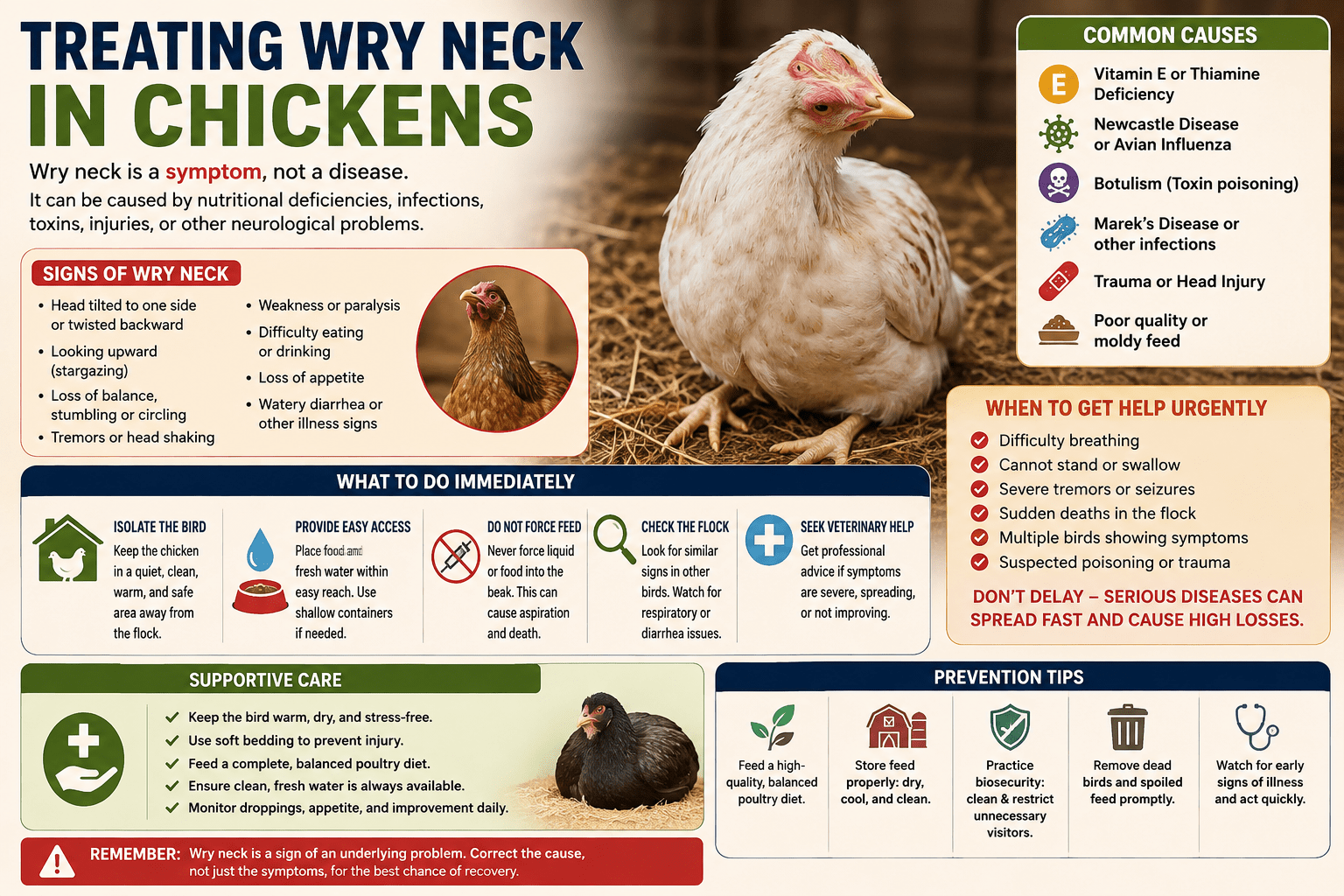
A chicken with its head twisted sideways, tilted backward, or unable to hold its neck normally may have what poultry keepers call wry neck. The most important thing to understand about treating wry neck in chickens is that wry neck is a sign, not a single disease.
Nutritional deficiencies can cause neurological problems, but infections, toxins, trauma, and other disorders can produce similar symptoms. That means automatically giving vitamin supplements without considering the cause can delay the treatment a sick bird actually needs.
Start by separating the affected chicken, making food and water easy to reach, checking the rest of the flock for illness, and arranging veterinary advice when symptoms are severe, spreading, or accompanied by respiratory disease, diarrhea, paralysis, or deaths.
What Is Wry Neck in Chickens?
Wry neck describes an abnormal position or movement of the head and neck. Veterinarians may use the term torticollis when the head or neck is abnormally twisted.
An affected chicken may:
- Hold its head tilted to one side
- Twist its neck backward
- Look upward continuously
- Tuck its head underneath its body
- Rotate or circle while trying to walk
- Lose its balance
- Fall backward
- Have head tremors
- Struggle to reach food or water
Some birds remain alert despite the abnormal posture. Others develop weakness, poor coordination, paralysis, appetite loss, or additional signs of systemic disease.
The pattern matters because several very different conditions can affect the nervous system and produce abnormal head positioning.
What Should You Do First if a Chicken Develops Wry Neck?
The safest first response is supportive care combined with an attempt to determine why the neurological signs developed.
1. Separate the Chicken From the Flock
Place the bird in a quiet, clean, protected enclosure where other chickens cannot peck, knock over, or compete with it.
Separating a sick bird also makes it easier to monitor exactly how much it eats, drinks, defecates, and moves. Isolation may also reduce disease transmission when an infectious cause is involved. Veterinary guidance for sick birds similarly recommends isolation and reduced stress during recovery.
Keep the isolation area:
- Dry
- Draft-free
- Well ventilated
- Quiet
- Protected from extreme temperatures
- Free from high perches or objects the bird could fall from
Use soft, non-slip bedding if the chicken is unstable.
2. Put Food and Water Within Easy Reach
A bird with a twisted neck may be physically unable to reach a normal feeder or drinker even when it still wants to eat.
Place shallow containers close to the bird’s natural resting position. Fresh water is particularly important because adequate water intake is necessary for normal digestion and feed consumption.
A nutritionally complete poultry ration should remain the main food rather than replacing the diet with treats, seeds, bread, or homemade mixtures.
3. Do Not Pour Water or Food Into the Bird’s Mouth
This is an important but commonly overlooked precaution.
A severely affected chicken may have impaired swallowing. Forcing liquid or food into a bird that cannot swallow normally can allow material to enter the respiratory tract. Aspiration can cause serious or fatal complications in birds.
If the chicken cannot voluntarily eat or drink, professional veterinary assistance is safer than aggressive syringe feeding by an inexperienced owner.
4. Examine the Rest of the Flock
Ask yourself whether this is truly an isolated neurological problem.
Check other chickens for:
- Twisted necks
- Tremors
- Falling or circling
- Weakness or paralysis
- Sneezing or coughing
- Nasal discharge
- Difficulty breathing
- Facial swelling
- Watery or green diarrhea
- Sudden decline in egg production
- Unexplained deaths
Multiple sick birds substantially change the situation because contagious flock diseases become more important possibilities.
Common Causes of Wry Neck in Chickens
Several conditions can produce similar outward symptoms. The cause cannot always be identified simply by looking at the neck position.
| Possible cause | Clues that may occur | Appropriate response |
|---|---|---|
| Vitamin E-related neurological disease | Ataxia, weakness, poor coordination, especially in young birds or birds on an inadequate/rancid diet | Review diet and seek veterinary guidance on supplementation |
| Thiamine deficiency | Reduced appetite, weakness, tremors, backward head position, progressing neurological signs | Correct the nutritional problem under veterinary guidance |
| Newcastle disease | Twisted neck, tremors, respiratory signs, diarrhea, flock illness or deaths | Isolate and contact a veterinarian/animal-health authority urgently |
| Highly pathogenic avian influenza | Torticollis, stumbling, respiratory signs, swelling, diarrhea, sudden death | Urgent veterinary and animal-health notification |
| Botulism | Progressive weakness and floppy paralysis, especially inability to hold the neck up | Veterinary assessment and investigation of feed/environment |
| Marek’s disease or another neurological disorder | Progressive paralysis or nerve dysfunction, particularly in susceptible birds | Veterinary diagnosis; vitamins alone will not correct the underlying disease |
| Trauma or physical injury | Sudden onset after collision, predator attack, fighting, fall or handling injury | Restrict movement and obtain veterinary examination |
| Toxin or contaminated feed exposure | Several birds affected or neurological illness associated with new/spoiled feed | Remove suspected source and seek veterinary/toxicology advice |
The key lesson is that the appearance of the neck does not tell you the cause with certainty.
Vitamin E Deficiency and Wry Neck
Vitamin E deficiency is one of the reasons nutritional supplementation is frequently discussed in relation to wry neck.
In chicks, severe vitamin E deficiency can cause encephalomalacia, a neurological disorder involving damage to the cerebellum. A classic sign is ataxia or loss of coordinated movement. The condition can respond to vitamin E when treatment begins before neurological damage becomes too advanced.
Risk is greater when diets contain inadequate vitamin E or unstable, oxidized fats. Properly formulated poultry feeds normally contain supplemental vitamins, which is one reason nutritional history is important when investigating neurological disease.
When Is Vitamin E Deficiency More Plausible?
Consider the diet carefully if the affected bird has been:
- Eating mostly scratch grains or treats
- Receiving a homemade ration that has not been professionally formulated
- Eating old or improperly stored feed
- Consuming feed containing rancid fats
- Receiving an improperly mixed ration
- Growing rapidly while nutritional intake is poor
A chicken eating fresh, correctly stored, nutritionally complete commercial poultry feed is less likely to develop a major deficiency simply because vitamin supplements were not added to its water.
That does not rule deficiency out, but it makes a broader diagnostic approach more important.
Should You Give Vitamin E to a Chicken With Wry Neck?
Vitamin E may be appropriate when vitamin E deficiency is actually responsible for the neurological signs. It should not be treated as a universal cure for every twisted neck.
Veterinary references describe vitamin E supplementation as treatment for specific vitamin E-deficiency disorders in poultry and note that neurological recovery depends on how much cerebellar damage has already occurred.
The practical approach is to:
- Confirm that the chicken is receiving a nutritionally complete feed.
- Replace questionable, old, damp, moldy, or rancid feed.
- Discuss an appropriate poultry vitamin-E product and dose with an avian/poultry veterinarian.
- Follow the product label rather than combining several supplements randomly.
- Reassess the diagnosis if the bird continues deteriorating.
Giving a vitamin does not treat Newcastle disease, avian influenza, botulism, trauma, or other non-nutritional causes.
What About Selenium?
Vitamin E and selenium have related antioxidant functions, which is why the two nutrients are frequently mentioned together. However, that does not mean additional selenium should automatically be given to every chicken with wry neck.
Selenium is required only in very small quantities. Merck notes that poultry diets are subject to strict limits because excessive selenium can cause toxicity and reproductive problems.
Therefore, avoid guessing selenium doses or combining:
- Poultry vitamins
- Human selenium tablets
- Livestock mineral products
- Selenium-containing feed supplements
unless you know exactly how much selenium the bird is already receiving.
This is one area where seemingly helpful supplementation can create another nutritional problem.
Thiamine Deficiency Can Also Cause an Abnormal Neck Position
Vitamin E is not the only nutrient associated with neurological signs.
Severe thiamine, or vitamin B1, deficiency can cause loss of appetite, weakness, head tremors, convulsions, impaired balance, and a backward-drawn or “stargazing” position of the head. As the deficiency progresses, chickens may lose their ability to stand upright.
This is another reason the phrase “wry neck equals vitamin E deficiency” is too simplistic.
If several nutrients are deficient because a chicken has been receiving an unbalanced homemade diet, treating only one nutrient may not solve the underlying nutritional problem.
When Wry Neck Could Mean a Serious Infectious Disease
A twisted neck becomes much more concerning when it occurs alongside respiratory, digestive, or flock-wide illness.
Virulent Newcastle Disease
Virulent Newcastle disease can cause neurological signs including:
- Head and neck twisting
- Tremors
- Circling
- Drooping wings
- Stiffness
Affected flocks may also show respiratory distress, nasal discharge, watery green diarrhea, reduced appetite, decreased egg production, swelling around the eyes or neck, and sudden deaths.
Because Newcastle disease can spread rapidly, suspected cases require veterinary and animal-health attention rather than home vitamin treatment.
Highly Pathogenic Avian Influenza
Highly pathogenic avian influenza can also produce torticollis, stumbling, respiratory difficulty, nasal discharge, diarrhea, swelling, reduced egg production, and sudden death. USDA APHIS includes twisting of the head and neck among recognized signs of HPAI in poultry.
If several birds suddenly become sick or die, minimize movement of birds, equipment, footwear, and contaminated materials between poultry areas and contact your veterinarian or appropriate local animal-health authority.
Reporting requirements vary by country and region.
Botulism and “Limberneck”
Botulism causes a different kind of neck problem that can sometimes be confused with wry neck.
Affected poultry typically develop progressive muscle weakness followed by flaccid paralysis. The legs, wings, and neck can become weak, and severely affected birds may be unable to lift or support their heads. This has historically been called limberneck.
Botulism may be associated with exposure to toxin produced in decomposing material. Investigation may involve feed, water, carcasses, maggots, and environmental contamination.
A bird whose neck hangs weakly downward therefore presents a different diagnostic picture from a bird forcefully twisting its head backward.
Could Marek’s Disease Cause Similar Problems?
Marek’s disease should also remain on the differential list when chickens develop unexplained neurological dysfunction or paralysis.
It is particularly important because once clinical Marek’s disease has developed, there is no curative treatment for the underlying viral disease. Pennsylvania State University Extension identifies Marek’s disease as a common disease of small flocks and notes that it is not treatable after clinical signs begin.
A veterinarian may need to distinguish Marek’s disease from nutritional deficiencies, botulism, injury, and other neurological problems.
Check the Chicken’s Feed Before Adding Supplements
One of the most useful diagnostic questions is simple:
What has this bird actually been eating?
A nutritionally balanced poultry ration should provide the foundation of the diet. Problems become more plausible when formulated feed is substantially displaced by:
- Scratch grains
- Corn
- Bread
- Kitchen foods
- Seeds
- Large quantities of treats
- Home-mixed feed without a calculated nutrient profile
Also check the feed itself.
Discard feed that is:
- Moldy
- Damp
- Infested
- Foul smelling
- Rancid
- Far beyond its normal storage period
- Stored in excessive heat or humidity
Changing supplements while continuing to feed a defective ration does not correct the underlying problem.
A Practical Care Checklist
For a single chicken that develops an abnormal neck position:
- Separate the bird safely.
- Prevent falls and flock bullying.
- Place clean water and complete feed within easy reach.
- Observe whether it can swallow normally.
- Do not force liquid down its throat.
- Examine the chicken for injuries.
- Check the feed for age, spoilage, moisture, mold, and nutritional adequacy.
- Watch the entire flock for neurological, respiratory, or digestive signs.
- Record when symptoms began and whether they are getting better or worse.
- Contact a poultry or avian veterinarian when the cause is uncertain or the bird is seriously affected.
This approach is safer than beginning several medications and supplements simultaneously because doing so can mask the progression of disease and make the cause harder to identify.
Signs That Require Prompt Veterinary Attention
Seek veterinary help urgently if the chicken:
- Cannot stand
- Cannot swallow
- Cannot obtain water
- Is having repeated seizures or severe tremors
- Has difficulty breathing
- Becomes rapidly weaker
- Has significant trauma
- Develops complete or progressive paralysis
- Has severe diarrhea
- Is showing signs of poisoning
- Has been exposed to spoiled feed or decomposing carcasses
Also treat the situation as a potential flock-health emergency if multiple chickens develop symptoms or unexplained deaths occur.
Twisting of the head or neck together with respiratory illness, diarrhea, swelling, rapidly spreading sickness, or sudden deaths warrants particular concern because serious infectious diseases such as Newcastle disease and HPAI can produce this combination of signs.
Common Mistakes When Treating Wry Neck
Assuming Every Case Is Vitamin E Deficiency
This is probably the most consequential mistake.
Vitamin E deficiency can cause neurological disease, but so can infectious disease, another vitamin deficiency, intoxication, injury, and neurological disorders.
Better approach: use the bird’s age, diet, onset of symptoms, flock history, and accompanying signs to narrow the possibilities.
Giving Large Amounts of Selenium “Just in Case”
Selenium is a trace mineral, not a harmless general supplement. Excessive intake can be toxic.
Better approach: use a correctly formulated poultry product and follow veterinary or label guidance.
Treating the Chicken but Ignoring Its Feed
If a nutritional problem caused the illness, continuing the same poor-quality ration can affect the sick chicken again or produce disease in other flock members.
Better approach: correct the entire diet, not merely the symptoms of one bird.
Force-Feeding a Chicken That Cannot Swallow
Trying to save a weak bird by pouring fluids into its mouth can send liquid or food into the respiratory tract.
Better approach: offer accessible food and water when the bird can swallow voluntarily. Seek professional help when assisted feeding is necessary.
Returning the Bird to the Flock Too Early
A chicken that still has poor balance or unusual movements may be knocked down, pecked, or prevented from eating.
Better approach: return it only after it can move, eat, drink, and protect itself adequately and contagious disease has been reasonably excluded.
How Long Does Wry Neck Take to Improve?
There is no reliable universal recovery time because “wry neck” has multiple causes.
A nutritional problem corrected before substantial nervous-system damage has occurred may respond to appropriate treatment. In vitamin E-related encephalomalacia, however, Merck notes that response depends on the extent of cerebellar damage.
Recovery may be incomplete when nerve or brain tissue has been permanently damaged.
The direction of change is therefore often more useful than expecting improvement on a specific day. Monitor whether the chicken is:
- Holding its head more normally
- Standing more consistently
- Eating independently
- Drinking independently
- Walking with better balance
- Showing fewer tremors
- Maintaining body condition
Continued deterioration despite supportive care means the diagnosis and treatment plan need reassessment.
Can Wry Neck Be Prevented?
Not every case is preventable, but good flock management can reduce several important risks.
Feed a Complete Poultry Diet
Use feed appropriate for the bird’s age and production stage and avoid allowing treats to replace a substantial portion of the balanced ration.
Store Feed Properly
Keep feed dry, cool, clean, protected from pests, and rotated so that old feed is used before freshly purchased feed.
Practice Biosecurity
Limit unnecessary visitors and poultry contact, clean equipment, avoid sharing contaminated crates or tools, quarantine additions appropriately, and reduce contact with wild birds where possible. Biosecurity is especially important for preventing infectious poultry diseases.
Remove Decomposing Material
Promptly remove dead birds, spoiled feed, and decaying organic matter. This is particularly relevant to reducing environmental conditions associated with botulism.
Investigate Neurological Signs Early
Waiting until a chicken can no longer eat, drink, or stand decreases the options for supportive care and may allow a contagious condition to spread before it is recognized.
Frequently Asked Questions
Is wry neck contagious in chickens?
Wry neck itself is not a contagious disease; it is a physical or neurological sign. However, some diseases that can cause a twisted neck, including virulent Newcastle disease and highly pathogenic avian influenza, are contagious.
Is vitamin E always the cure for wry neck?
No. Vitamin E can help when vitamin E deficiency is responsible, but it will not cure infectious diseases, botulism, trauma, Marek’s disease, or every other cause of neurological dysfunction.
Should I give selenium with vitamin E?
Not automatically. Vitamin E and selenium interact nutritionally, but selenium has a relatively narrow safety margin and excessive intake can be harmful. Use selenium-containing products only according to appropriate poultry guidance.
Can a chicken recover completely from wry neck?
Some chickens can recover, particularly when a reversible cause is identified and treated early. Permanent neurological injury, however, can limit recovery. Vitamin E-related encephalomalacia, for example, may respond differently depending on how much cerebellar damage has already occurred.
Should a chicken with wry neck be isolated?
Usually, yes. Isolation protects a weak bird from flock competition and injury, makes monitoring easier, and provides an additional biosecurity measure while an infectious cause is being considered.
Can I syringe-feed a chicken with wry neck?
Do not force-feed a bird that cannot swallow normally unless you have been shown how to do so safely. Birds can aspirate food or liquids into their respiratory tract, which can cause serious complications.
Why is my chicken twisting its head backward?
A backward head position can occur with neurological or nutritional disorders, including severe thiamine deficiency, but the posture alone cannot establish the diagnosis. Examine the diet, other symptoms, and flock health before choosing treatment.
The Safest Approach to treating wry neck in chickens
Successful treating wry neck in chickens starts with identifying the cause rather than treating the neck position alone. Isolate the affected bird, provide easy access to balanced feed and clean water, prevent injury, and examine both the diet and the rest of the flock.
Vitamin E can be valuable when a genuine deficiency is involved, but automatically combining vitamin E, selenium, antibiotics, and home remedies is not a reliable diagnostic strategy. A twisted neck accompanied by breathing problems, diarrhea, progressive paralysis, multiple sick birds, or sudden deaths deserves prompt professional evaluation because serious infectious or toxic conditions can look very similar at first.