

A chicken with its head twisted sideways, tucked underneath its body, or pulled backward may have torticollis, commonly called wry neck. If you are searching for wry neck treatment chickens, the most important point is that wry neck is a symptom, not a diagnosis. Treatment depends on whether the underlying problem is nutritional, infectious, toxic, traumatic, or neurological.
Start by protecting the bird from injury and making food and water accessible. Then look for clues to the cause. Vitamin E deficiency can produce neurological disease in chickens, but automatically treating every case with large doses of vitamin E and selenium can delay diagnosis of more serious conditions.
Quick answer: What should you do for a chicken with wry neck?
For a chicken that suddenly develops a twisted or abnormal neck position:
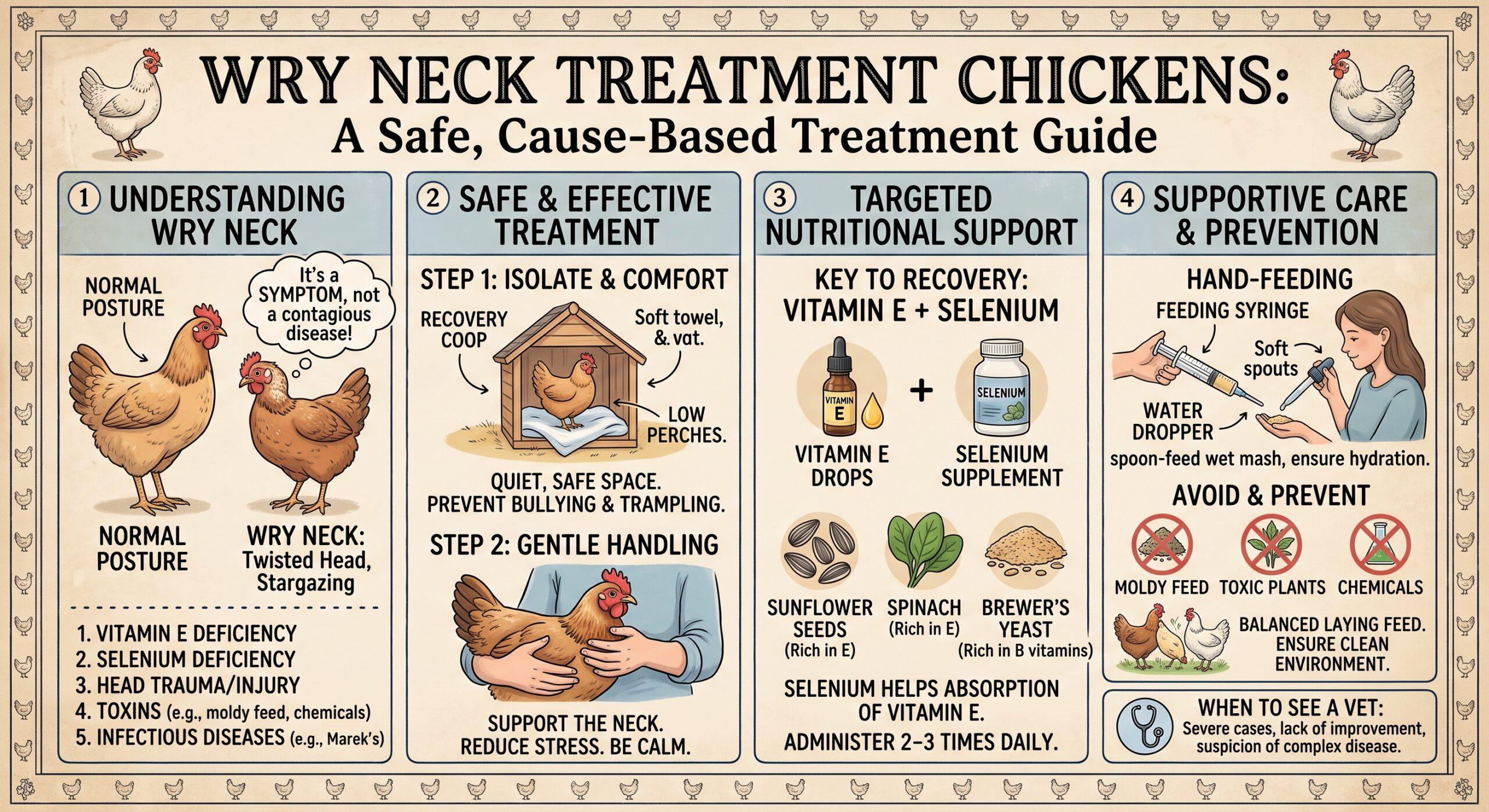
- Separate the affected bird safely. Place it somewhere quiet where flockmates cannot peck, trample, or compete with it.
- Provide easy access to complete poultry feed and fresh water. A bird that cannot control its head may quickly stop eating and drinking.
- Do not forcibly straighten, stretch, splint, or pull the neck.
- Avoid force-feeding liquids unless you know how to do it safely. Syringe-feeding birds incorrectly can result in aspiration into the respiratory tract.
- Check the entire flock. More than one sick bird, sudden deaths, respiratory signs, diarrhea, swelling, or neurological symptoms raise concern for infectious disease.
- Review feed and possible exposures. Old or improperly stored feed, nutritional imbalance, toxins, carcasses, contaminated material, or a recent injury can change the likely diagnosis.
- Contact a veterinarian experienced with poultry or birds if the condition is severe, unexplained, worsening, or accompanied by other symptoms.
If several birds are affected or you see sudden deaths, difficulty breathing, purple or swollen combs or wattles, diarrhea, falling, tremors, or other neurological signs, treat the situation as potentially infectious rather than assuming it is a vitamin deficiency. Highly pathogenic avian influenza can include torticollis among its signs, and Newcastle disease can also cause twisted necks and neurological abnormalities.
What does wry neck look like in chickens?
Wry neck describes abnormal positioning caused by dysfunction involving the muscles, nerves, balance system, brain, or supporting structures of the neck.
An affected chicken may:
- Hold its head tilted sharply to one side.
- Twist the neck so the head appears upside down.
- Pull the head backward toward the back.
- Tuck the head downward or underneath the body.
- Stare upward in a posture sometimes called “stargazing.”
- Circle, stumble, fall, or lose its balance.
- Have difficulty locating food and water.
- Show tremors or abnormal head movements.
The veterinary term torticollis refers to the abnormal head and neck position itself. It does not tell you what caused it. Vitamin deficiencies, neurological disease, infection, toxins, ear disease, and trauma can all produce similar-looking signs.
The most important step: Find the cause
One of the biggest mistakes in treating wry neck is assuming that every case is caused by vitamin E deficiency.
Vitamin E deficiency is a legitimate cause of neurological disease in poultry. However, thiamine deficiency, avian influenza, Newcastle disease, Marek’s disease, botulism, respiratory or ear disease, poisoning, and other neurological disorders can produce overlapping symptoms.
Use the pattern of symptoms to decide how urgently veterinary testing is needed.
| Possible cause | Clues that may accompany wry neck | Treatment direction |
|---|---|---|
| Vitamin E-related neurological disease | Ataxia or neurological signs, particularly with a questionable or nutritionally inadequate diet | Correct the diet and use appropriate vitamin E supplementation; early treatment matters. |
| Thiamine (vitamin B1) deficiency | Poor appetite, weakness, tremors, stargazing, convulsions, inability to remain upright | Restore dietary thiamine; severely affected birds may require veterinary treatment. |
| Head or neck trauma | Sudden onset after a collision, attack, fall, handling incident, or flock aggression | Rest, protection from further injury, veterinary assessment if severe |
| Ear or respiratory disease | Head tilt plus eye/nasal discharge, swollen sinuses, coughing, sneezing, or respiratory illness | Identify and treat the underlying disease; some cases involve secondary bacterial infection. |
| Marek’s disease | Weakness, ataxia, paralysis, especially characteristic leg paralysis or progressive neurological disease | No curative treatment is available for Marek’s disease; diagnosis and flock management are important. |
| Newcastle disease | Torticollis with tremors, paralysis, respiratory signs, circling, diarrhea, or flock-wide illness | Urgent veterinary and animal-health evaluation. |
| Avian influenza | Twisted neck, stumbling, respiratory signs, swelling, purple discoloration, diarrhea, reduced appetite, sudden deaths | Isolate exposure risk and report suspected serious poultry disease promptly. |
| Botulism | Progressive weakness and flaccid paralysis, often after access to decaying material or carcasses | Remove the toxin source and seek veterinary care; supportive treatment and antitoxin may be considered. |
This is not a complete diagnostic list. A veterinarian may need the bird’s history, physical examination, necropsy findings, laboratory testing, or several of these together to distinguish one neurological condition from another.
Step-by-step supportive care for a chicken with wry neck
Supportive care does not cure every underlying disease, but it can prevent a bird with poor coordination from deteriorating while the cause is being investigated.
1. Move the bird to a protected recovery area
Separate the chicken from birds that might peck, trample, or prevent it from reaching feed.
Use a secure enclosure with good footing and minimal obstacles. The objective is not strict isolation at any cost; it is preventing injury and allowing you to monitor exactly how much the chicken eats, drinks, and defecates.
If infectious disease is possible, use separate equipment and practice careful hygiene rather than moving repeatedly between the sick bird and the healthy flock. Avian influenza, for example, can spread through contaminated manure, equipment, clothing, footwear, and hands.
2. Make food and water easy to reach
Offer the bird’s normal, nutritionally complete poultry feed in a container it can reach without having to make large head movements.
Watch the chicken rather than assuming it has eaten because food is missing. Birds with neurological problems may repeatedly peck beside the dish or knock food around without swallowing enough.
Water access is equally important. Sick birds that stop eating or drinking may require professional supportive care.
3. Be cautious with syringe-feeding
A severely twisted neck makes oral feeding more difficult, not less.
Do not rapidly squirt water or liquid food into the beak. Incorrect syringe-feeding can cause a bird to inhale material into its respiratory tract, resulting in aspiration and potentially serious secondary complications.
If the chicken cannot eat or drink voluntarily, ask a veterinarian or experienced poultry professional to demonstrate a safe method rather than improvising.
4. Reduce unnecessary stress
Keep handling to what is needed for examination, feeding support, medication, or moving the bird safely.
A neurologically impaired bird benefits from an environment where it cannot repeatedly fall from perches, collide with objects, or be chased by flockmates.
5. Record what you see
A short written or video record can be surprisingly valuable.
Note:
- When the abnormal neck position started.
- Whether onset was sudden or gradual.
- Whether the chicken can stand and walk.
- Appetite and water intake.
- Dropping appearance.
- Respiratory symptoms.
- Eye, facial, or sinus swelling.
- Tremors, seizures, circling, or paralysis.
- Recent feed changes.
- Possible injuries.
- Access to spoiled food, chemicals, carcasses, or other unusual materials.
- Whether any flockmates are developing similar signs.
This information can help a veterinarian narrow the differential diagnosis far more effectively than the description “my chicken has wry neck.”
Does vitamin E treat wry neck in chickens?
Vitamin E can help when the neurological signs are caused by vitamin E deficiency, but it is not a universal treatment for torticollis.
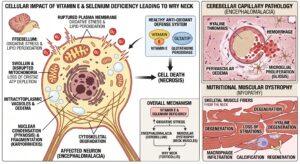
Severe vitamin E deficiency in chicks can cause encephalomalacia, a neurological disorder involving damage to the cerebellum. Ataxia is a classic sign. Merck Veterinary Manual notes that some vitamin E deficiency disorders can respond when supplementation is started early, while response in encephalomalacia depends partly on how much neurological damage has already occurred.
That distinction matters. If a bird has torticollis because of Newcastle disease, Marek’s disease, an ear infection, botulism, poisoning, or significant trauma, vitamin E does not remove the underlying cause.
When vitamin deficiency should be higher on your list
A dietary cause becomes more plausible when:
- The bird has been eating an incomplete or improperly formulated diet.
- A major portion of the ration consists of treats or home-mixed ingredients instead of complete poultry feed.
- Feed quality or storage has been questionable.
- Several birds eating the same diet develop compatible deficiency signs.
- Young birds came from breeders with poor nutritional status.
- There are neurological signs without a clear injury or flock-wide infectious pattern.
Commercial complete feeds are formulated to supply poultry with vitamins and minerals, but vitamin quality can decline through problems involving feed formulation, storage conditions, time, temperature, humidity, or unstable ingredients. Merck notes that omission of a complete vitamin premix is a major cause of poultry vitamin deficiencies.
Should you give selenium with vitamin E?
Do not assume that more selenium is better.
Vitamin E and selenium have related antioxidant functions, and deficiency of both nutrients can contribute to some nutritional disorders in poultry. However, selenium is a trace mineral with genuine toxicity risk when excessive amounts are supplied.
This is an area where many backyard-chicken treatment instructions become unnecessarily risky. Statements that every chicken with wry neck “needs selenium so vitamin E can work” oversimplify the relationship between the nutrients.
A safer approach is to:
- Start with a nutritionally complete poultry ration.
- Use a poultry vitamin/mineral product according to its labeled directions when appropriate.
- Avoid combining multiple selenium-containing supplements without calculating the total intake.
- Ask a veterinarian for an individual dose if using concentrated human or livestock supplements.
Merck reports adverse effects from excessive dietary selenium in poultry and other animals, and improperly formulated or excessive supplementation can produce selenium toxicosis.
Could vitamin B1 deficiency cause wry neck?
Yes. Thiamine, or vitamin B1, deficiency can cause neurological signs that resemble what chicken keepers describe as wry neck.
Early signs may include lethargy, reduced appetite, and head tremors. More advanced deficiency can cause weakness, convulsions, stargazing, and backward retraction of the head. Chickens may eventually lose their ability to remain upright.
This is another reason to avoid treating torticollis as synonymous with vitamin E deficiency.
If dietary deficiency is suspected, correcting the overall ration is often more sensible than continually adding isolated nutrients while leaving the original dietary problem unchanged.
When wry neck may indicate an infectious disease
A single otherwise-alert chicken with a known recent injury is a very different situation from five birds suddenly showing neurological and respiratory symptoms.
Pay particular attention to flock-level patterns.
Avian influenza
USDA lists twisting of the head and neck, stumbling or falling, respiratory difficulty, nasal discharge, diarrhea, lack of appetite, swelling, discoloration, decreased egg production, and sudden death among possible signs of highly pathogenic avian influenza.
If you are in the United States and serious poultry disease is suspected, USDA advises contacting a veterinarian, cooperative extension service, State veterinarian, or animal-health authorities. The USDA’s current Defend the Flock reporting number is 1-866-536-7593.
Do not transport sick birds to poultry swaps, feed stores, shows, neighboring flocks, or other locations while an infectious cause is being considered.
Newcastle disease
Newcastle disease can cause torticollis, tremors, convulsions, wing or leg paralysis, circling, respiratory distress, diarrhea, and sudden death. Clinical appearance varies with the strain, so the twisted neck alone cannot confirm or exclude the disease.
The practical rule is simple: neurological symptoms affecting multiple birds deserve professional investigation.
Marek’s disease
Marek’s disease can produce ataxia, paralysis, peripheral nerve dysfunction, and other neurological problems in chickens. A commonly recognized presentation involves leg paresis, sometimes with one leg positioned forward and the other backward.
There is no treatment that cures Marek’s disease. Vaccination and biosecurity are central prevention and control tools.
Can an ear problem cause a twisted neck?
Yes. Problems affecting the ear or balance system can produce head tilt or torticollis.
For example, MSD Veterinary Manual describes torticollis associated with swollen head syndrome in chickens, where respiratory disease and ear involvement may occur along with sinus swelling, frothy eyes, or nasal discharge.
If the chicken’s head tilt occurs with facial swelling, eye discharge, nasal discharge, coughing, sneezing, or obvious ear abnormalities, an infectious or inflammatory process deserves consideration rather than automatically reaching for vitamin supplements.
Could botulism cause wry neck?
Botulism primarily causes flaccid paralysis, and affected poultry may progressively lose muscular control after ingesting botulinum toxin.
Sources can include decaying organic material or carcasses under appropriate conditions. Treatment centers on removing the source, supportive care, and, in some circumstances, administration of an appropriate botulinum antitoxin.
A weak bird that cannot hold its head up should therefore not automatically be diagnosed with a nutritional deficiency simply because the neck position looks abnormal.
How long does wry neck take to improve?
There is no reliable recovery time because wry neck has multiple causes.
A nutritional problem caught early may respond after the deficient nutrient and underlying diet are corrected. Advanced neurological damage can take considerably longer to improve or may be irreversible. Merck specifically notes that the response of vitamin E-deficiency encephalomalacia depends on the extent of cerebellar damage.
A bird with trauma may improve as inflammation and injured tissues heal. A bird with a progressive neurological disease may worsen despite excellent supportive care.
Instead of judging treatment only by neck position, monitor:
- Ability to stand.
- Ability to walk.
- Head control.
- Voluntary eating and drinking.
- Body condition.
- Alertness.
- Frequency and severity of neurological episodes.
- Development of new symptoms.
Improvement in several of these measures is more meaningful than a few hours of straighter neck posture.
Common wry neck treatment mistakes
Assuming vitamin E is the diagnosis
The mistake: Seeing a twisted neck and immediately concluding that vitamin E deficiency is proven.
Why it matters: Serious infectious, toxic, neurological, or traumatic conditions can resemble nutritional disease.
Do instead: Provide supportive care while examining diet, flock patterns, recent exposures, injuries, and accompanying symptoms.
Giving large amounts of selenium “just in case”
The mistake: Combining concentrated selenium products because online instructions say selenium must accompany vitamin E.
Why it matters: Selenium is required in small amounts but excessive intake can be toxic.
Do instead: Use nutritionally complete feed and measured supplementation appropriate for poultry. Get professional dosing advice before administering concentrated products.
Forcing the neck straight
The mistake: Stretching, splinting, weighting, or repeatedly manipulating the neck.
Why it matters: Torticollis is usually a manifestation of another problem, not simply a mechanically crooked neck. Forcing the neck into position does not correct neurological disease and could aggravate an injury.wry neck treatment chickens
Do instead: Support the bird in a safe posture and treat the cause.
Pouring or syringing water into the mouth
The mistake: Rapidly administering water because the chicken appears dehydrated.
Why it matters: Improper oral feeding can cause aspiration into the respiratory tract.
Do instead: Encourage voluntary drinking and obtain guidance if assisted hydration or feeding is required.
Treating only the sick bird’s symptoms
The mistake: Focusing entirely on the twisted neck without checking feed, flockmates, the coop, or environmental exposures.
Why it matters: Nutritional mistakes and contagious diseases can affect other birds, while contaminated feed or environmental toxins can continue exposing the flock.
Do instead: Evaluate the chicken and its environment together.
A better decision framework for wry neck
Instead of asking only “What supplement fixes wry neck?”, ask these four questions.
Is this one bird or a flock problem?
One bird makes injury or an individual disorder more plausible.
Several birds becoming ill close together increases concern about a shared diet, toxin, or transmissible disease.
Are there other neurological signs?
Tremors, seizures, circling, stumbling, wing or leg paralysis, or inability to stand point toward broader nervous-system involvement and increase the value of veterinary assessment. Newcastle disease, Marek’s disease, nutritional deficiencies, and several other disorders can produce neurological abnormalities.
Are respiratory or systemic symptoms present?
Coughing, sneezing, nasal discharge, swollen eyes or sinuses, purple combs, diarrhea, sudden egg-production changes, or deaths should move infectious disease much higher on the list.
Is there a credible nutritional reason?
If the bird eats a fresh, correctly formulated complete feed and flockmates are normal, a severe dietary deficiency may be less obvious than in birds fed heavily diluted, homemade, spoiled, or incomplete diets.
That does not rule nutritional disease out, but it prevents “vitamin deficiency” from becoming a diagnosis based solely on appearance.
Preventing nutritional and management-related cases
Good prevention begins with the ordinary parts of poultry care.
Use a complete feed formulated for the chicken’s age and production stage as the nutritional foundation. Treats and scraps should not replace enough complete feed to create a nutrient imbalance.
Store feed somewhere dry and protected from excessive heat, moisture, pests, and prolonged storage. Merck notes that time, temperature, humidity, unstable fats, and vitamin-premix problems can affect vitamin availability in poultry feed.wry neck treatment chickens
Also:
- Reduce opportunities for serious head injuries.
- Maintain clean water.
- Remove spoiled feed and decaying organic material.
- Prevent access to chemicals, contaminated materials, and potentially toxic objects.
- Limit contact with wild birds.
- Clean footwear and equipment when moving between poultry areas.
- Quarantine and observe new or sick birds appropriately.
USDA identifies biosecurity and limiting transfer through contaminated equipment, clothing, hands, and other materials as key measures for reducing poultry disease spread.
When should you call a veterinarian immediately?
Seek prompt professional help if:
- The chicken cannot eat or drink.
- It repeatedly falls or cannot stand.
- Seizures or severe tremors occur.
- The bird is rapidly deteriorating.
- Significant trauma is possible.
- More than one bird develops neurological signs.
- Birds are dying unexpectedly.
- There is respiratory distress.
- The comb or wattles become swollen or purple.
- Neurological signs occur with diarrhea or respiratory disease.
- You suspect poisoning.
- The chicken does not respond as expected to basic supportive care.
- You are unsure how to administer supplements or assisted feeding safely.
Neurological signs can look dramatic while still having a treatable cause, but they can also be the first visible indication of a serious flock disease. Early differentiation is more useful than repeatedly changing supplements.
Frequently Asked Questions
Is wry neck contagious in chickens?
Wry neck itself is a symptom and therefore is not “contagious.” However, the disease causing it may be contagious. Newcastle disease and avian influenza are examples of infectious diseases capable of producing torticollis or other neurological signs.wry neck treatment chickens
Can a chicken recover completely from wry neck?
Yes, some chickens can recover completely, especially when a reversible cause is identified and treated early. The outlook depends on the underlying problem and whether permanent neurological damage has occurred. Vitamin E-deficiency encephalomalacia, for example, may respond differently depending on the extent of damage already present.wry neck treatment chickens
Should I isolate a chicken with wry neck?
Usually, temporary separation is useful for safety and monitoring. It protects a disoriented bird from bullying or injury and helps you measure food and water intake. If infectious disease is suspected, isolation should also be paired with biosecurity precautions to reduce transmission risk.wry neck treatment chickens
What vitamins are associated with wry neck?
Vitamin E deficiency can cause neurological disease in poultry, while thiamine deficiency can produce head tremors, stargazing, weakness, convulsions, and backward head retraction. Other vitamin deficiencies can also affect the nervous system.wry neck treatment chickenswry neck treatment chickenswry neck treatment chickens
The presence of a twisted neck alone does not establish which nutrient, if any, is deficient.wry neck treatment chickenswry neck treatment chickens
Should I give vitamin E and selenium immediately?
Correcting a genuine vitamin E deficiency can be beneficial, but selenium should not be given indiscriminately. Excessive selenium intake can cause toxicity, so concentrated supplements require careful dosing.wry neck treatment chickens
Can Marek’s disease cause wry neck?
Marek’s disease can cause neurological dysfunction, ataxia, and paralysis in chickens, although wry neck is not specific to Marek’s disease. wry neck treatment chickens There is no curative treatment for Marek’s disease; vaccination and biosecurity are the primary control measures.
Can a head injury cause wry neck?
Yes. Trauma affecting the brain, neck, nerves, or balance system can result in abnormal head positioning. A sudden onset following an attack, collision, fall, or other known injury warrants careful handling and veterinary assessment when symptoms are significant.
When is wry neck an emergency?
Treat it as urgent when the chicken cannot stand, eat, or drink; develops seizures or breathing difficulty; deteriorates rapidly; or when several birds become sick. Sudden deaths combined with respiratory or neurological signs should raise concern for serious infectious poultry disease.wry neck treatment chickenswry neck treatment chickens
The safest approach to wry neck treatment
Effective wry neck treatment chickens starts with recognizing that a crooked neck is a clinical sign, not a disease name. Protect the bird, make food and water accessible, avoid unsafe force-feeding or neck manipulation, and investigate the cause rather than relying automatically on vitamin E and selenium.wry neck treatment chickens
Nutritional deficiencies can be treatable, particularly when addressed early. But wry neck can also signal injury, poisoning, ear disease, botulism, Marek’s disease, Newcastle disease, avian influenza, or another neurological problem. If the symptoms are severe, spreading through the flock, or accompanied by respiratory illness or sudden deaths, involve a veterinarian or animal-health authority promptly.wry neck treatment chickens