


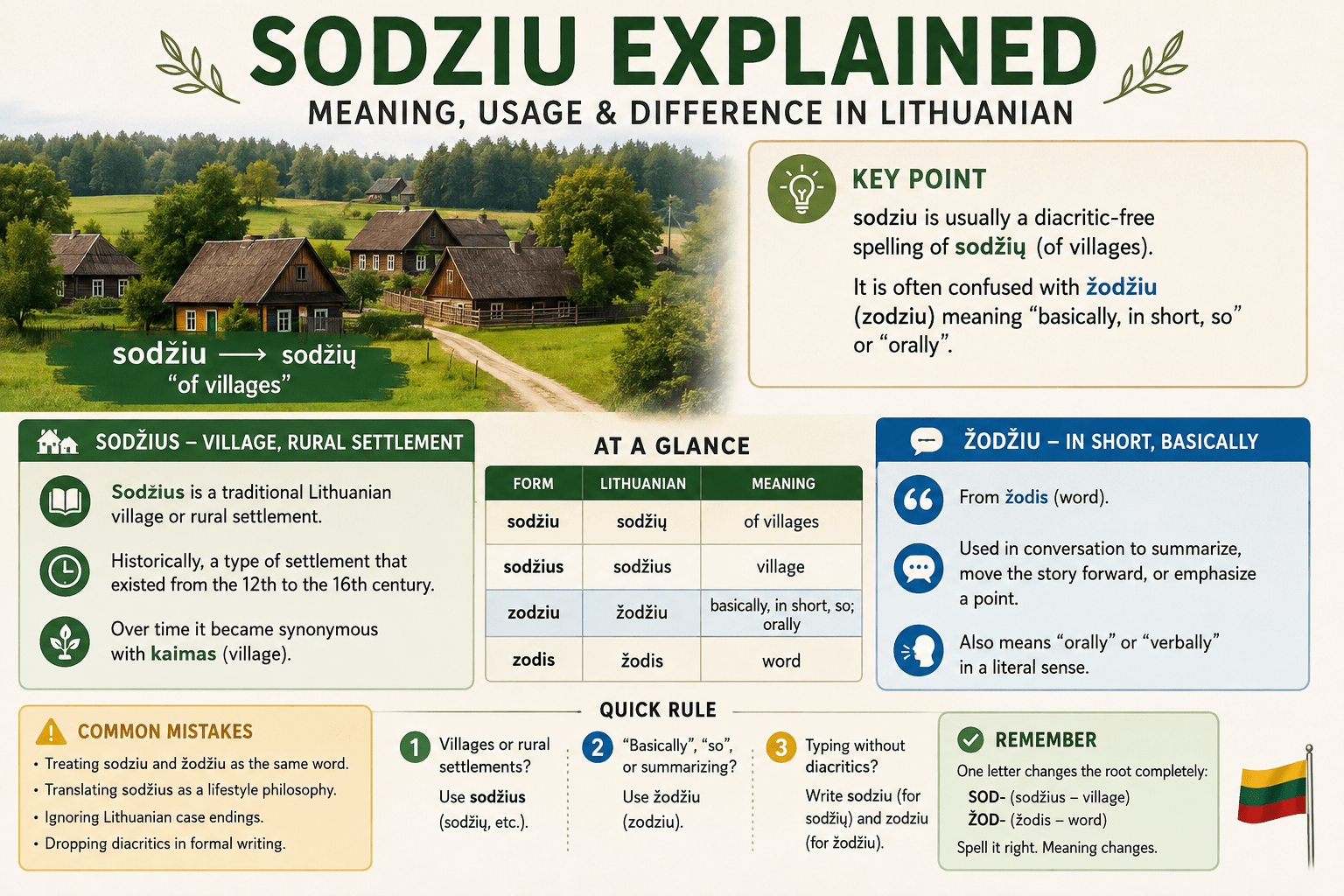
If you searched for sodziu, you are probably trying to understand a Lithuanian word or expression. The important detail is that sodziu is ambiguous when Lithuanian diacritics are removed—and several similar-looking words have very different meanings.
In standard Lithuanian,most directly corresponds to a grammatical form connected with meaning “village” or “rural settlement.” However, it is also frequently confused online with zodziu, the diacritic-free spelling of žodžiu, a common expression meaning roughly “in short,” “basically,” or “so.”
Understanding that distinction is the key to using the term correctly.
What Does sodziu Mean?
There is no single standard Lithuanian dictionary headword spelled exactly sodziu. Instead, the meaning depends on which Lithuanian characters were removed or which word the writer intended.
| Form | Basic meaning | Typical use |
|---|---|---|
| sodziu | Ambiguous ASCII spelling | Usually represents sodžių or appears as a misspelling |
| sodžių | “of villages” | Genitive plural form of sodžius |
| sodžius | village, rural settlement | Noun describing a traditional village |
| zodziu | ASCII spelling of žodžiu | Common in typing without Lithuanian characters |
| žodžiu | “in a word,” “basically,” “so”; also “orally” | Conversation, summaries, or descriptions of spoken communication |
This distinction matters because sodžius and žodis are separate Lithuanian words with different meanings and grammatical histories.
Why sodziu and zodziu Are Commonly Confused
Lithuanian uses letters such as ž, ų, š, č, ė, and ū. When people type on keyboards without Lithuanian characters, those diacritics are often removed.
That produces forms such as:
- sodžių → sodziu
- sodžius → sodzius
- žodžiu → zodziu
Notice the critical difference: žodžiu becomes zodziu, not sodziu.
This is where many online explanations go wrong. Articles sometimes treat as though it were simply another spelling of žodžiu. Linguistically, that is not an accurate one-to-one transliteration.
sodziu as sodžių: The Literal Grammatical Meaning
When sodziu is simply Lithuanian text written without diacritics, the most straightforward reconstruction is .
is the genitive plural form of , a noun meaning a village or rural settlement. Lithuanian dictionaries list with meanings including “village,” while its inflection includes the plural genitive sodžių.
In English, the grammatical meaning is generally equivalent to “of villages.”
Examples of sodžių in context
Consider phrases such as:
- senųjų sodžių istorija — the history of old villages
- sodžių gyventojai — inhabitants of villages
- Lietuvos sodžių tradicijos — traditions of Lithuanian villages
The exact English translation changes with the sentence, because Lithuanian relies heavily on grammatical cases.
Is sodziu a standalone noun?
Not normally in standard Lithuanian.
If someone writes by itself, context is essential. It may be with the diacritics stripped away, but it could also be a typo, informal transcription, brand name, username, or an incorrect attempt to write another Lithuanian word.
What Does sodžius Mean?
The base noun refers to a village or traditional rural settlement. Modern dictionary sources also associate it with a farmstead or rural dwelling in certain contexts.
Historically, however, the word has a more specific significance.
The Visuotinė lietuvių enciklopedija describes as a type of Lithuanian rural settlement believed to have existed from approximately the 12th through the 16th centuries. These settlements developed within agricultural communities and were generally less formally organized than later street-style villages.
How the meaning changed over time
During the 16th-century Valakų land reform, many older settlements—particularly in Aukštaitija—were reorganized into more regular villages.
Over time, sodžius increasingly became synonymous with kaimas, the ordinary Lithuanian word for “village.”
That gives sodžius both:
- a historical meaning, referring to an older settlement type;
- a broader literary or traditional meaning, referring to a village or countryside community.
Is sodziu Connected With Lithuanian Rural Culture?
Yes—but the connection needs to be described accurately.
Because sodžius refers to rural settlements, the word naturally appears in discussions of traditional Lithuanian village life, agriculture, family communities, land, and cultural heritage.
It can therefore evoke ideas such as:
- ancestral villages;
- rural traditions;
- agricultural life;
- community ties;
- traditional homesteads;
- Lithuanian countryside identity.
However, these are cultural associations, not additional dictionary definitions.
Calling sodziu itself a Lithuanian philosophy meaning “simple living,” “harmony with nature,” or “community spirit” goes further than the linguistic evidence supports. Those ideas may describe the cultural imagery surrounding traditional village life, but they should not be presented as literal translations.
What About zodziu and žodžiu?
This is the other major interpretation people encounter when searching sodziu.
Žodžiu comes from žodis, meaning “word.” Grammatically, žodžiu is the instrumental singular form of žodis. It can also function adverbially, meaning “orally” or “verbally.”
In conversational Lithuanian, however, žodžiu often behaves much like an English discourse marker.
Depending on context, natural translations include:
- in short
- in a word
- basically
- so
- anyway
- to sum it up
There is rarely one perfect English equivalent because tone and position within the conversation affect the meaning.
How žodžiu Is Used in Everyday Lithuanian
1. To summarize a story
After explaining several events, a speaker may use žodžiu to move directly to the conclusion.
Žodžiu, viskas pavyko.
A natural English rendering would be:
“Basically, everything worked out.”
The word signals that the speaker is condensing what came before.
2. To move a conversation forward
Sometimes žodžiu functions more like “so” or “anyway.”
It can indicate that the speaker has finished discussing unnecessary details and wants to reach the main point.
English has many similar conversational devices, but none maps perfectly onto every Lithuanian use.
3. To mean “orally”
The same spelling can also carry a more literal grammatical meaning.
For example, žodžiu can contrast spoken communication with written communication. Lithuanian lexical sources recognize meanings equivalent to “orally,” “verbally,” or “vocally.”
Context therefore determines whether žodžiu is functioning as conversational shorthand or describing speech as a mode of communication.
sodziu vs zodziu: The Difference at a Glance
For anyone learning Lithuanian, this is the most useful distinction to remember:
| If you see… | It most likely represents… | Meaning |
| sodziu | sodžių | of villages |
| sodzius | sodžius | village |
| zodziu | žodžiu | in short, basically, so; orally |
| zodis | žodis | word |
One letter changes the root completely.
sod- is associated here with sodžius, while žod- belongs to žodis.
How to Identify the Intended Meaning
When sodziu appears in a message, article, social post, or search query, use the surrounding context rather than assuming a translation.
It probably refers to sodžių or sodžius when the context mentions:
- villages;
- Lithuania’s countryside;
- historical settlements;
- rural communities;
- farms or homesteads;
- regional traditions;
- cultural heritage.
It probably intends žodžiu when the context involves:
- casual conversation;
- summarizing a story;
- saying “basically” or “anyway”;
- transitioning between thoughts;
- spoken versus written communication.
If someone writes “sodziu, everything went fine”, for example, the intended Lithuanian word is almost certainly žodžiu, but the spelling should normally be zodziu without diacritics or žodžiu with correct Lithuanian characters.
Common Mistakes to Avoid
Treating sodziu and žodžiu as identical
This is the biggest mistake.
Žodžiu begins with the Lithuanian letter ž. Removing its diacritic gives z, not s. Therefore zodziu is the natural plain-keyboard spelling.
Translating sodžius as a lifestyle philosophy
genuinely has historical and rural significance, but its core lexical meaning concerns a village or rural settlement.
Ideas such as simplicity, belonging, nature, and ancestral identity are interpretations of rural culture rather than literal meanings of the word.
Ignoring Lithuanian case endings
Lithuanian nouns change form according to grammatical case.
That means:
- sodžius is not the same grammatical form as ;
- žodis is not the same form as žodžiu.
Looking only at the root can produce incorrect translations.
Dropping diacritics in formal writing
Native speakers often understand Lithuanian typed without diacritics, particularly in informal digital communication.
For polished writing, educational material, translations, and professional content, however, using, sodžių, žodis, and žodžiu correctly removes unnecessary ambiguity.
Why Accurate Spelling Matters More Than It Seems
Lithuanian is an inflected language, so small changes in letters and endings can encode grammatical information that English often expresses with separate words.
In English, “village” and “of villages” require an added preposition and a plural ending. Lithuanian can communicate much of that relationship through the noun’s case ending.
Diacritics also distinguish sounds and spellings. Removing them may be convenient in casual typing, but it can collapse several visually similar forms into strings that are much harder for learners—and search engines—to interpret.
A Practical Rule for Using sodziu Correctly
Use this three-step check:
- Are you talking about villages or rural settlements?
Look for a form of , such - Are you trying to say “basically,” “in short,” or “so”?
The word you want is žodžiu. - Are you typing without Lithuanian characters?
Write sodziu for and zodziu for žodžiu.
That simple distinction prevents most of the confusion surrounding the keyword.
Frequently Asked Questions About sodziu
What is the English meaning of sodziu?
If sodziu represents Lithuanian its meaning is generally “of villages.” It is the genitive plural form of meaning village.
If the writer actually intended zodziu/žodžiu, the meaning may instead be “in short,” “basically,” “so,” or “orally,” depending on context.
Is a Lithuanian word?
It is best understood as a diacritic-free written form, not a standard dictionary headword in that exact spelling.
The corresponding Lithuanian form may be .
Doesmean “basically”?
Not precisely.
The Lithuanian expression commonly translated as “basically” is žodžiu, which becomes zodziu when typed without diacritics.
What does mean?
means a village or rural settlement. Historically, the term also described a particular type of Lithuanian agricultural settlement that existed before many villages were reorganized during the 16th century.
What does žodžiu mean?
Žodžiu derives from žodis, “word.” It can mean “in a word,” “basically,” “in short,” or function as a conversational “so/anyway.” It can also mean “orally” or “verbally.”
Is the same as sodžius?
Not grammatically.
is the base noun meaning “village.” is another grammatical form, including the genitive plural meaning “of villages.” When Lithuanian diacritics are removed, becomes .
Can I write Lithuanian without diacritics?
People frequently do so in informal messages, but correct Lithuanian spelling is preferable whenever accuracy matters.
In this case, retaining the diacritics immediately distinguishes from žodžiu.
The Bottom Line on sodziu
The most important thing to know about is that it should not automatically be treated as one mysterious Lithuanian word with a single cultural meaning.
In accurate Lithuanian usage, most naturally represents —a form of sodžius, meaning “village.” Meanwhile, the conversational expression meaning “in short,” “basically,” or “so” is žodžiu, normally written zodziu when diacritics are unavailable.
That spelling distinction may look small, but it separates two completely different Lithuanian words. Understanding it gives you a far more accurate picture of , its linguistic context, and the rural or conversational meanings you may encounter online.