


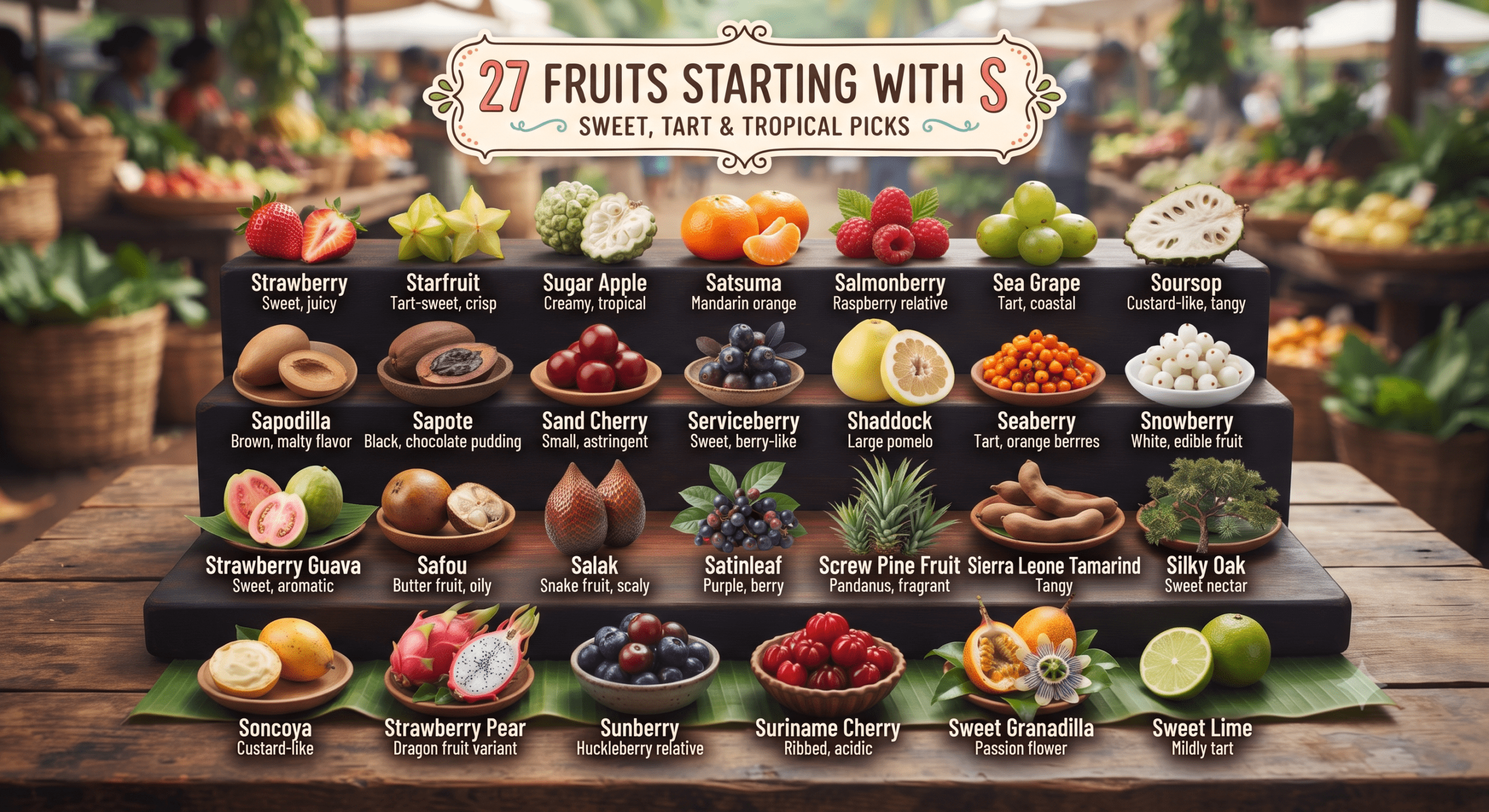
Looking for a fruit that starts with s? Strawberry may be the first one that comes to mind, but the letter S covers an unexpectedly diverse range of fruits—from juicy satsumas and crisp star fruit to tropical soursop, snake-skinned salak, and bright orange sea buckthorn berries.
Below, you will find 27 edible fruits beginning with S, including familiar supermarket staples and lesser-known varieties from Asia, Africa, the Americas, and the Mediterranean. Each entry includes flavor, origin, common uses, and practical tips for choosing or eating it.
Quick facts
- Most familiar: Strawberry
- Popular citrus choice: Satsuma
- Most distinctive shape: Star fruit
- Creamiest tropical option: Soursop
- Most unusual exterior: Salak
- Notable tart fruit: Sea buckthorn
- Dessert-like flavor: Sapodilla
- Important note: Common fruit names vary by country, so some fruits may have several regional names.
Fruit that starts with s: Quick comparison table
| Fruit | Flavor | Common Origin/Region | Best Uses |
|---|---|---|---|
| Strawberry | Sweet, mildly tart | Europe, Americas, worldwide | Fresh, desserts, smoothies |
| Star fruit | Sweet-tart, crisp | Southeast Asia | Fresh, salads, garnish |
| Satsuma | Sweet, mild citrus | Japan | Snacking, juice |
| Sapodilla | Sweet, malty, caramel-like | Mexico, Central America | Fresh, shakes |
| Soursop | Sweet-tart, creamy | Tropical Americas | Drinks, desserts |
| Salak | Sweet-tart, crisp | Indonesia | Fresh, preserves |
| Santol | Sweet-sour | Southeast Asia | Fresh, preserves |
| Serviceberry | Sweet, berry-like | North America | Fresh, pies, jams |
| Sea buckthorn | Intensely tart | Europe, Asia | Juice, sauces |
| Sugar apple | Very sweet, creamy | Tropical Americas | Fresh, desserts |
| Surinam cherry | Sweet-tart, aromatic | South America | Fresh, jams |
| Safou | Mild, buttery | Central and West Africa | Cooked, roasted |
| Salmonberry | Mildly sweet-tart | Pacific Northwest | Fresh, preserves |
| Strawberry guava | Sweet, aromatic | South America | Fresh, juice |
| Star apple | Sweet, milky | Caribbean, Central America | Fresh |
| Spanish lime | Tart to sweet | Caribbean, Latin America | Fresh |
| Sweet lime | Mild, sweet citrus | South Asia, Middle East | Juice, fresh |
| Sudachi | Sharp, aromatic citrus | Japan | Seasoning, juice |
| Soncoya | Sweet, fragrant | Central America | Fresh, drinks |
| Sweet granadilla | Sweet, floral | South America | Fresh, desserts |
| Star gooseberry | Very tart | Tropical Asia | Pickles, preserves |
| Sea grape | Sweet-tart | Caribbean, coastal Americas | Fresh, jelly |
| Sycamore fig | Mildly sweet | Africa, Middle East | Fresh, dried |
| Saguaro fruit | Sweet | Sonoran Desert | Fresh, syrup |
| Sugar palm fruit | Mild, refreshing | South and Southeast Asia | Desserts, drinks |
| Strawberry tree fruit | Sweet, slightly tart | Mediterranean | Fresh, jams |
| Sour cherry | Bright, tart | Europe, Western Asia | Baking, sauces |
1. Strawberry
Strawberries are easily the best-known answer when someone asks for a fruit that starts with s. They have juicy red flesh, a floral sweetness, and enough acidity to keep their flavor refreshing rather than cloying.
Eat strawberries fresh, blend them into smoothies, bake them into cakes, or turn them into sauces and preserves. Choose berries with an even red color and fresh green caps; strawberries do not become significantly sweeter after picking.
Interestingly, the strawberry is not a botanical berry. Its visible “seeds” are individual fruits called achenes attached to a fleshy receptacle.
2. Star fruit
Star fruit, also called carambola, comes from Southeast Asia. Slice the yellow fruit crosswise and each piece naturally forms a five-pointed star.
The entire fruit is generally eaten, including its thin skin. Ripe star fruit has a refreshing sweet-tart flavor with a crisp, juicy texture reminiscent of citrus, pear, and grape.
People with kidney disease may need to avoid star fruit because it contains compounds that impaired kidneys may not eliminate safely. Anyone affected should follow their clinician’s dietary guidance.
3. Satsuma
A satsuma is a type of mandarin citrus prized for its loose skin, low seed count, and sweet, mild flavor. It is particularly associated with Japan, although satsumas are now cultivated in several citrus-growing regions.
Their easy-to-peel skin makes them excellent lunchbox or travel fruit. A ripe satsuma should feel relatively heavy for its size, which generally indicates good juice content.
4. Sapodilla
Sapodilla is a round or oval tropical fruit with rough brown skin and exceptionally sweet flesh. Its flavor is often compared with brown sugar, caramel, pear, and malt.
The fruit originated in southern Mexico and Central America but is widely cultivated in tropical Asia as well. Wait until a sapodilla gives slightly under gentle pressure before eating it; unripe fruit can be unpleasantly astringent.
Remove the hard black seeds before eating.
5. Soursop
Soursop, sometimes called graviola or guanabana, is a large green tropical fruit covered with soft-looking spines. Beneath the skin is creamy white flesh surrounding numerous dark seeds.
Its flavor combines tropical sweetness with noticeable acidity, often described as a mixture of pineapple, strawberry, citrus, and banana. Soursop is commonly blended into smoothies, juices, ice creams, and desserts.
Although soursop has a history of traditional use, claims that it can cure cancer or other serious diseases are not supported by reliable clinical evidence. It should be enjoyed as food rather than treated as a substitute for medical care.
6. Salak
Salak is better known internationally as snake fruit because its reddish-brown skin resembles reptile scales. It is native to Indonesia and is particularly associated with Java and Bali.
Peel away the thin shell and you will find pale segmented flesh. Depending on the variety and ripeness, salak can be crisp or slightly soft, with flavors ranging from apple-like and nutty to sweet, acidic, and tropical.
7. Santol
Santol is a tropical Southeast Asian fruit with a thick yellowish or reddish rind and pale segmented flesh. Its taste ranges from gently sweet to distinctly sour.
It can be eaten fresh, although the edible pulp may cling closely to the seeds. Santol also appears in preserves, candies, curries, and savory dishes in parts of Southeast Asia.
Avoid biting or swallowing the large seeds.
8. Serviceberry
Serviceberries grow on shrubs and small trees belonging to the Amelanchier genus. Depending on the region, they may also be called juneberries or saskatoons.
The small purple fruits resemble blueberries but have a distinctive sweet, slightly nutty flavor. They can be eaten fresh or used in pies, muffins, jams, syrups, and dried-fruit mixtures.
9. Sea buckthorn
Sea buckthorn produces clusters of brilliant orange berries on thorny shrubs across parts of Europe and Asia. The berries are famous for their intense acidity.
Eating them straight from the bush can be an eye-opening experience: they are much more tart than a typical berry. Their juice is commonly sweetened or combined with other ingredients in sauces, syrups, teas, and preserves.
Sea buckthorn is also naturally rich in several plant compounds and nutrients, although nutritional content varies with variety and processing.
10. Sugar apple
Sugar apple belongs to the Annona family, making it a relative of soursop and cherimoya. It has knobbly green skin divided into scale-like sections.
Inside is soft, custard-like flesh with an intensely sweet flavor. It is usually eaten by splitting open a ripe fruit and scooping out the flesh.
The dark seeds and skin are not eaten.
11. Surinam cherry
Surinam cherry is a small ribbed fruit that may ripen from green through orange and red to deep reddish-purple. Despite its name, it is not a true cherry.
Its flavor can vary dramatically. Fully ripe fruits may be sweet and pleasantly tart, while less-ripe examples can taste resinous or sharply acidic.
For the best experience, allow the fruit to become fully colored and detach easily from the plant.
12. Safou
Safou, or African pear, is native to tropical Central and West Africa. Unlike sugary dessert fruits, its pulp has a rich, buttery character.
It is commonly softened by roasting, boiling, or placing it in hot water. The resulting flesh can be eaten alongside staple foods, giving safou a culinary role that feels closer to avocado than strawberry.
13. Salmonberry
Salmonberries are raspberry relatives native to the Pacific coast of North America. Their fruits range from golden yellow to orange and reddish tones.
They are juicy and delicate, with a flavor that is usually milder than cultivated raspberries. Fresh berries can be eaten straight from the plant when correctly identified, while larger harvests can be made into jams or syrups.
14. Strawberry guava
Strawberry guava produces small red or yellow fruits with highly aromatic flesh. The flavor combines the tropical fragrance of guava with a sweetness that can suggest strawberry.
The fruit can be eaten fresh, seeds included, or used for juice, jam, desserts, and sauces. Its powerful aroma makes even a small amount noticeable in recipes.
In some regions, strawberry guava is an invasive plant, so gardeners should check local guidance before planting it.
15. Star apple
Star apple is a tropical fruit native to the Caribbean and Central America. Depending on the variety, its skin may be green or purple.
Cut the fruit horizontally and its seed chambers create a star-shaped pattern. The flesh is soft, sweet, and milky, which explains another common name: milk fruit.
Scoop out the ripe flesh rather than eating the skin or seeds.
16. Spanish lime
Spanish lime is known by numerous regional names, including mamoncillo, quenepa, and genip. Despite the word “lime,” it is not closely related to familiar citrus limes.
The fruit has a thin green shell surrounding translucent pulp and a large seed. Depending on ripeness, the pulp can taste tart, tangy, or pleasantly sweet.
It is generally eaten by cracking the shell and sucking the pulp away from the seed.
17. Sweet lime
Sweet lime is a citrus fruit cultivated widely in South Asia and other warm regions. Compared with lemon or conventional lime, it has much lower acidity.
Its subtle flavor makes it particularly popular for fresh juice. Look for fruit that feels heavy and firm, while recognizing that the skin may remain partly green even when the fruit is ready to eat.
18. Sudachi
Sudachi is a small Japanese citrus fruit valued more for its fragrant juice than for eating out of hand. It is usually harvested while the peel is still green.
Its sharp acidity and complex aroma make it useful much like lemon or lime. Sudachi juice can brighten grilled fish, noodles, sauces, dressings, and dipping sauces without requiring much quantity.
19. Soncoya
Soncoya is another member of the Annona family. Native to tropical areas of the Americas, it produces a large fruit with a striking textured or spiny exterior.
Its aromatic pulp can be sweet and flavorful when fully ripe. Soncoya remains far less commercially available than soursop or sugar apple, so most people encounter it in regions where the tree is grown locally.
20. Sweet granadilla
Sweet granadilla is a passion fruit species with a hard orange shell and translucent pulp surrounding crunchy black seeds. Unlike more acidic passion fruits, it has a notably gentle sweetness.
The easiest way to eat one is to crack or cut open the shell and scoop out the seed-filled pulp with a spoon. Both the pulp and seeds are edible.
21. Star gooseberry
Star gooseberry produces small, pale yellow fruits arranged in clusters. It is also known as Otaheite gooseberry and several other regional names.
The fruits are extremely tart, so they are frequently transformed rather than eaten plain. Pickling, candying, chutneys, syrups, and preserves can balance their acidity effectively.
22. Sea grape
Sea grape grows naturally in tropical coastal environments, particularly around the Caribbean and the Americas. Its name comes partly from the clusters of round fruits that resemble bunches of grapes.
Ripe fruits turn purple and offer a sweet-tart pulp around a relatively large seed. They can be eaten fresh or prepared as jelly and preserves.
Sea grape plants also play an ecological role in coastal landscapes, so wild harvesting should respect local rules and protected areas.
23. Sycamore fig
The sycamore fig, Ficus sycomorus, has a long history in parts of Africa and the Middle East. It should not be confused with the unrelated trees called sycamores in North America and Europe.
Its figs grow directly from larger branches and the trunk. Ripe fruits are edible and mildly sweet and have been consumed fresh or dried for centuries.
24. Saguaro fruit
Saguaro fruit grows on the iconic giant cactus of the Sonoran Desert. When ripe, the fruit opens to reveal bright red pulp filled with numerous black seeds.
The fruit has deep cultural significance for Indigenous peoples of the region, particularly the Tohono O’odham. It has traditionally been eaten fresh or processed into syrup and other preparations.
Wild harvesting must be done only where it is legal and culturally appropriate.
25. Sugar palm fruit
Sugar palms produce fruits containing translucent, jelly-like seed kernels that are eaten when young. They are popular in several parts of South and Southeast Asia.
Their flavor is mild rather than intensely sweet, while the soft, slippery texture makes them especially refreshing in hot weather. The kernels often appear in chilled drinks and desserts.
Commercially prepared fruit is the simplest option because processing mature palm fruit can require specialized handling.
26. Strawberry tree fruit
The strawberry tree, Arbutus unedo, is native to the Mediterranean region and western Europe. Despite its name, it is unrelated to strawberries.fruit that starts with s
Its round red fruits have a rough, textured surface and soft yellow-orange interior. Fully ripe fruits can be eaten fresh, but they are perhaps better known for jams, preserves, liqueurs, and fermented products.fruit that starts with s
The species name unedo is traditionally associated with the idea of eating only one, reflecting the fruit’s distinctive texture and flavor.fruit that starts with s
27. Sour cherry
Sour cherries, also known as tart cherries, are considerably more acidic than the sweet cherries commonly sold for fresh snacking.
That acidity is exactly what makes them valuable in cooking. They work especially well in pies, preserves, sauces, compotes, juices, and dishes where added sugar or rich ingredients can balance their tartness.
Popular cultivated types include Morello and Montmorency cherries.
Which S fruits are easiest to find?
If you want to try several fruits on this list, availability will depend heavily on where you live.
Typically easier to find:
- Strawberries
- Satsumas
- Star fruit
- Sour cherries
- Sweet lime
- Soursop, especially frozen pulp in international markets
More likely at Asian or specialty grocers:
- Salak
- Sugar apple
- Santol
- Sweet granadilla
- Sudachi
- Star gooseberry
Usually regional or seasonal:
- Serviceberry
- Salmonberry
- Sea grape
- Saguaro fruit
- Safou
- Soncoya
Frozen fruit pulp is worth considering when fresh tropical fruit is unavailable. For soursop, passion fruit relatives, and guava-type fruits, frozen pulp can also be more convenient for drinks and desserts.
How to choose ripe fruit that starts with s
Because these fruits come from very different botanical families, there is no universal ripeness test. Color alone is especially unreliable.fruit that starts with s
Check weight
Juicy fruits such as satsumas and sweet limes should generally feel heavy relative to their size. A surprisingly light citrus fruit may have begun to dry internally.
Test firmness carefully
Soft-fleshed tropical fruits such as sapodilla and sugar apple usually become more yielding as they ripen. Press gently rather than squeezing, since bruising can accelerate spoilage.fruit that starts with s
Pay attention to aroma
A ripe strawberry, guava, or tropical Annona fruit often becomes increasingly fragrant. Aroma can provide information that skin color alone does not.fruit that starts with s
Learn the specific fruit
Some fruits change dramatically after harvest while others do not. Strawberries, for example, should already have good color when purchased because they will not become substantially sweeter on your kitchen counter.
What nutrients do S fruits provide?
There is no single nutritional profile shared by every S fruit. Their nutrient content depends on species, variety, growing conditions, ripeness, serving size, and preparation.
Across the group, however, you will commonly find:
- Vitamin C: especially associated with many citrus fruits, strawberries, guavas, and sea buckthorn.
- Dietary fiber: found in whole fruits and generally reduced when fruit is strained into juice.
- Plant pigments and polyphenols: particularly abundant in deeply colored berries and red, orange, or purple fruits.
- Carbohydrates: naturally occurring fruit sugars are an important energy source in sweeter fruits such as sapodilla and sugar apple.
- Water: juicy fruits such as strawberries, citrus, and star fruit contribute significantly to dietary fluid intake.
Whole fruit generally offers more fiber than filtered juice, making the intact fruit a useful default when both options are available.
Common mistakes when trying unfamiliar S fruits
Assuming the skin is edible
Some fruits can be eaten whole, while others have skins that are tough, unpleasant, or simply not used as food. Star fruit is commonly eaten with its skin, whereas sugar apple and star apple are normally scooped from their skins.
Eating the seeds automatically
Edible fruit does not mean every part of the fruit should be consumed. Large seeds from fruits such as sugar apple, soursop, santol, and star apple should be discarded.
Judging tropical fruit by appearance alone
A sapodilla’s rough brown skin may look unremarkable even when the flesh inside is exceptionally sweet. Likewise, some citrus varieties can remain greenish despite being mature.
Expecting every exotic fruit to taste sweet
Sea buckthorn and star gooseberry can be aggressively tart. Safou is rich and savory rather than dessert-like.
Understanding the expected flavor prevents a perfectly good fruit from being mistaken for a bad one.
Believing exaggerated health claims
Unusual fruits are frequently marketed with dramatic “superfood” or disease-treatment claims. Nutrient-rich foods can certainly contribute to a balanced diet, but that does not make a fruit a clinically proven treatment for a medical condition.fruit that starts with s
Best S fruits for different tastes
If you prefer very sweet fruit, start with sapodilla, sugar apple, sweet granadilla, or ripe strawberries.
For a sweet-and-tart balance, try star fruit, Surinam cherry, strawberry guava, salmonberry, or sea grape.
If you enjoy strong acidity, sea buckthorn, star gooseberry, sour cherry, and sudachi provide considerably more bite.
For something creamy or custard-like, soursop, sugar apple, and star apple are the strongest options.
For a completely different experience, try salak for its scaly skin and crisp flesh or safou for its rich, almost avocado-like character.
Frequently asked questions
What is the most common fruit that starts with s?
Strawberry is probably the most widely recognized example. It is cultivated commercially around the world and is commonly available fresh, frozen, dried, and processed.fruit that starts with s
What tropical fruit starts with S?
Several do, including soursop, sapodilla, salak, santol, sugar apple, star apple, soncoya, and strawberry guava.fruit that starts with s
What citrus fruit starts with S?
Satsuma, sweet lime, and sudachi all begin with S. Each has a different flavor profile: satsuma is sweet and easy to peel, sweet lime is mild, and sudachi is sharply acidic and aromatic.fruit that starts with s
What yellow fruit starts with S?
Star fruit becomes yellow as it ripens, while some varieties of star gooseberry and strawberry guava also produce yellow fruit.fruit that starts with s
What red fruit starts with S?
Strawberries, Surinam cherries, salmonberries, strawberry tree fruits, and some strawberry guavas can all have red coloring when ripe.
What small fruit starts with S?
Good examples include strawberries, serviceberries, salmonberries, Surinam cherries, sea buckthorn berries, and sudachi.
Is snake fruit the same as salak?
Yes. Snake fruit is the common English nickname for salak, referring to its distinctive brown, scale-like skin.fruit that starts with s
Are all fruits starting with S safe to eat?
No. A plant or wild berry beginning with S should never be assumed edible merely because its name appears similar to a known fruit. Correct identification matters, particularly with wild plants.fruit that starts with s
For example, snowberry is sometimes included casually in alphabetical fruit lists because it produces berry-like fruits, but it is not a sensible addition to an edible-fruit list. When foraging, rely on authoritative local identification resources rather than alphabetical lists.fruit that starts with s
Final thoughts
There is far more variety behind the keyword fruit that starts with s than strawberries alone suggest. Familiar choices such as satsumas and sour cherries sit alongside tropical fruits such as soursop and sapodilla, Southeast Asian specialties such as salak and santol, and regional treasures such as salmonberries and saguaro fruit.
Start with the flavors you already enjoy, then branch out. If you like sweet fruit, try sapodilla or sugar apple; if tart flavors are your preference, explore sea buckthorn or star gooseberry; and if you simply want something memorable, a sliced star fruit or freshly peeled salak makes an excellent introduction to the surprisingly diverse world of fruits beginning with S.