

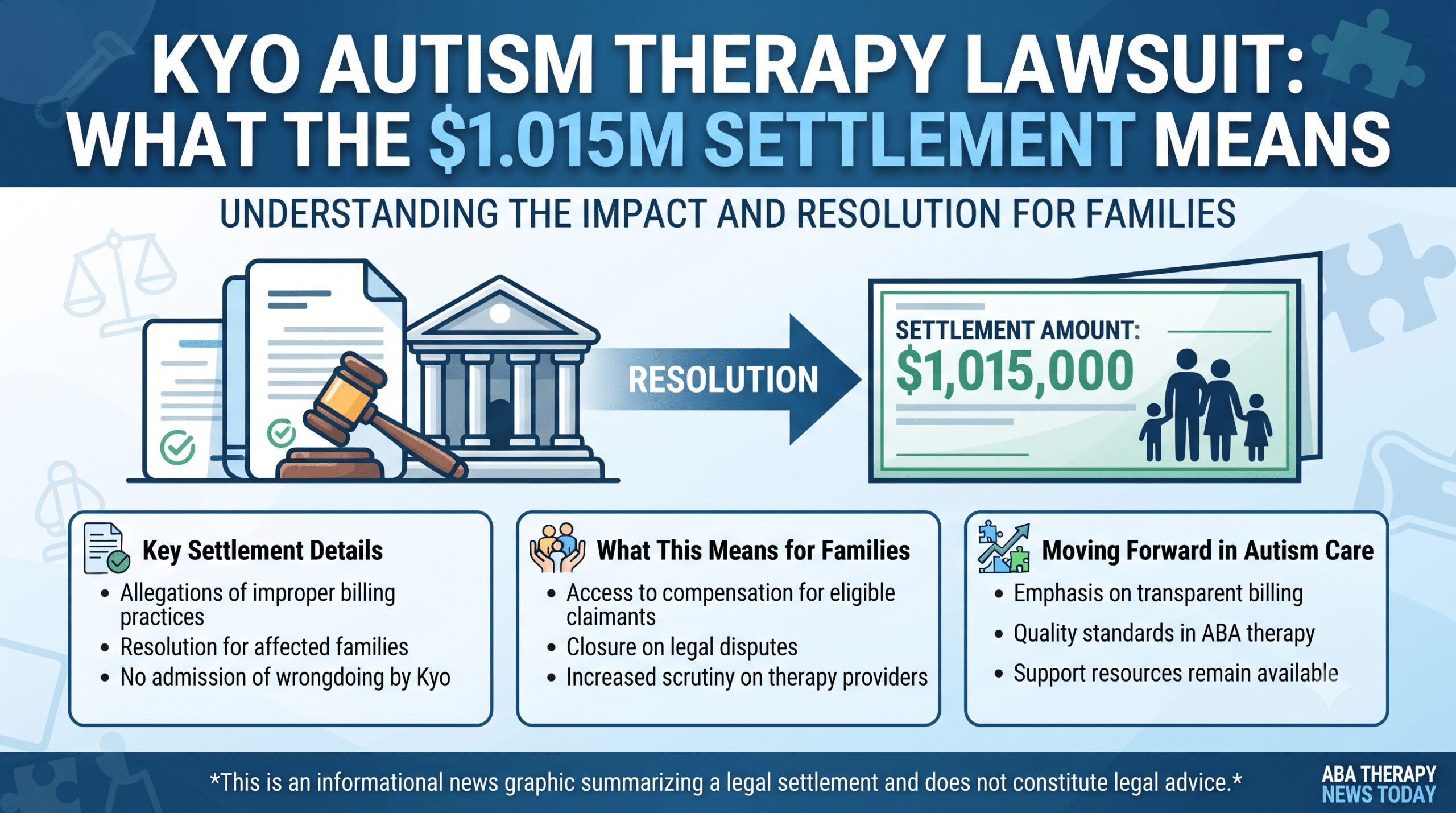
The kyo autism therapy lawsuit most people are searching for was an employment class action against Kyo Autism Therapy, LLC—not a lawsuit alleging that Kyo’s autism treatment harmed patients.
In Liliya Gotishan v. Kyo Autism Therapy, LLC, a former employee alleged that Kyo violated California wage-and-hour laws affecting non-exempt employees. Kyo denied liability and wrongdoing, and the case ultimately ended in a $1.015 million class action settlement that received final court approval in October 2023.
That distinction matters. A settlement is not the same as a court finding that the defendant committed the alleged violations, and the final order expressly stated that it was not a determination of wrongdoing by Kyo or any other party.
Kyo Autism Therapy Lawsuit: Quick Facts
| Key fact | Details |
|---|---|
| Case | Liliya Gotishan v. Kyo Autism Therapy, LLC |
| Court | Superior Court of California, County of San Francisco |
| Case number | CGC-21-596378 |
| Original filing date | November 10, 2021 |
| Type of case | Employment wage-and-hour class action |
| Defendant | Kyo Autism Therapy, LLC |
| Gross settlement | $1,015,000 |
| Settlement class period | November 10, 2017–January 1, 2023 |
| Final approval entered | October 26, 2023 |
| Kyo’s position | Kyo denied liability and wrongdoing |
| Court finding of wrongdoing? | No |
The official settlement notice and final approval records confirm the case number, allegations, class definition, settlement amount, and final approval.
What Was the Kyo Autism Therapy Lawsuit About?
The lawsuit centered on employee compensation and workplace requirements under California law.
Plaintiff Liliya Gotishan filed the lawsuit on behalf of herself and other current and former non-exempt Kyo employees in California. According to the official settlement materials, she alleged violations involving wages, breaks, expense reimbursement, wage statements, and related labor requirements.
The Main Allegations Against Kyo
The plaintiff alleged that Kyo failed to:
- Pay all minimum wages allegedly owed.
- Pay all overtime wages allegedly owed.
- Provide legally compliant meal periods.
- Authorize and permit required rest breaks.
- Provide accurate wage statements.
- Timely pay all wages due when employment ended.
- Reimburse employees for certain business expenses.
The lawsuit also asserted a claim under California’s Unfair Competition Law. An amended complaint filed November 19, 2021 added a claim for civil penalties under California’s Private Attorneys General Act, commonly called PAGA.
The final settlement release also encompassed certain claims connected with background checks and California paid-sick-leave requirements.
These were allegations, not judicial findings that Kyo committed the violations.
How Did Kyo Respond to the Allegations?
Kyo disputed the plaintiff’s claims.
The official settlement notice states that Kyo expressly denied violating the law and agreed to settle to avoid the expense, disruption, and time associated with continuing litigation.
The court’s final order reinforces an important legal point: neither the settlement agreement nor the approval order constituted an admission of fault, liability, omission, or wrongdoing.
The judge specifically stated that final approval did not represent the court’s opinion on the merits of either side’s claims or defenses.
How Much Was the Kyo Autism Therapy Settlement?
Kyo agreed to a gross settlement amount of $1,015,000.
The settlement was structured as non-reversionary, meaning the agreement provided that settlement money would not simply return to Kyo if some class payments went unclaimed.
That $1.015 million was not divided exclusively among employees. It also covered court-approved attorneys’ fees, litigation expenses, settlement administration, PAGA penalties, and representative payments.
Settlement Cost Breakdown
The court approved:
| Settlement component | Amount |
|---|---|
| Gross settlement fund | $1,015,000 |
| Class counsel attorneys’ fees | $338,333.33 |
| Litigation costs and expenses | $14,470.08 |
| Settlement administration | $20,000 |
| PAGA penalties | $50,000 |
| Class representative service payment | $10,000 |
The settlement agreement also provided for a separate $10,000 payment to the plaintiff in exchange for a broader release of her individual claims.
The amount an individual class member received therefore depended on the allocation formula rather than simply dividing $1.015 million equally among employees.kyo autism therapy lawsuit
Who Was Included in the Kyo Settlement?
The settlement class covered:
Current and former non-exempt Kyo Autism Therapy employees who worked in California from November 10, 2017 through January 1, 2023.kyo autism therapy lawsuit
The court certified that class for settlement purposes when granting final approval.
“Non-exempt” is an important qualifier. In California employment law, non-exempt workers are generally employees covered by wage-and-hour protections such as minimum wage, overtime, meal periods, and rest breaks.
Simply being a Kyo employee during some other period—or working for Kyo outside California—did not automatically place someone within this particular settlement class.
Who Qualified for the PAGA Portion?
A narrower group qualified as PAGA members.
The settlement identified PAGA members as non-exempt Kyo employees who worked in California during the applicable PAGA period beginning September 15, 2020 and continuing through January 1, 2023 under the final class definition.
Of the $50,000 designated for PAGA penalties:
- $37,500, or 75%, was allocated to California’s Labor and Workforce Development Agency.
- $12,500, or 25%, was allocated among eligible PAGA members.
That allocation followed the structure specified in the settlement.
How Were Employee Settlement Payments Calculated?
This was not a settlement in which every employee received the same check.
According to the official FAQ, participating class members received a proportional share based largely on the number of qualifying weeks they worked for Kyo during the class period relative to the total qualifying workweeks of participating class members.
PAGA payments were calculated separately for members of the PAGA subclass using qualifying workweeks during the PAGA period.
Employees Did Not Have to File a Claim Form
One unusual point that can cause confusion today is that eligible employees generally did not need to submit a traditional claim form to participate.kyo autism therapy lawsuit
Class members were automatically included unless they submitted a valid request to exclude themselves. The original deadline to object or request exclusion was August 26, 2023.
The final order records that one class member submitted a timely exclusion request.kyo autism therapy lawsuit
When Was the Kyo Autism Therapy Lawsuit Settled?
The case followed a multi-year timeline.
November 10, 2021: Lawsuit Filed
Liliya Gotishan filed the original complaint in San Francisco County Superior Court.
November 19, 2021: Amended Complaint Filed
The amended complaint added a PAGA cause of action.
April 12, 2023: Preliminary Approval
The court preliminarily approved the proposed settlement and conditionally certified the settlement class.
June 27, 2023: Settlement Notices Mailed
Notices were sent to potential settlement class members.
August 26, 2023: Opt-Out and Objection Deadline
Class members wishing to exclude themselves or object were required to act by this date.
September 14, 2023: Final Approval Hearing
The court held the scheduled final approval hearing.
October 26, 2023: Final Approval Entered
The San Francisco Superior Court entered the order granting final approval of the settlement and attorneys’ fees and costs.
Is the Kyo Autism Therapy Lawsuit Still Active?
The class action settlement described above is not a newly pending lawsuit awaiting settlement approval.
The court entered final approval in October 2023. The settlement’s original objection and exclusion deadlines have also passed.kyo autism therapy lawsuit
For that reason, someone discovering the case today should be cautious with websites that describe the $1.015 million settlement as merely “proposed” without explaining that final approval was subsequently granted.kyo autism therapy lawsuit
What If an Eligible Employee Never Received Their Money?
The final order directed that settlement payments be distributed to participating class members.
It also provided that money associated with checks remaining uncashed after the applicable check-validity period would be forwarded to California’s Unclaimed Property Fund, rather than reverting to Kyo.
A former employee who believes they were entitled to a payment but never received or deposited it may therefore want to:
- Review the official Gotishan v. Kyo Autism Therapy settlement records.
- Check whether their address was correct when settlement notices and checks were issued.
- Contact the settlement administrator identified in the official materials.
- Search California’s official unclaimed-property records if a payment may have gone uncashed.
- Speak with an employment attorney if there is a separate legal issue not covered by the settlement.
The original settlement deadlines should not be confused with the time limits that may apply to an entirely separate employment claim.
Was the Lawsuit About Kyo’s ABA Therapy or Patient Care?
No—not the class action discussed here.
Kyo provides Applied Behavior Analysis, or ABA, services for children with autism, including in-home, school-based, virtual, parent-coaching, and BCBA-supervised services.kyo autism therapy lawsuit
But Gotishan v. Kyo Autism Therapy concerned employees’ wage-and-hour allegations, not whether ABA itself was clinically appropriate and not allegations that children receiving Kyo services were injured by therapy.
This distinction is particularly important because the phrase “Kyo autism therapy lawsuit” can sound like a medical-malpractice, patient-safety, or autism-treatment dispute. The primary court documents show that the major class action associated with that search phrase was instead an employment case.kyo autism therapy lawsuit
Did the Settlement Prove That Kyo Violated California Labor Law?
No.
Settlement approval means the court approved the parties’ negotiated resolution as fair and adequate for settlement purposes. It does not mean the court conducted a trial and concluded that every allegation was true.kyo autism therapy lawsuit
The final approval order states that the settlement was the product of arm’s-length negotiations and approved its terms, while separately emphasizing that the agreement was not an admission of wrongdoing and not a judicial determination of the underlying claims’ merits.
That is why accurate reporting should use wording such as “the lawsuit alleged” rather than stating that Kyo definitively committed the alleged violations.kyo autism therapy lawsuit
Why Did Kyo Settle If It Denied Wrongdoing?
Companies routinely settle civil litigation without admitting liability.
Litigation can involve years of discovery, depositions, expert work, motion practice, class-certification disputes, trial preparation, appeals, and substantial legal fees. A negotiated settlement allows both sides to exchange those uncertainties for a defined outcome.
Here, the official notice says Kyo denied liability but chose to settle to avoid costly, disruptive, and time-consuming litigation.
Accordingly, the existence of a seven-figure settlement should not be treated as proof that Kyo accepted the plaintiff’s allegations.
What Claims Did Class Members Release?
Participating class members gave up certain claims falling within the settlement’s release.
The final order describes released claims involving alleged unpaid minimum and overtime wages, meal and rest periods, final wages, wage statements, expense reimbursement, unfair competition, PAGA penalties, certain background-check issues, sick-leave requirements, and related wage-and-hour claims arising from the allegations during the class period.
This matters for former workers evaluating old employment disputes.
A class settlement release does not necessarily eliminate every conceivable claim a person could ever have against a company. Its effect depends on the precise release language, the employee’s class status, the relevant dates, the factual basis of the claim, and whether that employee opted out where permitted.
Anyone facing a specific legal issue should have the actual settlement release reviewed rather than relying solely on a summary article.
Common Misunderstandings About the Kyo Lawsuit
“Kyo was found guilty.”
Civil class actions do not result in a criminal finding of “guilty,” and this case did not produce a trial verdict finding Kyo liable.
Kyo denied wrongdoing, and the court expressly stated that the settlement was not a determination of wrongdoing.
“Every Kyo employee received part of $1.015 million.”
Not necessarily.
The class was limited to qualifying non-exempt California employees during the specified class period, and the gross settlement also funded fees, costs, administration, PAGA penalties, and representative payments.
“Each class member received the same amount.”
No.
Payments were generally tied to qualifying workweeks, so two class members could receive substantially different amounts.
“The lawsuit accused Kyo of harming children through autism therapy.”
That is not what the Gotishan class action alleged.
The lawsuit addressed employment and wage-and-hour issues.
“The $1.015 million settlement is still open for new claims.”
The principal settlement process dates back to 2023, and the court entered final approval on October 26, 2023.
What Former Kyo Employees Should Check
Former employees researching this case should first establish whether they actually fell within the settlement class.
The most useful records to gather include employment dates, job classification, California work location, old pay statements, settlement correspondence, and any record of a settlement check.
Someone considering a separate wage claim should also determine whether the potential issue occurred inside or outside the class period and whether it was covered by the settlement release.
That analysis can materially change a person’s legal options.
Frequently Asked Questions
What was the Kyo autism therapy lawsuit?
The best-documented class action associated with that phrase is Liliya Gotishan v. Kyo Autism Therapy, LLC, an employment lawsuit alleging California wage-and-hour violations affecting non-exempt workers.kyo autism therapy lawsuit
How much did Kyo Autism Therapy settle for?
The gross settlement amount was $1,015,000.
Did Kyo admit wrongdoing?
No. Kyo denied liability and wrongdoing, and the court stated that settlement approval was not a determination that wrongdoing occurred.kyo autism therapy lawsuitkyo autism therapy lawsuit
Who was covered by the settlement?
The settlement class consisted of current and former non-exempt employees who worked for Kyo in California from November 10, 2017 through January 1, 2023.
Did employees have to submit a claim form?
Generally, no. Participating class members were automatically included unless they validly opted out.kyo autism therapy lawsuit
When did the court approve the settlement?
The court entered final approval on October 26, 2023.
Was this an autism-treatment malpractice case?
No. The Gotishan case concerned employee wage-and-hour allegations rather than allegations of malpractice or harm arising from ABA treatment.
What happened to uncashed settlement checks?
The final order directed funds attributable to uncashed checks after the applicable deadline to California’s Unclaimed Property Fund.
The Bottom Line on the Kyo Autism Therapy Lawsuit
The kyo autism therapy lawsuit was primarily an employment class action involving allegations that Kyo Autism Therapy failed to comply with several California wage-and-hour requirements for non-exempt employees.
Kyo denied the allegations and did not admit wrongdoing. The parties reached a $1.015 million settlement, and the San Francisco County Superior Court entered final approval in October 2023 while expressly stating that approval did not amount to a finding that Kyo had violated the law.
For former employees, the most important questions are whether they worked for Kyo in California during the covered period, whether they were classified as non-exempt, whether they received their settlement payment, and whether any current dispute falls within the claims released by the settlement.kyo autism therapy lawsuit
For families researching Kyo as an autism-services provider, the central takeaway is different: this particular class action concerned employment practices, not allegations that Kyo’s ABA therapy injured patients or was ruled clinically improper.
This article provides general informational coverage of public court and settlement records and is not legal advice.