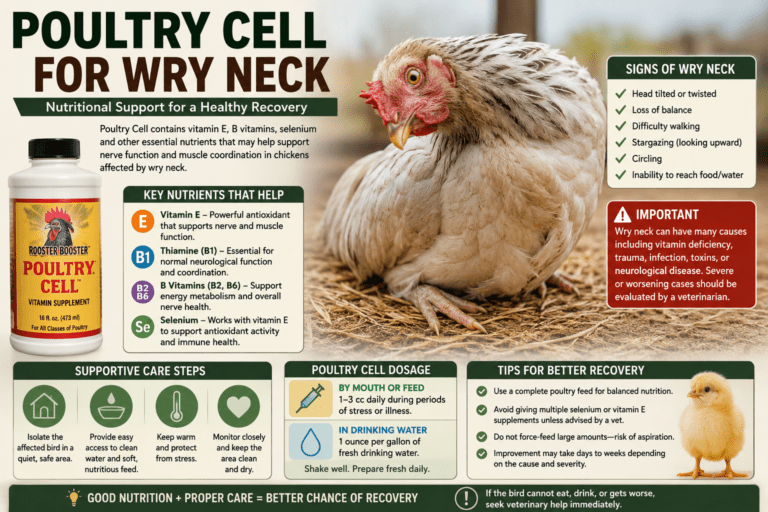


Using poultry cell for wry neck can be reasonable supportive care when a chicken’s abnormal neck position is related to nutritional deficiency or when illness has reduced its nutrient intake. Rooster Booster Poultry Cell contains vitamin E, B vitamins, minerals, iron, selenium, and amino acids, and its manufacturer specifically lists wry neck and vitamin deficiency among conditions it may help support.
But wry neck—also called torticollis—is a symptom, not a diagnosis. Vitamin deficiency is only one possible cause. Head trauma, neurologic disease, infection, toxins, and other illnesses can produce similar signs, so Poultry Cell should not automatically be treated as a cure.
Quick Answer: Does Poultry Cell Help Wry Neck in Chickens?
It may help if nutritional deficiency is contributing to the problem, particularly when vitamin E status is inadequate. It will not treat every cause of wry neck.
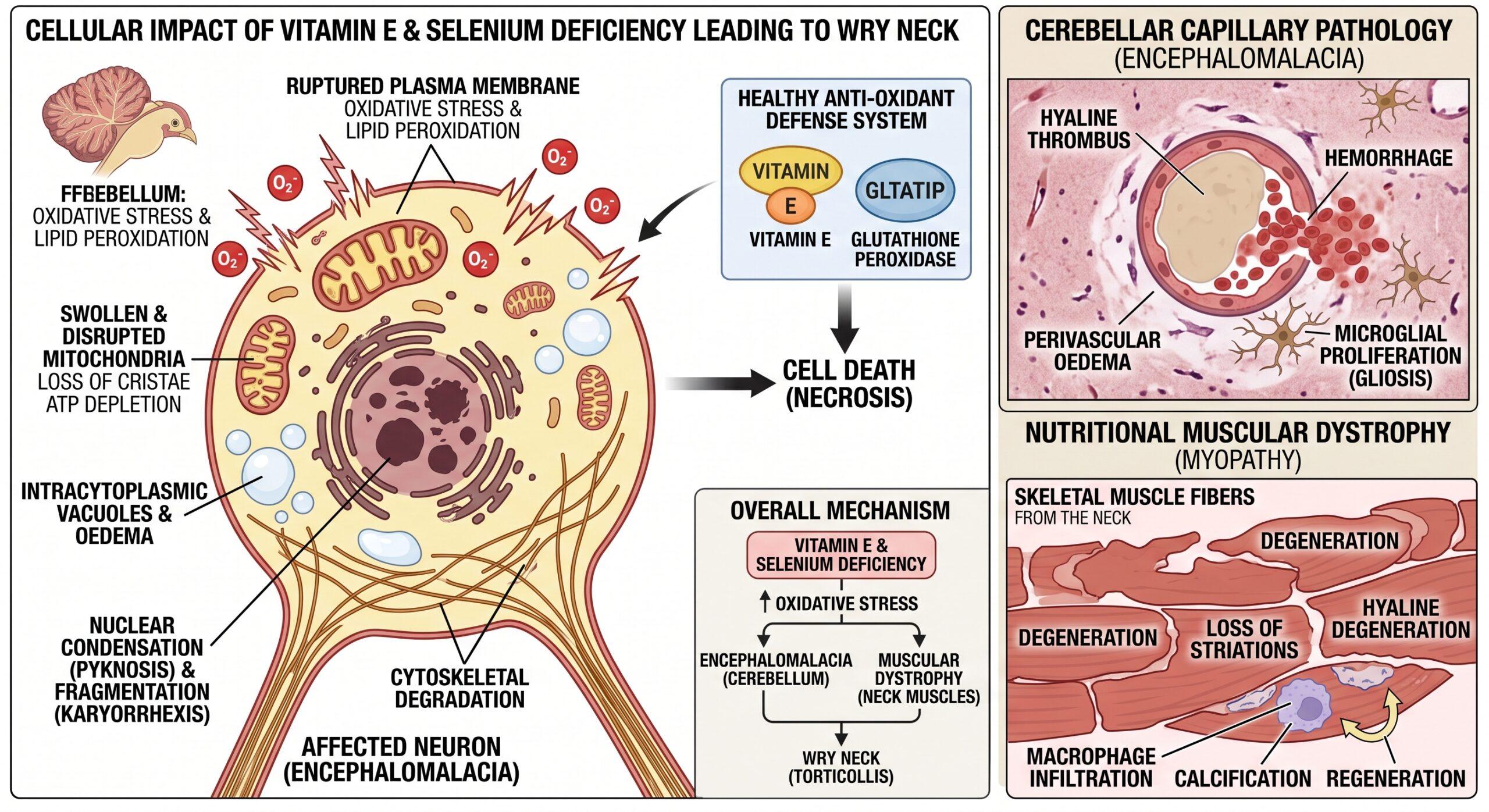
Vitamin E deficiency can cause neurologic disease in chicks, including encephalomalacia, which commonly produces ataxia and other nervous-system abnormalities. Early vitamin E supplementation may help in some deficiency-related cases, although recovery depends partly on how much neurologic damage has already occurred.
Rooster Booster describes Poultry Cell as a vitamin-and-mineral supplement for poultry experiencing illness, nutritional deficiency, molting, or other stress. Its formula includes vitamins A, D and E, essential B vitamins, minerals, amino acids, iron, and selenium.
That makes Poultry Cell a supportive nutritional supplement, not a diagnostic test or treatment for every disease that causes a twisted neck.poultry cell for wry neck
What Is Wry Neck?
Wry neck is an abnormal position or movement of a bird’s head and neck. A chicken may:
- Twist its neck sideways
- Pull its head backward over its body
- Hold its head upside down
- Look upward repeatedly, sometimes called “stargazing”
- Lose balance or walk backward
- Fall, roll, or circle
- Struggle to coordinate eating and drinking
The severity can range from a slight persistent head tilt to an inability to stand or control the head.
Because several diseases can produce these signs, the appearance of the neck alone cannot tell you what caused the problem.
Why Poultry Cell May Help
The strongest nutritional reason for considering Poultry Cell is its vitamin E content combined with other micronutrients that support a bird whose normal intake has been compromised.
Vitamin E has an important neurologic role
Vitamin E functions as an antioxidant that protects tissues from oxidative damage. Merck Veterinary Manual identifies encephalomalacia, exudative diathesis, and muscular dystrophy as the three major disorders associated with vitamin E deficiency in chicks. Neurologic disease from encephalomalacia commonly causes loss of coordination.poultry cell for wry neckpoultry cell for wry neck
A bird eating a properly formulated, fresh commercial poultry ration is less likely to become deficient than a bird receiving an unbalanced diet, deteriorated feed, excessive treats, or a homemade ration without appropriate supplementation.poultry cell for wry neckpoultry cell for wry neck
Selenium and vitamin E work together—but more is not always better
Selenium and vitamin E have complementary roles in the body’s antioxidant system. Poultry Cell contains both nutrients.poultry cell for wry neckpoultry cell for wry neck
This does not mean that adding several selenium products at once will improve recovery. Selenium has a relatively narrow margin between nutritional adequacy and excessive intake, and over-supplementation can be harmful.
If Poultry Cell is already being used, avoid casually stacking it with concentrated selenium supplements unless an avian or poultry veterinarian has recommended a specific regimen.
Sick birds may need nutritional support even when deficiency was not the original cause
A chicken with severe torticollis may have difficulty reaching feed and water. Reduced intake can then create a secondary problem: the bird becomes weaker and receives fewer nutrients precisely when it needs adequate nutrition.
In that situation, Poultry Cell may provide supportive nutrition without necessarily treating the underlying illness.
How Much Poultry Cell Do You Give a Chicken With Wry Neck?
The commonly published Poultry Cell label directions are 1–3 cc (mL) daily during periods of stress or competition, given with feed or orally. The product can alternatively be mixed into drinking water at 1 fluid ounce per gallon.
Those are general product directions—not a veterinary, weight-based treatment protocol specifically for wry neck.
| Method | Published product direction | Practical consideration |
|---|---|---|
| Mixed with feed | 1–3 cc daily | Useful only if the affected bird is eating reliably |
| Oral administration | 1–3 cc daily | Greater control over intake, but incorrect administration can cause aspiration |
| Drinking water | 1 oz per gallon | Convenient for poultry that can drink normally, but actual intake varies |
The manufacturer’s FAQ also recommends making fresh Poultry Cell water regularly because the iron can settle and advises shaking or stirring the mixture.
What about chicks?
Do not automatically give a tiny chick the same direct oral quantity you would give a full-size adult bird.
The manufacturer’s guidance for a week-old duckling is to follow the product’s water-mixing directions rather than specifying an adult-style direct oral dose.
For a chick with significant neurologic signs, individualized dosing is best discussed with a veterinarian familiar with poultry. The bird’s age, weight, diet, hydration, ability to swallow, and other supplements all matter.
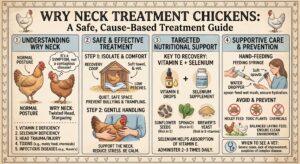
A Safer Step-by-Step Approach
1. Separate the affected bird for observation
Move the chicken to a quiet, protected recovery area where flock mates cannot peck or trample it.poultry cell for wry neck
Use secure footing or soft bedding. A bird with poor balance can repeatedly injure itself by tumbling against hard objects.poultry cell for wry neck
2. Check whether it can eat and drink
Place familiar feed and clean water where the chicken can reach them without having to stretch or twist its neck.
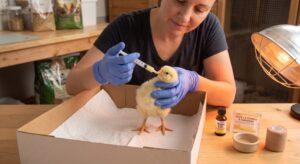
If the bird cannot coordinate swallowing, do not simply pour fluids into its mouth. Birds can aspirate liquid into the respiratory tract.
A chicken that cannot swallow or remain hydrated needs professional veterinary help promptly.
3. Review the diet
Ask what the chicken was eating before the symptoms started.
A balanced commercial starter, grower, all-flock, or layer ration appropriate for the bird’s age should normally provide the nutritional foundation. Heavy use of scratch grains, table scraps, treats, or homemade mixtures can dilute the nutrient density of the complete ration.
Also check the feed itself. Old, rancid, improperly stored, or nutritionally incomplete feed deserves suspicion when several birds develop abnormalities.
4. Use Poultry Cell according to its current label
Shake the product thoroughly and follow the directions printed on your bottle, since formulations and labeling can change.
Avoid combining multiple vitamin-and-mineral products simply because each one contains nutrients associated with neurologic health. Poultry Cell already contains numerous vitamins and trace minerals.
5. Watch the bird—not just its neck
Record whether the chicken is:
- Eating
- Drinking
- Standing
- Walking
- Maintaining weight
- Producing normal droppings
- Becoming more or less alert
- Developing tremors or paralysis
- Showing respiratory symptoms
- Developing symptoms in other flock members
A daily video can be particularly useful because gradual improvement or deterioration is easier to recognize when recordings are compared.
6. Investigate the cause if improvement does not follow
Do not continue nutritional treatment indefinitely while assuming every neurologic problem is a vitamin deficiency.
If symptoms are severe, progressing, affecting multiple birds, or failing to improve, veterinary examination becomes increasingly important.
When Poultry Cell Is Most Reasonable to Consider
Nutritional support becomes more plausible when:
- The bird has been eating an unbalanced or heavily treat-based diet.
- Feed quality or storage is questionable.
- A growing chick has neurologic signs without obvious trauma.
- Illness has significantly reduced food intake.
- The bird has recently experienced substantial nutritional stress.
- A veterinarian suspects vitamin deficiency.
Even in these situations, response to vitamins does not conclusively prove the original diagnosis.
When Poultry Cell May Not Solve the Problem
One of the most consequential mistakes in treating wry neck is assuming that a twisted neck always means vitamin E deficiency.
Infectious neurologic disease
Newcastle disease can cause torticollis along with tremors, paralysis, circling, respiratory signs, diarrhea, and potentially substantial flock mortality.
Avian encephalomyelitis can cause ataxia, leg weakness, paralysis, and characteristic head or neck tremors, particularly in young chicks.
Listeriosis can also produce twisting or backward retraction of the neck, ataxia, paralysis, and other neurologic abnormalities.
A vitamin supplement cannot eliminate these infections.
Marek’s disease
Marek’s disease frequently causes neurologic dysfunction through damage to peripheral nerves. Leg paresis is especially characteristic, although neurologic disease should generally be considered when weakness or paralysis accompanies abnormal posture.
Again, Poultry Cell may support general nutrition but does not treat Marek’s disease.
Aspergillosis
Although primarily a respiratory fungal disease, aspergillosis can occasionally affect the nervous system and cause torticollis and tremors.
Respiratory difficulty accompanying neurologic abnormalities therefore deserves prompt attention.
Botulism
Botulism more commonly produces flaccid neck paralysis, often called limberneck, rather than the characteristic twisting associated with torticollis. Weakness can progress through the legs, wings, neck, and other muscles.
A limp neck and generalized paralysis should not automatically be treated as nutritional wry neck.
Trauma
A collision, fall, predator encounter, peck to the head, or other injury can produce neurologic abnormalities.
Vitamin supplementation may support an injured bird’s overall condition, but it cannot correct serious head, spinal, or skeletal trauma.
Wry Neck Clues That Change What You Should Do
| What you observe | What it may suggest | Best next step |
| One bird, questionable diet, otherwise alert | Nutritional deficiency is more plausible | Correct diet, provide supportive care, consider Poultry Cell |
| Recent head injury | Trauma | Restrict further injury and seek veterinary assessment if neurologic signs persist |
| Multiple birds suddenly affected | Flock-level infectious, toxic, or nutritional problem | Isolate affected birds and obtain veterinary help |
| Twisted neck plus coughing, sneezing, or respiratory distress | Infectious or respiratory disease with neurologic involvement | Veterinary evaluation promptly |
| Tremors, seizures, paralysis, or rapid deterioration | Significant neurologic disease | Urgent veterinary evaluation |
| Cannot swallow or drink | High dehydration and aspiration risk | Veterinary assistance promptly |
| Limp, weak neck with generalized paralysis | Botulism or another neuromuscular disorder may be possible | Seek veterinary evaluation |
| Gradual improvement after correcting a clearly deficient diet | Nutritional cause becomes more plausible | Continue balanced nutrition and monitor closely |
This is a decision aid, not a diagnostic chart. Different illnesses can produce overlapping signs.
How Long Does Wry Neck Take to Improve?
There is no reliable universal recovery time because “wry neck” describes the symptom rather than the cause.
A correctable nutritional problem caught early may improve with appropriate diet and supplementation, whereas serious neurologic damage, infectious disease, toxin exposure, or trauma can have a very different course.
Merck notes that vitamin-E-deficiency encephalomalacia may respond to vitamin E depending on the extent of cerebellar damage.
The useful question is therefore not simply “How many days should I give Poultry Cell?” but “Is the bird measurably improving, and does the suspected diagnosis still make sense?”
Common Mistakes When Treating Wry Neck
Assuming vitamin deficiency is the diagnosis
Mistake: Seeing a twisted neck and immediately diagnosing vitamin E deficiency.
Why it matters: Several infectious, neurologic, toxic, and traumatic conditions can look similar.
Better approach: Use the bird’s diet, age, other symptoms, flock history, and response to treatment to decide whether nutritional deficiency is genuinely plausible.
Combining Poultry Cell with multiple selenium products
Mistake: Giving Poultry Cell, a separate vitamin E/selenium supplement, fortified water, and additional mineral products simultaneously.
Why it matters: More supplementation is not automatically better. Selenium can become excessive, and fat-soluble vitamins can accumulate when overfed for prolonged periods.
Better approach: Know what each product contains and avoid overlapping concentrated supplements without a specific reason.
Relying on medicated water when the chicken barely drinks
Mistake: Mixing supplements into a waterer and assuming the affected bird received the intended amount.
Why it matters: A severely neurologic chicken may drink very little, making intake unpredictable.
Better approach: Closely monitor actual eating and drinking and seek veterinary guidance if the bird cannot maintain hydration.
Forcing liquid into a poorly coordinated bird
Mistake: Quickly squirting supplement or water into the mouth.
Why it matters: A bird that cannot coordinate swallowing may aspirate.
Better approach: Do not force-feed liquids into a bird with severely impaired swallowing. Get hands-on veterinary assistance when hydration or feeding cannot be maintained safely.
Treating supplements as a replacement for complete feed
Poultry Cell is a supplement, not a complete diet.
Recovery still depends on access to an age-appropriate, nutritionally complete poultry ration. Treats and scratch grains should not become the bird’s main source of calories simply because they are easier to tempt it with.
When to Contact a Veterinarian
Seek veterinary help promptly if a chicken with wry neck:
- Cannot stand
- Cannot eat or drink
- Has difficulty swallowing
- Has seizures or severe tremors
- Develops paralysis
- Is rapidly worsening
- Has respiratory distress
- Has significant diarrhea or other systemic illness
- Recently experienced serious trauma
- May have encountered toxins
- Is losing substantial weight
- Shows no meaningful improvement despite appropriate supportive care
Multiple birds developing neurologic signs is especially important. That pattern makes a shared nutritional problem, toxin exposure, or contagious disease more concerning than an isolated individual problem.
Keep affected birds separated from the flock while an infectious cause is being considered.
Poultry Cell vs. Plain Vitamin E for Wry Neck
Neither option is automatically best.
Poultry Cell provides a broad mixture of vitamins, minerals, iron, selenium, and amino acids. This can be useful when a bird has experienced general nutritional stress or poor intake.
A veterinarian-directed vitamin E treatment is more targeted when vitamin E deficiency has specifically been identified or strongly suspected.
The trade-off is straightforward:
- Broad multinutrient supplementation can help cover several nutritional gaps.
- Targeted supplementation gives greater control over the amount of a particular nutrient.
- Combining the two without accounting for overlapping ingredients can result in unnecessary supplementation.
For a mild case associated with an obviously poor diet, correcting the ration and following the Poultry Cell label may be a practical starting point. For a severely affected chick or a bird already receiving other supplements, individualized veterinary dosing is preferable.
Frequently Asked Questions
Is Poultry Cell good for wry neck?
Poultry Cell may be useful when nutritional deficiency or poor intake is contributing to wry neck. The manufacturer lists wry neck and vitamin deficiency among the conditions the supplement may help support. It will not treat every underlying cause of torticollis.
How much Poultry Cell should I give a chicken?
Published product directions commonly specify 1–3 cc daily during periods of stress, administered with feed or orally, or 1 ounce per gallon of drinking water. Always follow the current bottle label and obtain veterinary advice for very small chicks, severely ill birds, or birds receiving other supplements.
Can I put Poultry Cell in drinking water?
Yes. The product can be mixed with drinking water. The manufacturer’s FAQ advises refreshing the mixture regularly and stirring or shaking because iron may settle. Keep in mind that a sick bird that drinks poorly may receive an unpredictable amount.
Does Poultry Cell contain vitamin E and selenium?
Yes. Poultry Cell contains vitamin E as well as selenium and numerous other vitamins and minerals. Because selenium can become harmful in excess, avoid adding multiple selenium-containing supplements without checking their combined intake.
Is wry neck always caused by vitamin E deficiency?
No. Vitamin E deficiency is one possible cause of neurologic abnormalities, but infections, trauma, toxins, Marek’s disease, avian encephalomyelitis, and other disorders may produce similar signs.
Can a chicken recover completely from wry neck?
Some chickens do recover, particularly when a reversible cause is recognized and corrected early. Prognosis depends on the underlying disorder and the degree of neurologic damage, not simply on how twisted the neck appears.
Should I isolate a chicken with wry neck?
Usually, yes. Temporary separation protects a poorly coordinated bird from injury and flock aggression and makes food, water, droppings, and symptom progression easier to monitor. Isolation is even more important when infectious disease has not been ruled out.
The Bottom Line on poultry cell for wry neck
Using poultry cell for wry neck makes the most sense as nutritional support, especially when vitamin deficiency, poor diet, illness, or reduced feed intake is plausible. Follow the current Poultry Cell label, avoid stacking concentrated vitamin-and-selenium products, and make sure the chicken continues receiving a complete poultry ration.
Most importantly, treat wry neck as a clinical sign that needs a cause, not as a diagnosis by itself. If the bird cannot eat or drink, develops paralysis or respiratory signs, worsens rapidly, or other flock members become affected, move beyond home supplementation and seek veterinary evaluation. Finding the underlying problem is what determines whether Poultry Cell is enough—or whether the chicken needs entirely different treatment.